
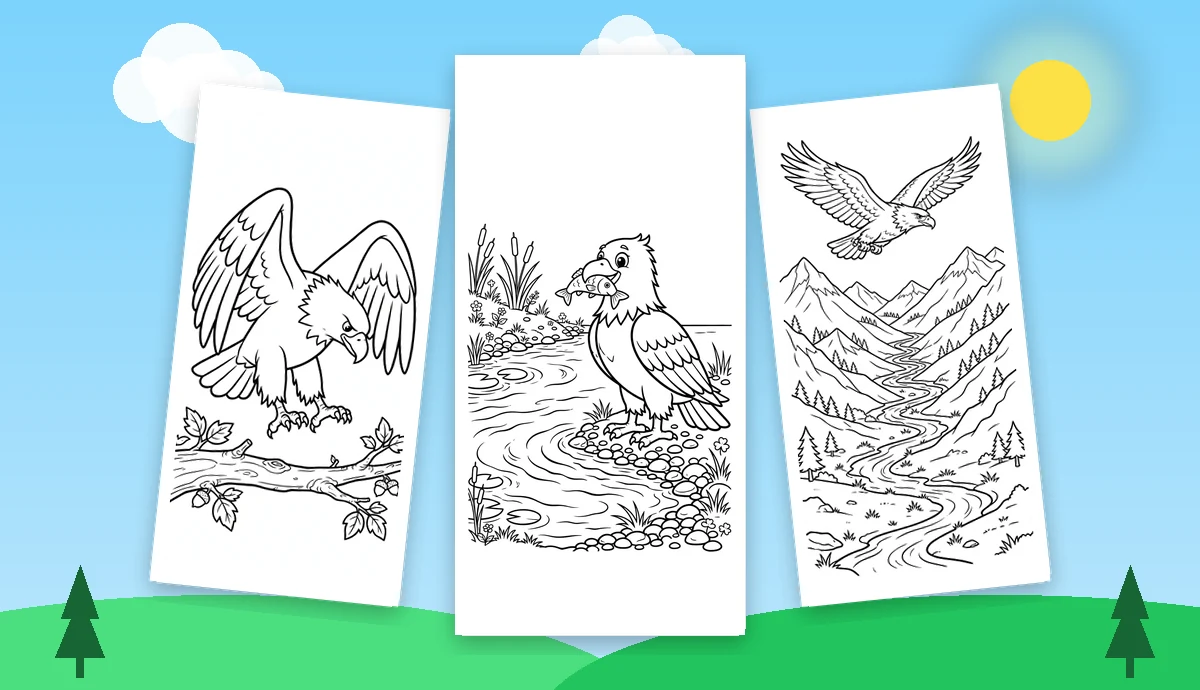
The eagle scream you hear in films is not an eagle at all. It belongs to a red-tailed hawk, borrowed by Hollywood because a real bald eagle sounds more like a high, thin chirp. That is the first surprise in these eagle coloring pages, and it is not the last. The bird on these pages is full of them.
A bald eagle can spot a fish from a mile away, dive at 100 miles an hour, and build a nest wider than a car is long. The 40 pictures in this set follow that bird through the sky, down to the river, into its nest, and up onto the highest branch it can find. There are bald eagles and golden eagles, chicks and hunters, sunny mornings and one very wet storm.
One free PDF holds the whole set, and these eagle coloring pages print again and again from it, a fresh copy whenever a child wants one. Download all 40 pages as one free PDF. Nothing to sign up for, nothing to pay, and no form waiting at the end.
Before you pick up a crayon, here is the one thing to know about colouring an eagle. A grown bald eagle has a white head and a white tail, a dark brown body, and a bright yellow beak and feet. A golden eagle is dark brown all over, with a wash of gold on the back of its neck and feathers running down its legs to its talons.
Get those few colours right and every picture in these eagle coloring pages looks like the real bird. That holds even for the eagle in the storm cloud and the one flying past the sailboat.
Bald Eagle or Golden Eagle? How to Tell
Most of the pictures in this set show bald eagles, the bird with the white head. A few show golden eagles, and the two are easy to mix up, especially since young bald eagles are brown all over and do not grow their white head until they are about five years old. The Smithsonian says the white head arrives at around that age, so a brown eagle in a picture might be a young bald eagle or a golden eagle. Here is how to tell them apart.
Look at the legs first. A golden eagle has feathers running all the way down its legs to its talons. A bald eagle has bare, bright yellow legs. That one detail settles most arguments.
Look at the head next. A grown bald eagle has a snowy white head and tail against a dark brown body. A golden eagle is dark brown from head to tail, with a golden wash over the back of its neck, which is where its name comes from. Its beak is darker too, with only a yellow base.
Look at where they live and what they hunt. Bald eagles live across North America near lakes, rivers and coasts, and they eat mostly fish. Golden eagles live across the whole northern half of the world, in mountains and open country, and they hunt rabbits, hares and ground squirrels. The Alaska Department of Fish and Game lists ground squirrels, hares and birds such as cranes and ptarmigans as the golden eagle’s main food.
Size will not help you much. Both birds are big. A bald eagle measures 28 to 38 inches from beak to tail with a wingspan of up to 80 inches, and weighs 6 to 14 pounds, according to the U.S. National Park Service. A golden eagle has a wingspan of 6 to 7 feet and weighs 8 to 12 pounds, according to the Alaska Department of Fish and Game. The females are bigger than the males in both kinds.
One more thing worth knowing before you start colouring. The word bald in bald eagle does not mean the bird has no feathers. It comes from an old word, piebald, which meant white-headed. The U.S. National Park Service explains that the name refers to the white head and tail against the dark body. And the bird has been the symbol of the United States since 1782, though it only became the official national bird in December 2024, when Public Law 118-206 was signed into law.
Wings Wide Open
An eagle spends most of its life in the air, and the first six pictures in these eagle coloring pages catch it there. Some soar with wings held flat, some dive with wings folded back, and one fills the whole page with its wings spread front on. Colour the sky pale blue and leave the clouds white, because a big bird needs a big sky around it.
1. Bald Eagle Soaring High Above the Clouds
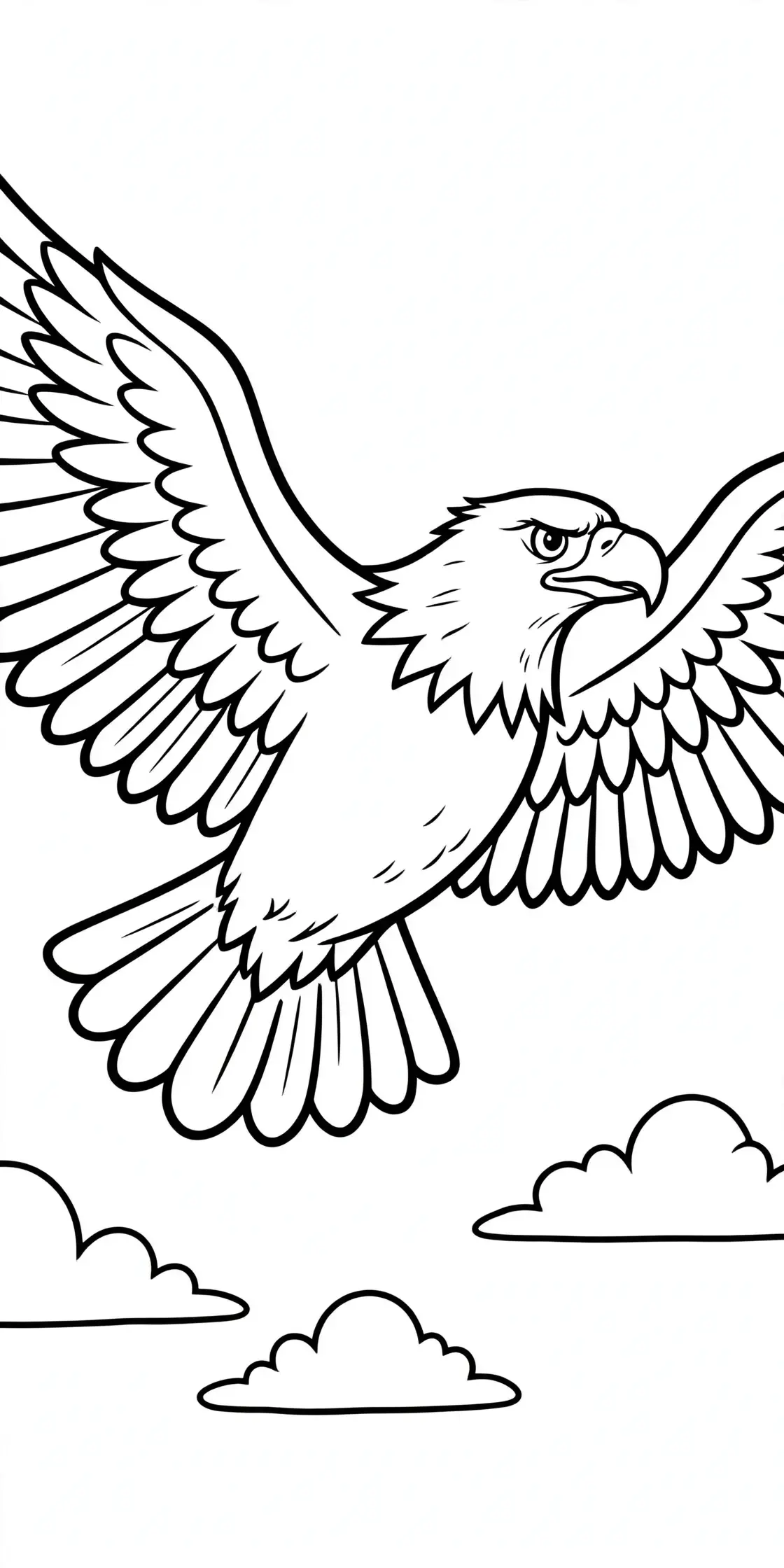
A bald eagle soars high with its wings spread wide, a few simple clouds drifting below it and nothing else in the sky.
Colouring tip: Colour the wings dark brown and leave the head and tail white, then give the sky the palest blue you have, so the bird stands out against it.
Age: Best for ages 3 to 5.
11. Eagle Diving Down from the Sky
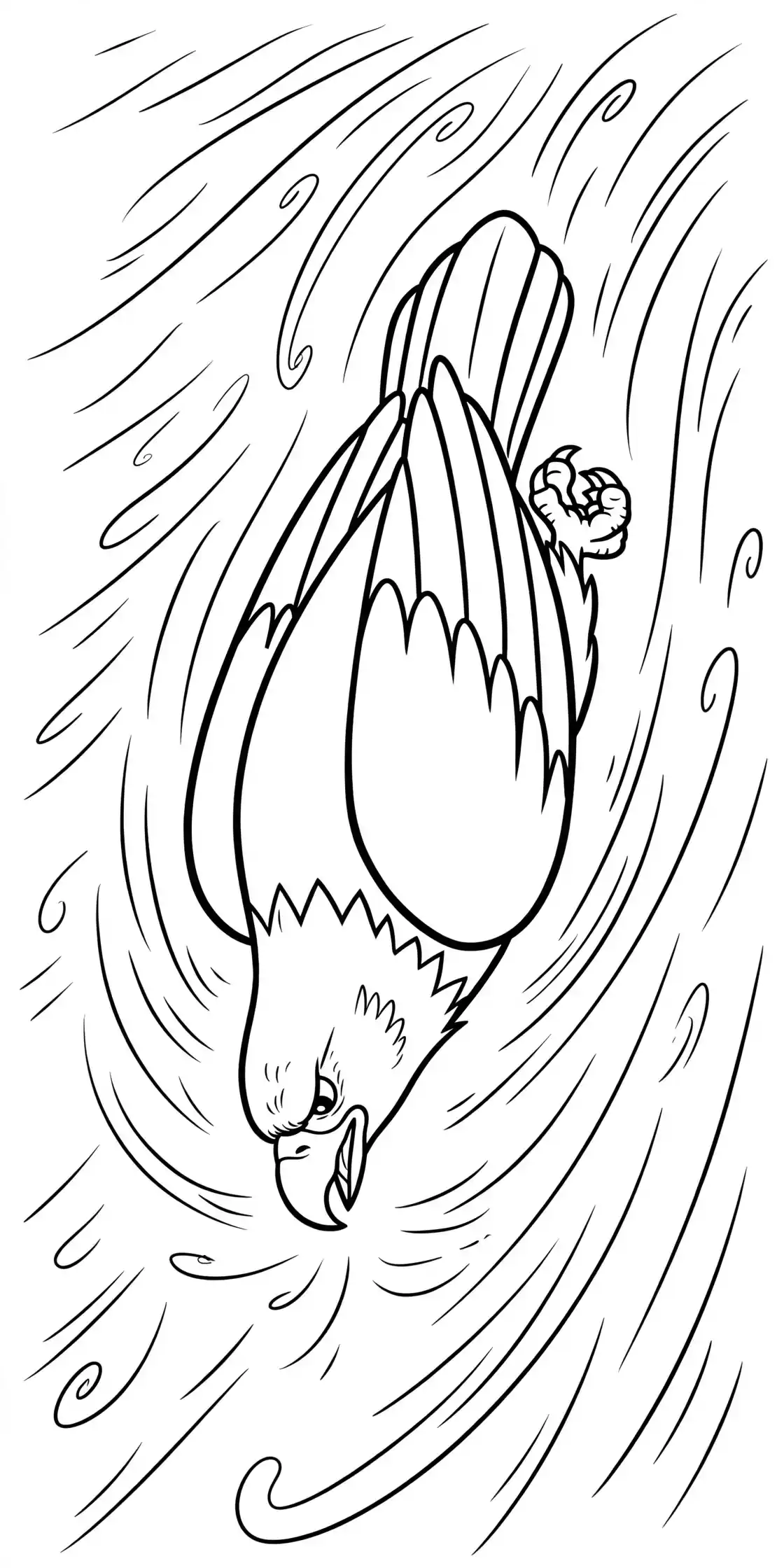
An eagle dives down from the sky with its wings folded back, wind lines streaming around it as it drops fast.
Colouring tip: Colour the wind lines a light grey blue and the eagle dark brown, so the speed of the dive shows in the picture.
Age: Best for ages 6 to 8.
17. Eagle Silhouette Soaring Above the Clouds
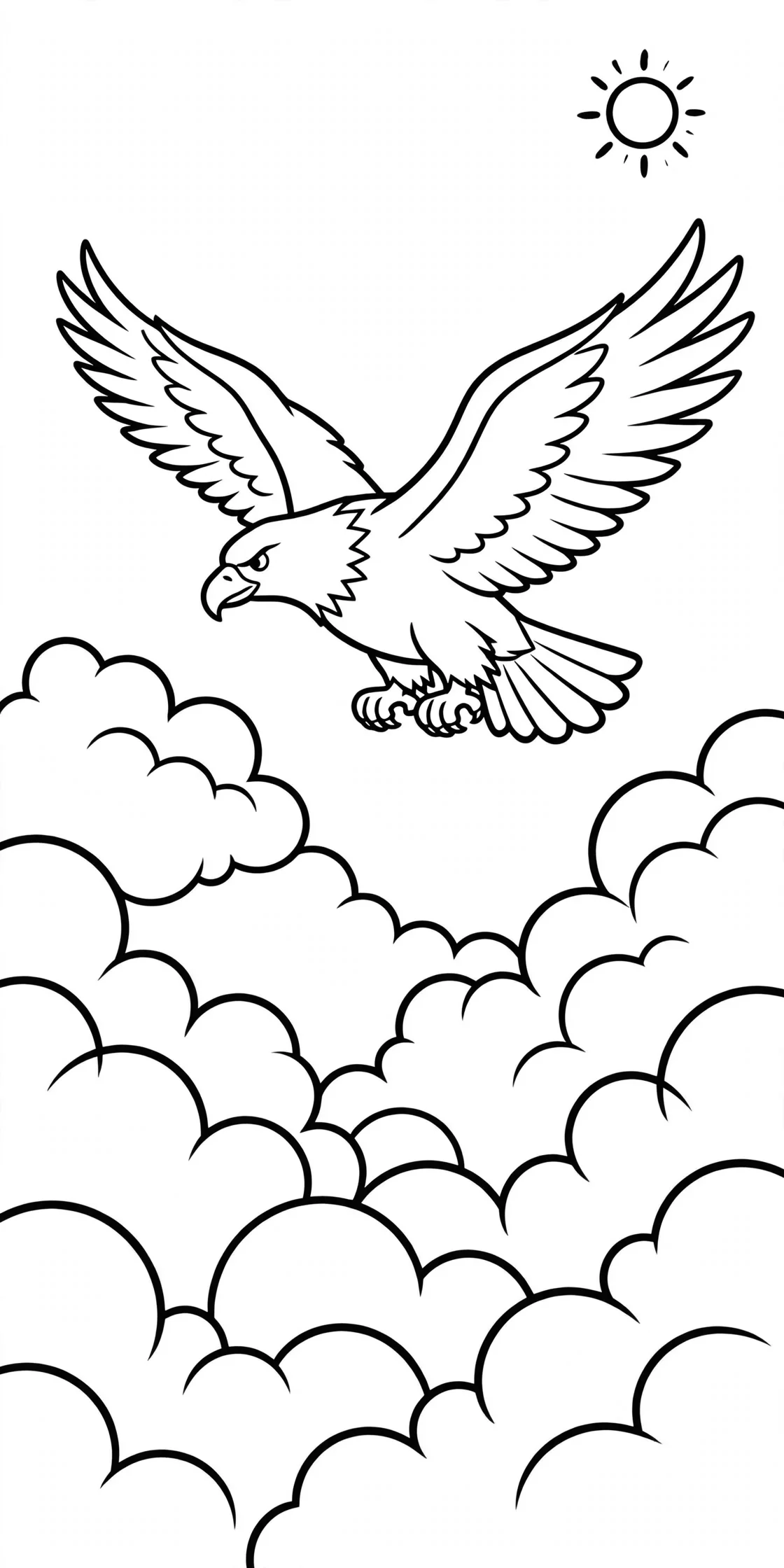
An eagle silhouette soars above soft fluffy clouds, with a small sun tucked into the corner of the sky.
Colouring tip: Colour the whole eagle one solid dark brown or black, and leave the clouds white, because a silhouette works best with no shading at all.
Age: Best for ages 3 to 5.
23. Eagle Seen from the Front with Wings Spread Wide
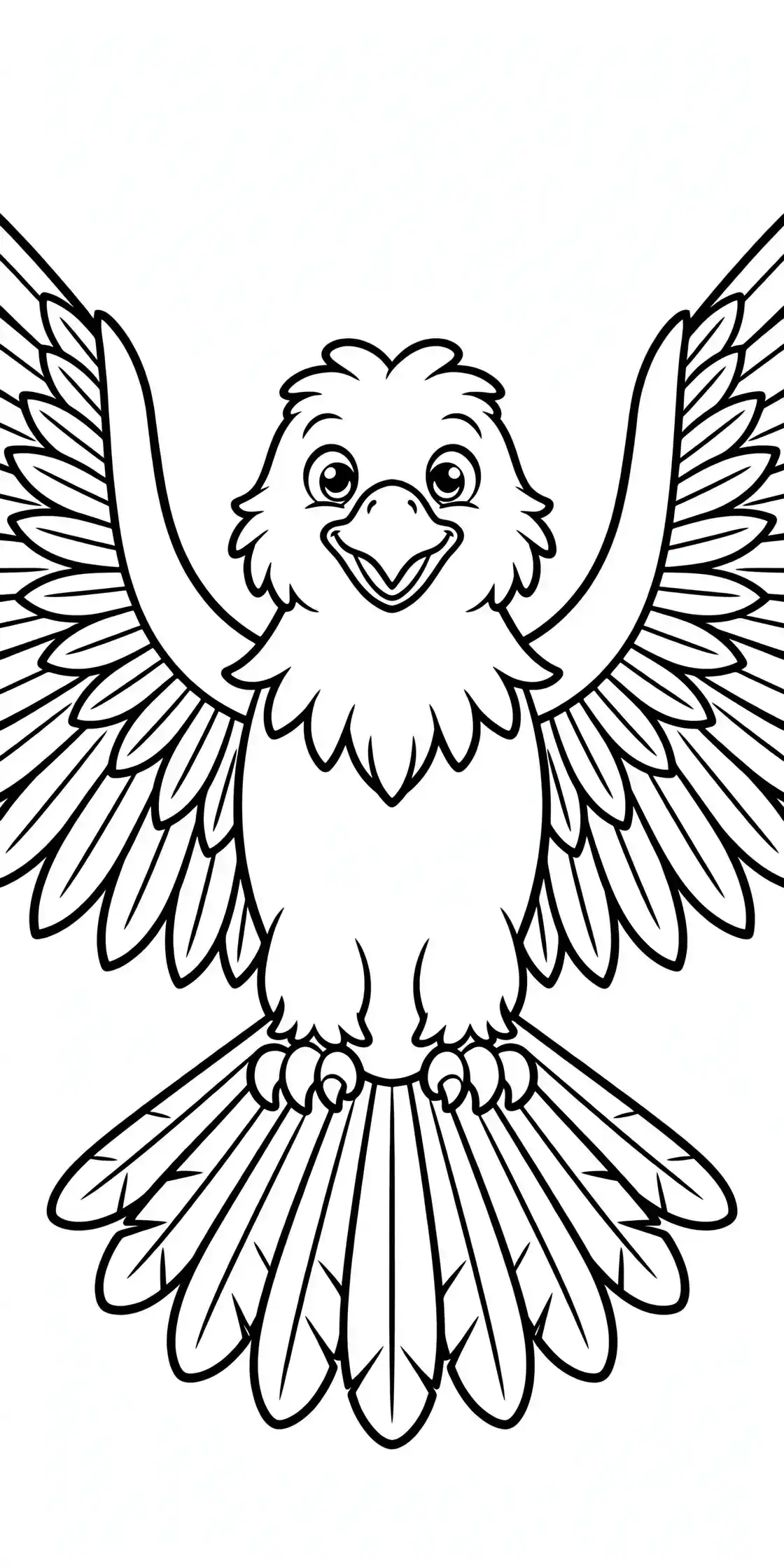
An eagle faces you head on with both wings spread wide open, its tail feathers fanned out below and its beak in the middle.
Colouring tip: Colour the left wing and the right wing the same brown, and make the beak bright yellow, because the face is the middle of this picture.
Age: Best for ages 3 to 5.
33. Eagle Gliding with Wings Flat and Outstretched
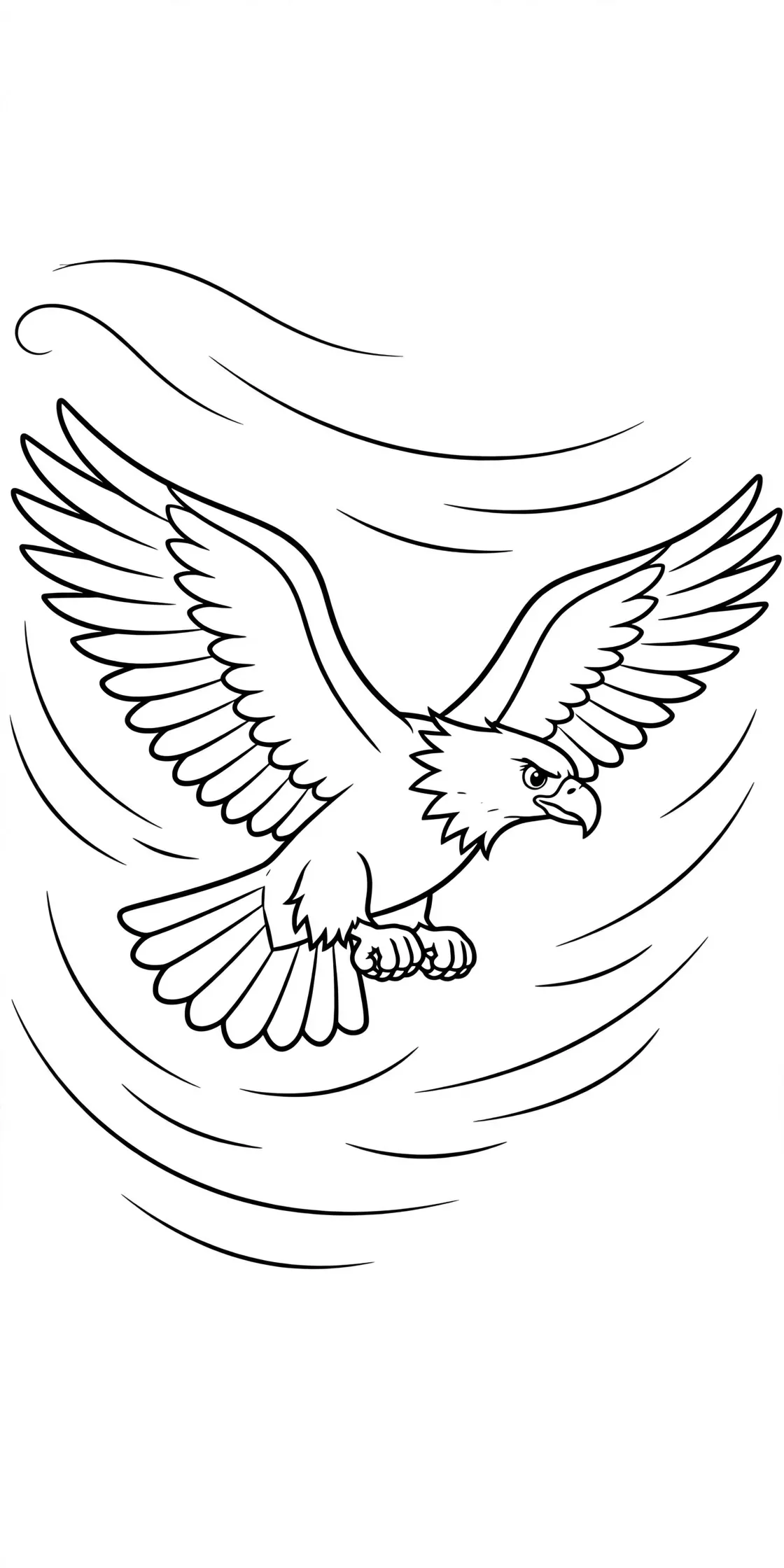
An eagle glides gracefully with its wings outstretched and flat, curved breeze lines flowing past it in the air.
Colouring tip: Colour the breeze lines pale blue and the wings two browns, a light one on top and a darker one underneath, to show the glide.
Age: Best for ages 3 to 5.
39. Eagle Flying Through Big Fluffy Clouds
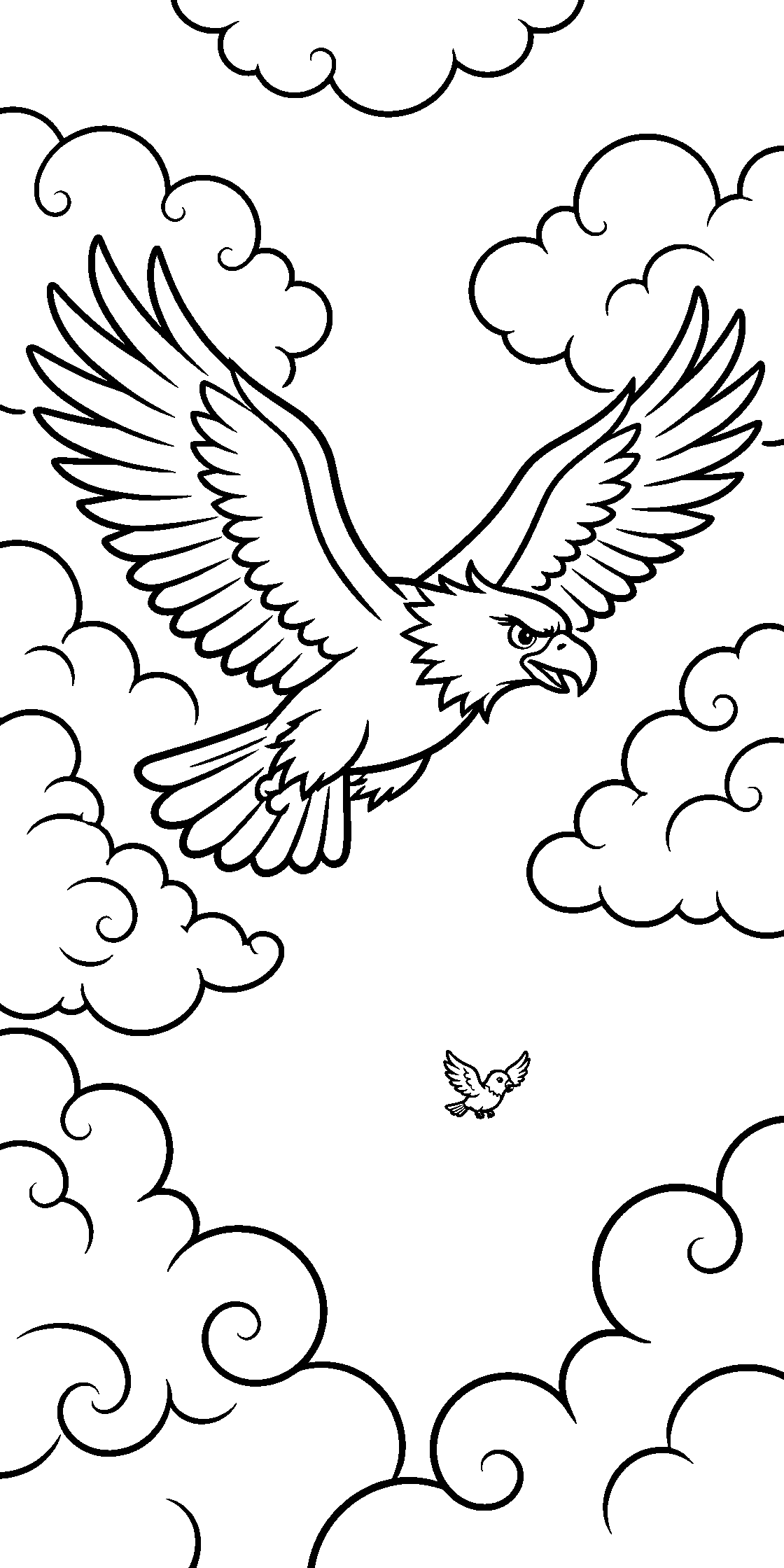
An eagle flies through big fluffy clouds with its wings spread, and a small bird flies far away in the distance.
Colouring tip: Colour the small bird a different colour from the eagle, maybe a soft grey, so the size difference between the two birds is clear.
Age: Best for ages 3 to 5.
Over Mountains, Rivers and Sea
Eagles live where the land is big and open, and the next six pictures in these eagle coloring pages put them there. Snow capped mountains, a winding river, a desert canyon, ocean waves and a waterfall all get a turn. Colour the water blue and the rock grey brown, and the eagle will look at home in every one.
6. Eagle Flying Over Snow Capped Mountains
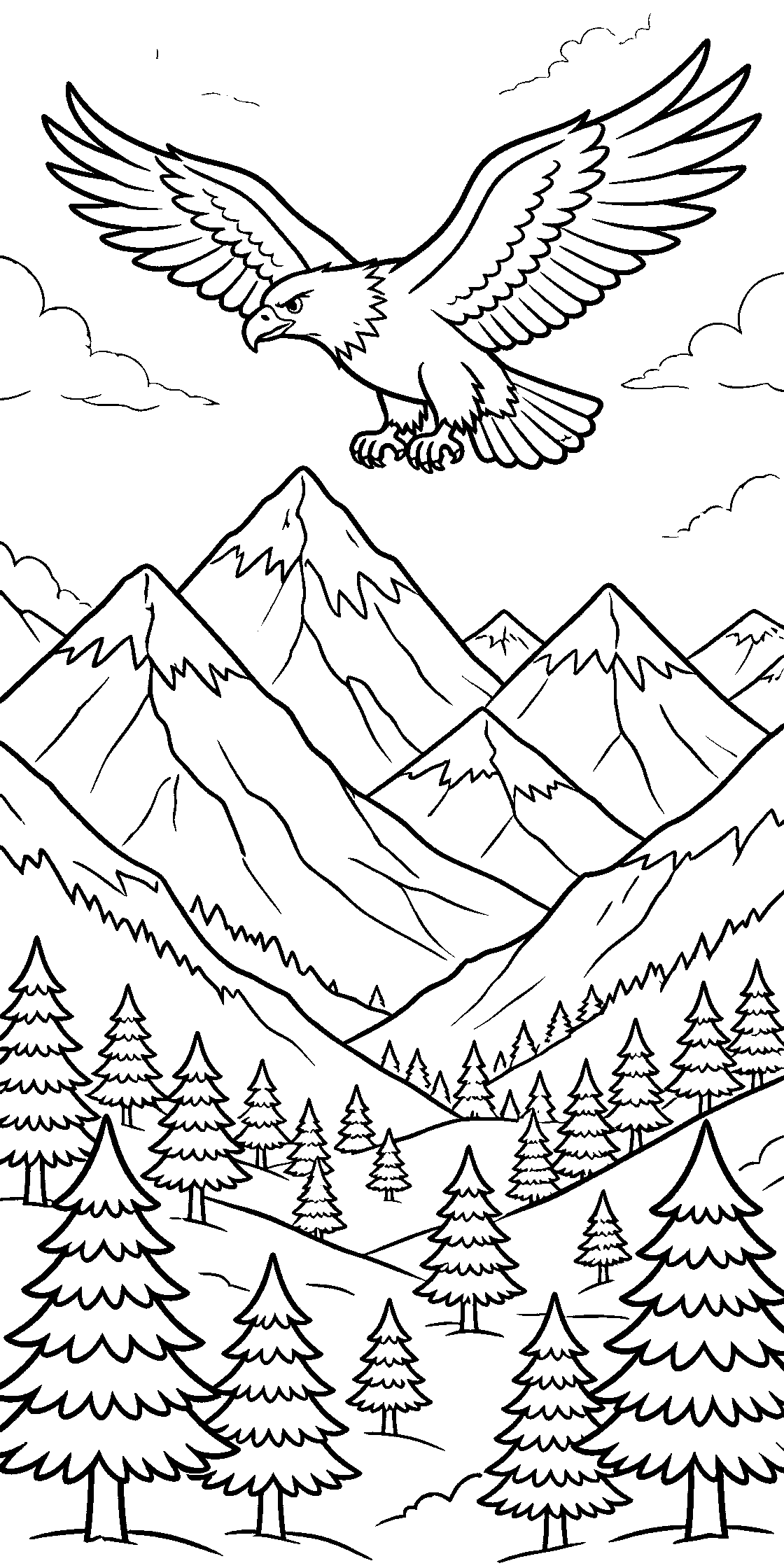
An eagle flies over tall snow capped mountains, with pine trees standing in the valley far below.
Colouring tip: Colour the mountain tops white and the pine trees dark green, so the eagle flying between them looks high up.
Age: Best for ages 6 to 8.
14. Eagle Flying Low Over a Calm Lake
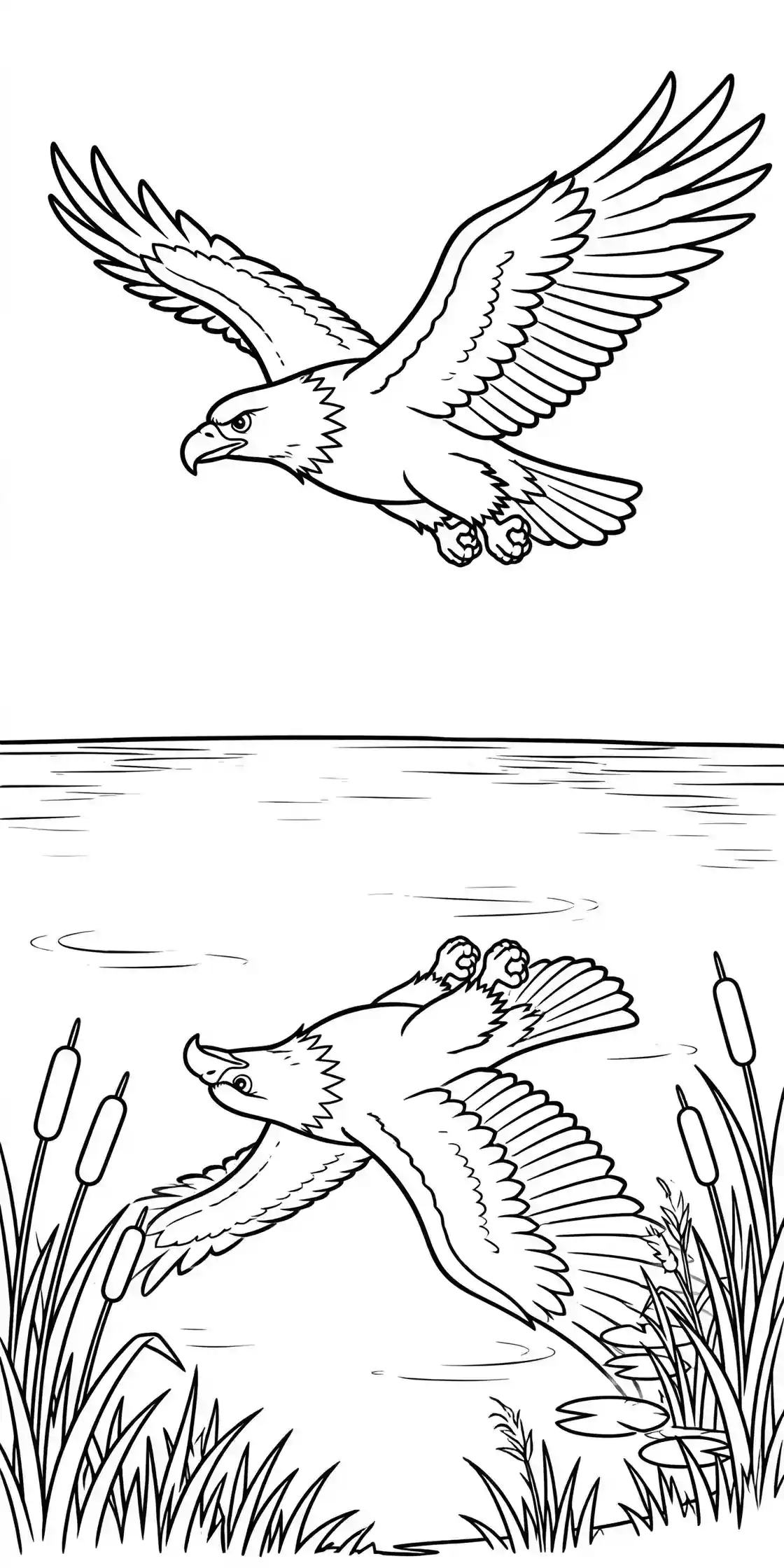
An eagle flies low over a calm lake, its reflection showing in the water below, with reeds growing at the edge.
Colouring tip: Colour the reflection a paler brown than the eagle itself, because reflections in water always look softer than the real thing.
Age: Best for ages 6 to 8.
26. Eagle Soaring Over a Desert Canyon
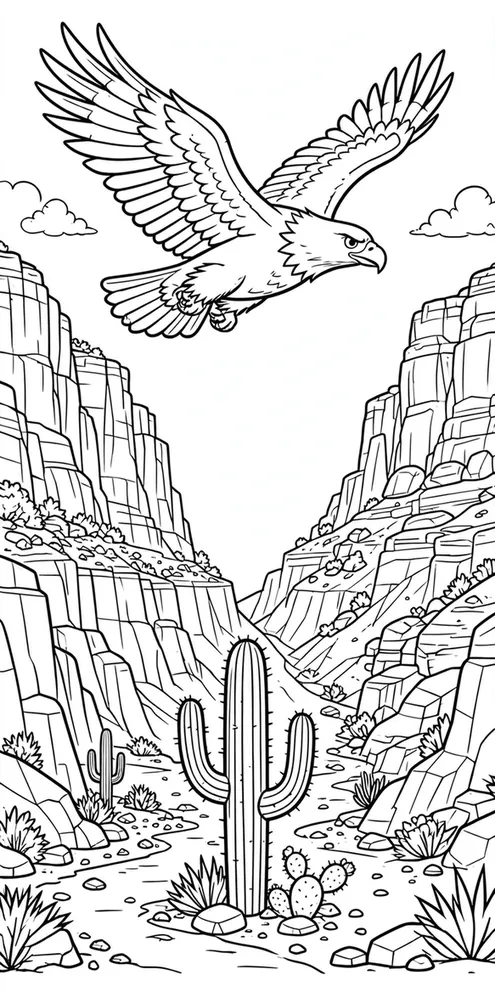
An eagle soars over a desert canyon, tall rock walls rising on both sides and a cactus growing down below.
Colouring tip: Colour the canyon walls a warm sandy red and the cactus green, so the dry desert looks hot and the eagle looks cool above it.
Age: Best for ages 6 to 8.
30. Eagle Soaring Over Ocean Waves
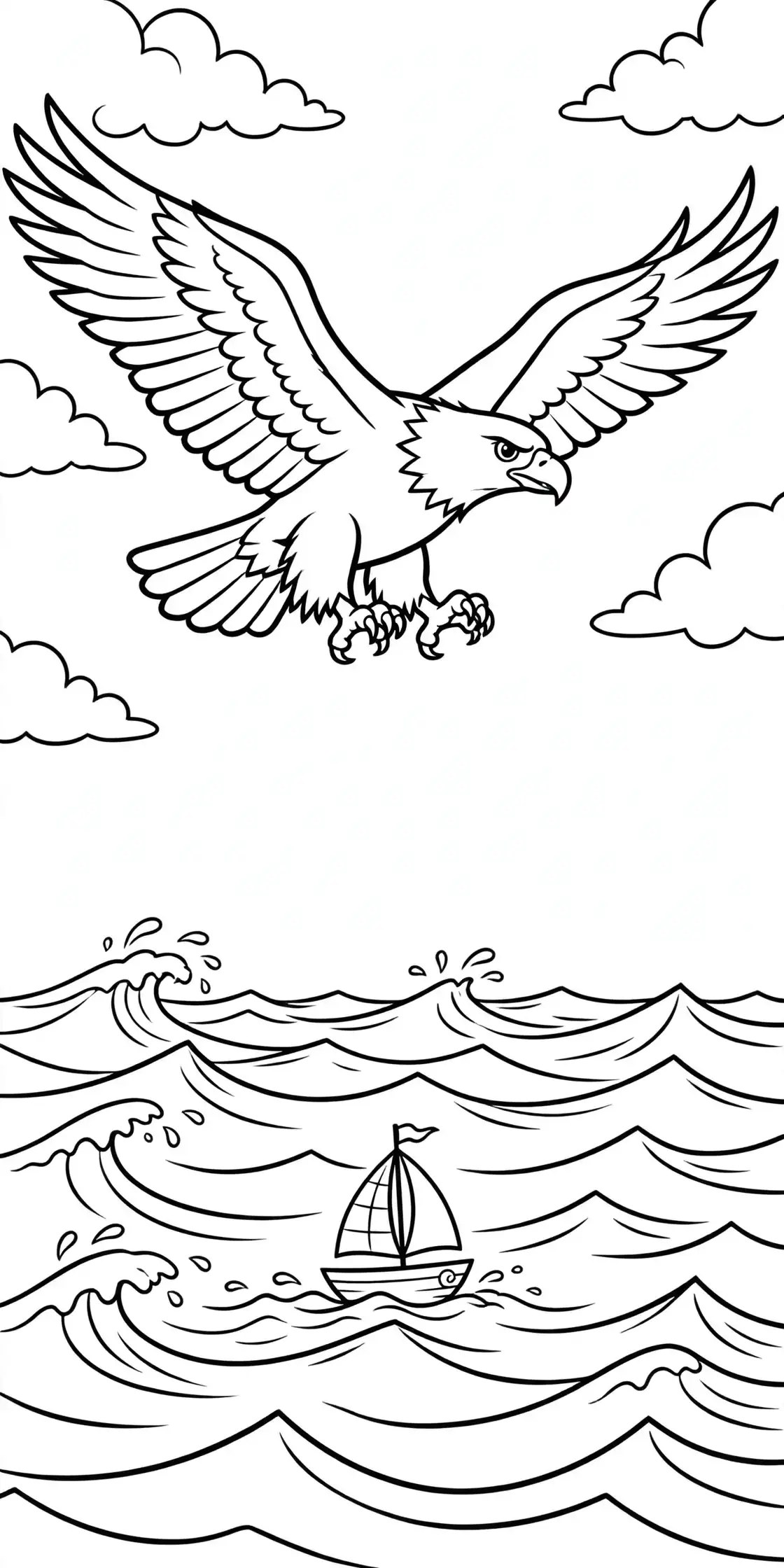
An eagle soars over ocean waves, and a small sailboat sits far below on the water.
Colouring tip: Colour the waves deep blue with white tops, and keep the sailboat tiny and white, so the eagle looks huge above it.
Age: Best for ages 6 to 8.
34. Eagle Flying Over Mountains with a River Below
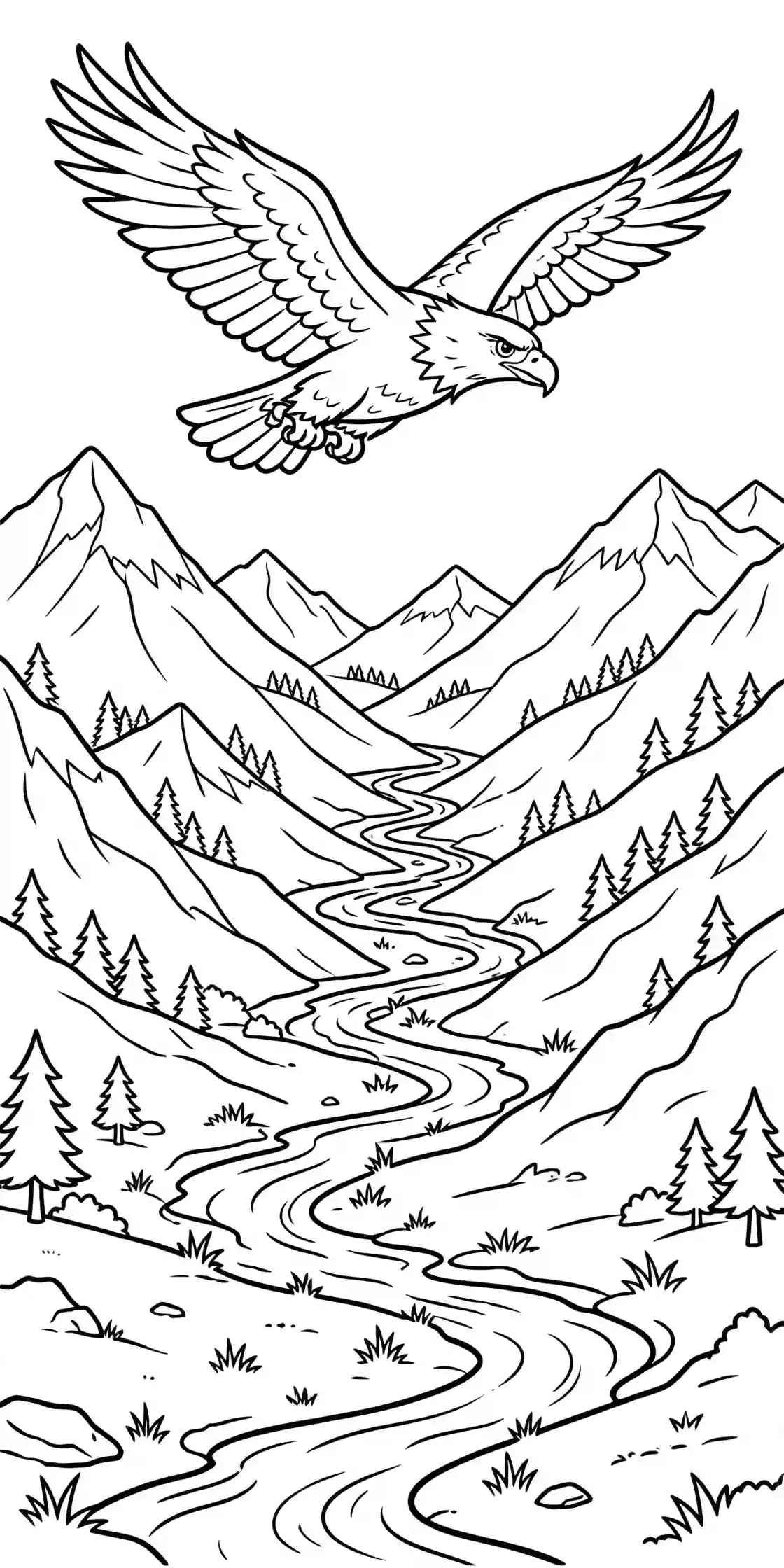
An eagle flies over mountains while a river winds through the valley far below, curving between the hills.
Colouring tip: Colour the river a bright blue so it stands out from the green valley, and follow its winding line with your crayon.
Age: Best for ages 6 to 8.
37. Eagle Flying Beside a Tall Waterfall
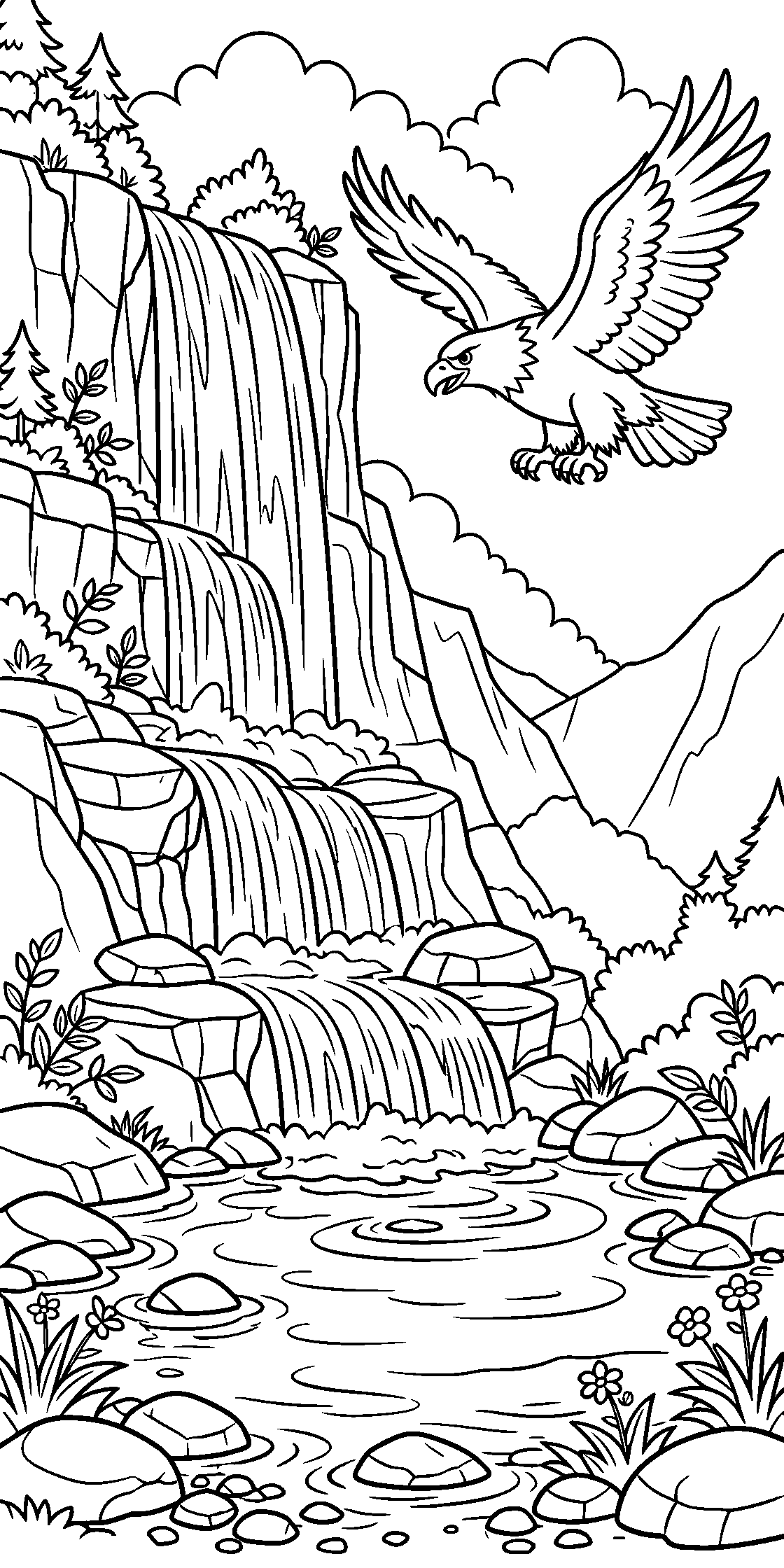
An eagle flies beside a tall tiered waterfall, water flowing over the rocks and down into a pool below.
Colouring tip: Colour the falling water pale blue with white foam at each step, and the rocks grey, so the waterfall looks cold and fast.
Age: Best for ages 6 to 8.
The Hunt
An eagle hunts from the air, and the next five pictures show how. It swoops, grabs, and carries its catch away, all without landing. Bald eagles eat mostly fish, and the National Park Service lists fish, mammals, gulls and waterfowl in their diet. Watch the talons in these pictures, because the talons do all the work.
4. Eagle Catching a Fish Over a River
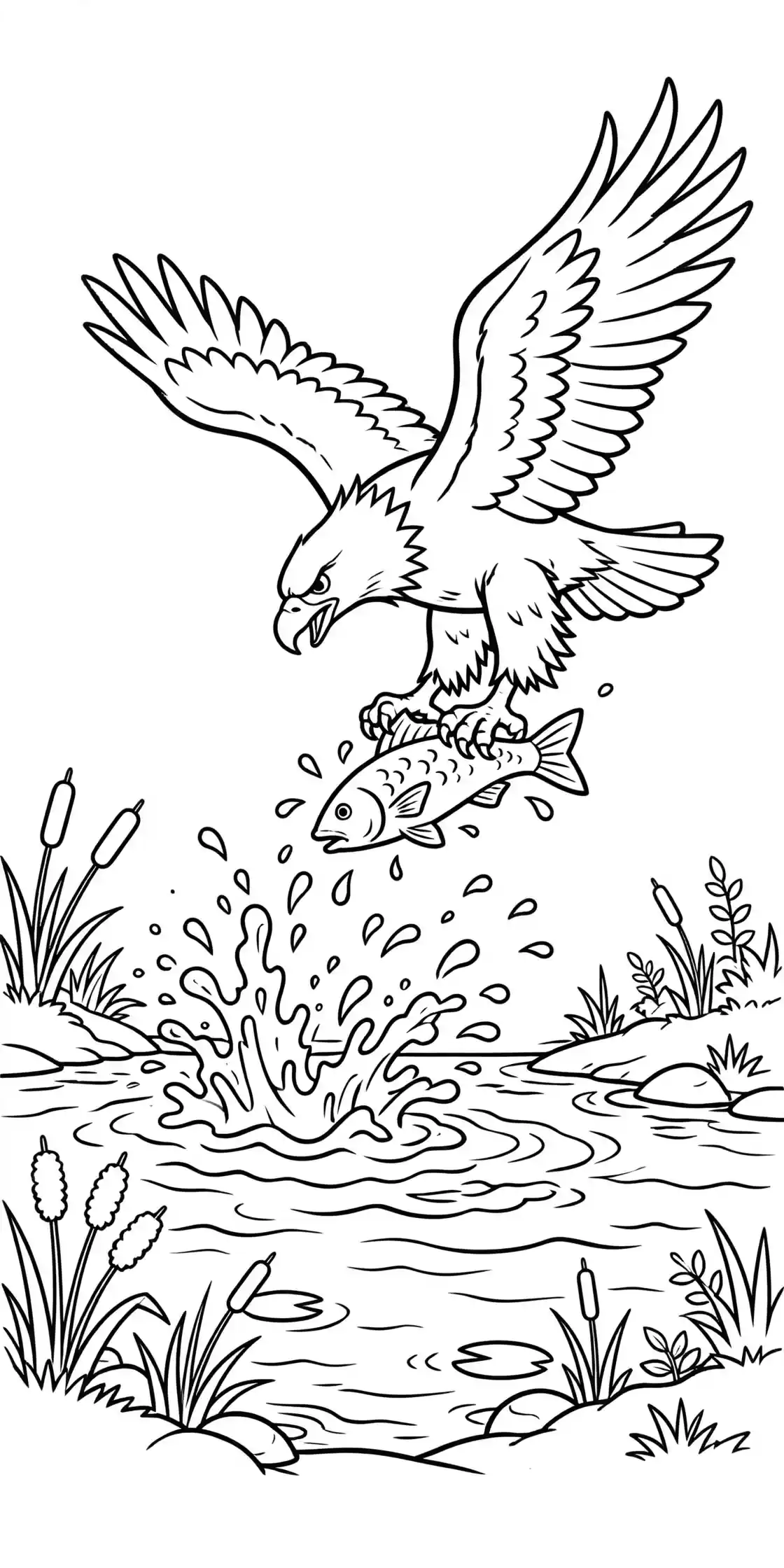
An eagle swoops down and catches a fish over a river, water splashing below and riverbank plants growing at the edge.
Colouring tip: Colour the splashing water white and light blue, and the fish silver grey, so the catch is the brightest part of the picture.
Age: Best for ages 6 to 8.
16. Eagle Perched on a Log Holding a Fish
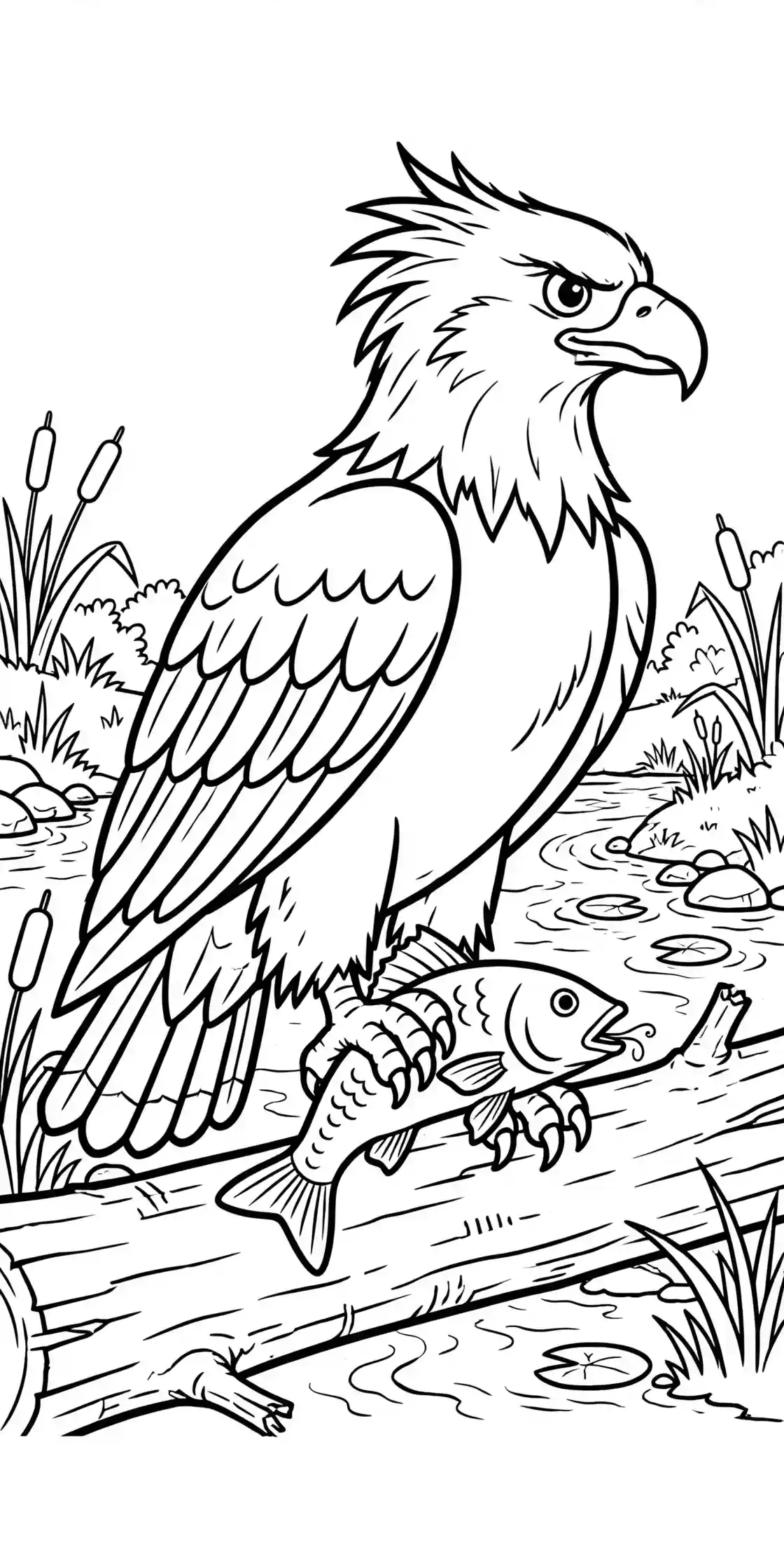
An eagle perches on a log and holds a fish tight in its talons, a small stream running behind it.
Colouring tip: Colour the log a rough brown and the fish a shiny silver, because the log is old wood and the fish is fresh from the water.
Age: Best for ages 9 to 12.
21. Eagle Standing on a Riverbank with a Fish in Its Beak
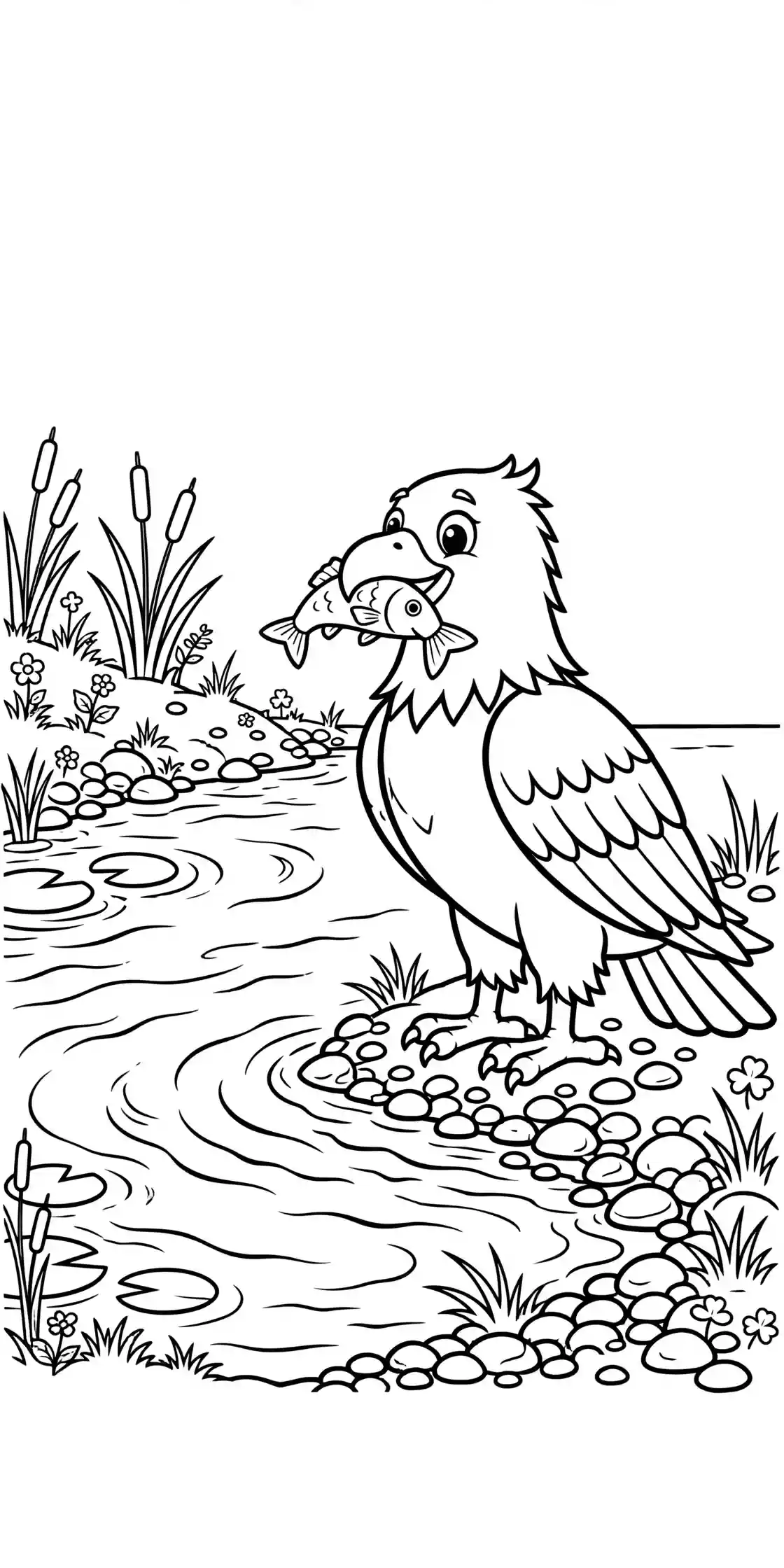
An eagle stands on a riverbank with a fish held in its beak, water ripples spreading out and pebbles lying around its feet.
Colouring tip: Colour the pebbles in different greys and browns, and the ripples pale blue rings, so the riverbank looks real.
Age: Best for ages 6 to 8.
22. Close Up of an Eagle’s Talons Gripping a Branch
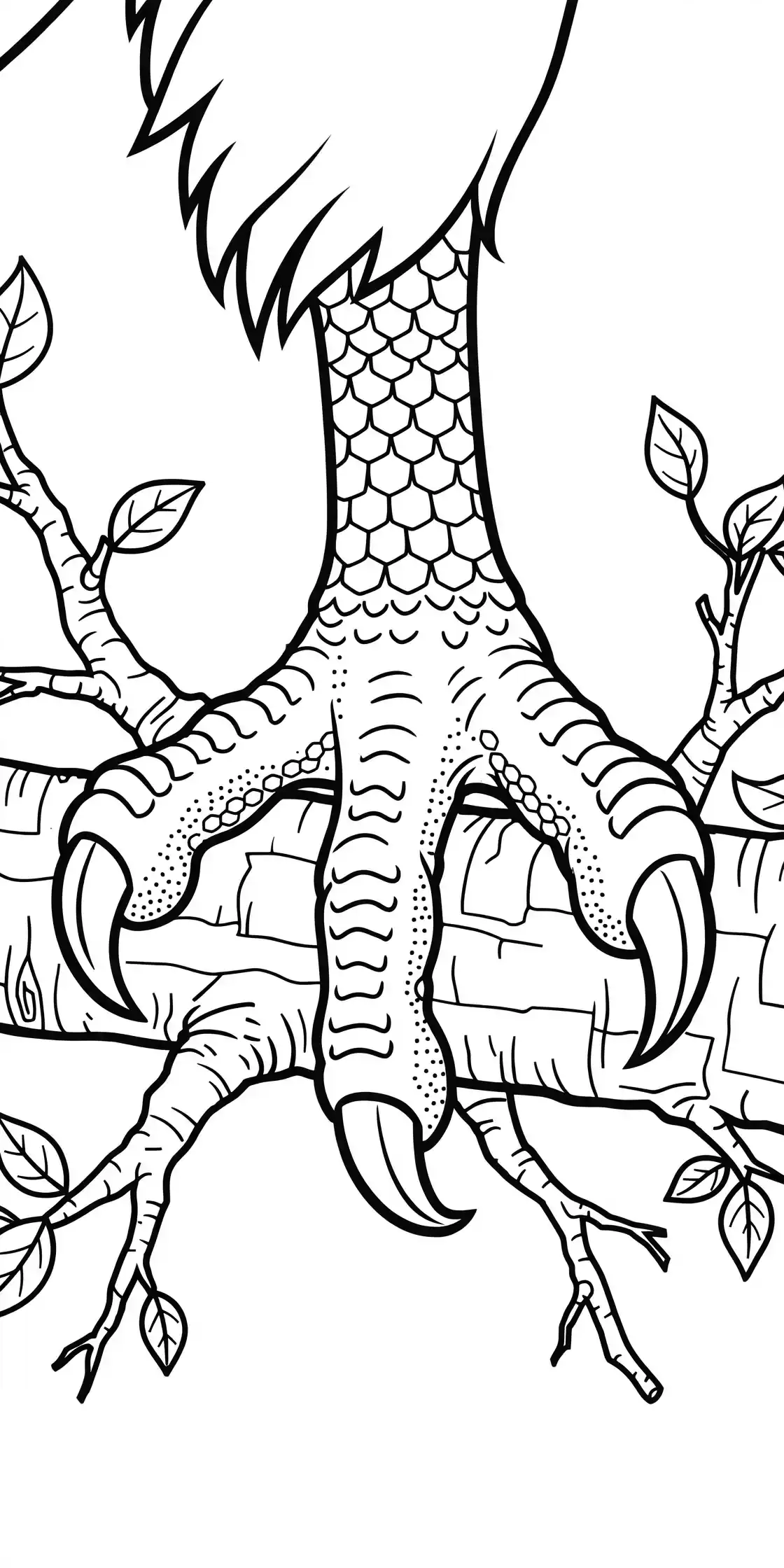
A close up shows an eagle’s strong talons gripping a tree branch, with curved claws and the scaly skin of its feet.
Colouring tip: Colour the talons bright yellow and the branch dark brown, because the yellow feet against the brown wood is what makes this picture pop.
Age: Best for ages 9 to 12.
25. Eagle Flying with a Snake in Its Talons
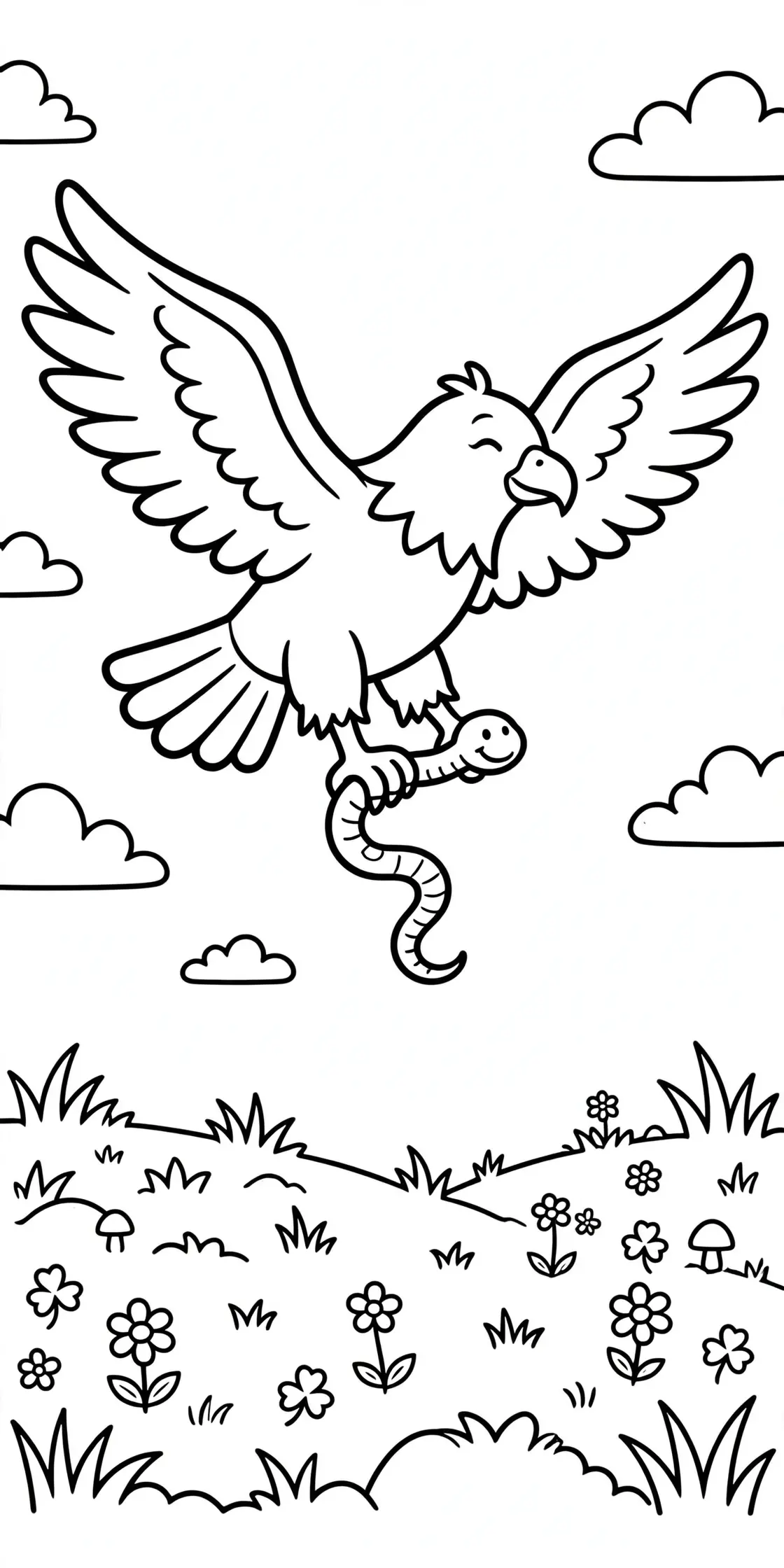
A gentle eagle flies over a meadow carrying a small friendly snake in its talons, the snake curving softly below it.
Colouring tip: Colour the snake green with a yellow belly, and the meadow grass a light green, so the snake and the grass are friends, not enemies.
Age: Best for ages 9 to 12.
Home in the Nest
An eagle’s nest is called an aerie, and it is the biggest nest of any bird in North America. The Smithsonian says a typical nest spans 4 to 6 feet across and about 3 feet deep, and the biggest nest ever measured was 9 feet 6 inches wide and 20 feet deep, weighing two tons. That nest stood near St Petersburg in Florida and was recorded in 1963. The next four pictures show the nest as a home, with eggs, chicks and both parents.
5. Eagle in a Large Nest with Two Small Eaglets
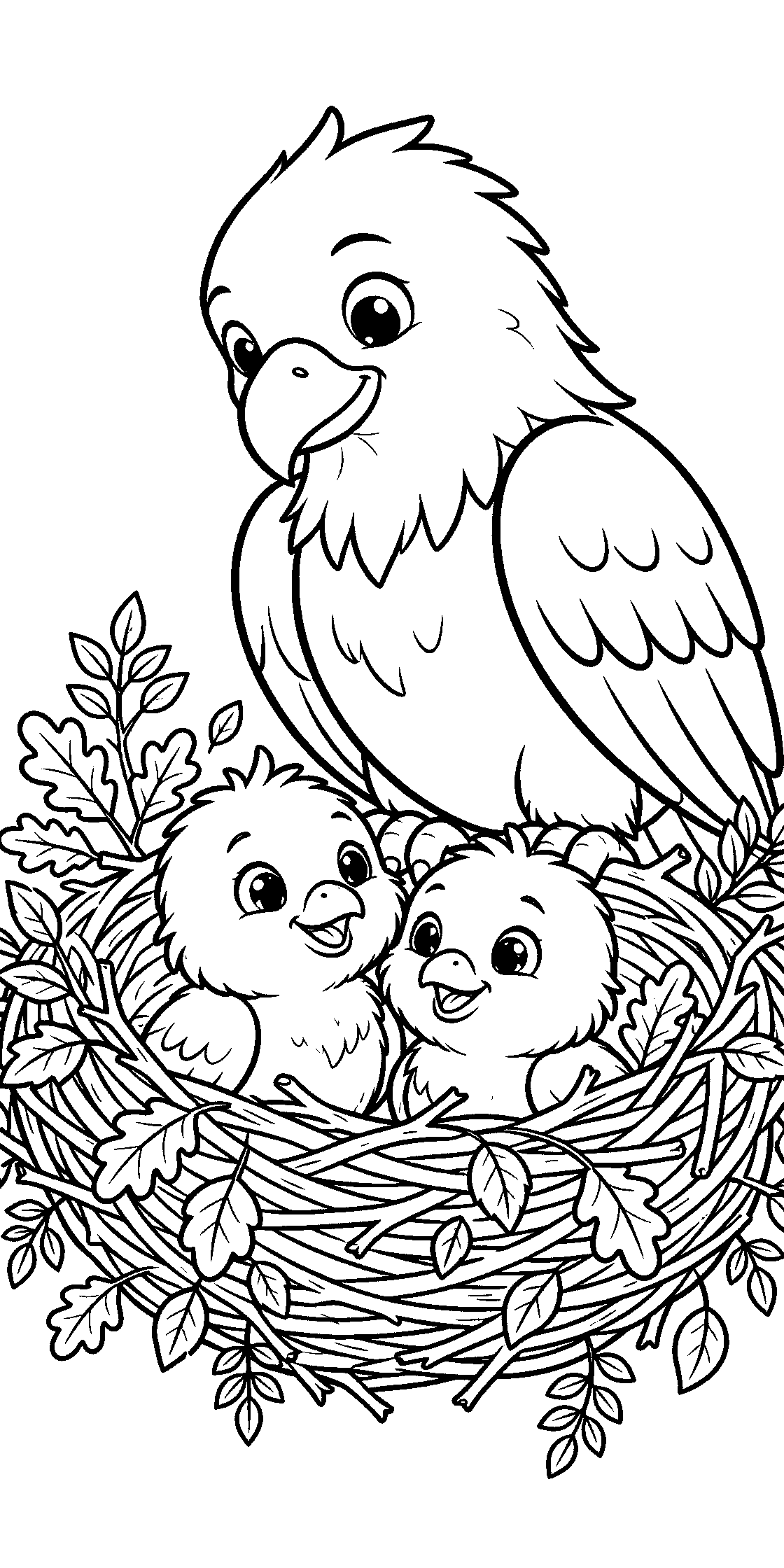
An eagle sits in a large nest with two small eaglets beside it, twigs and leaves woven together to form the nest.
Colouring tip: Colour the twigs in two browns, light and dark, so the woven nest looks like it was built stick by stick.
Age: Best for ages 3 to 5.
15. Eagle Family on a Wide Tree Branch
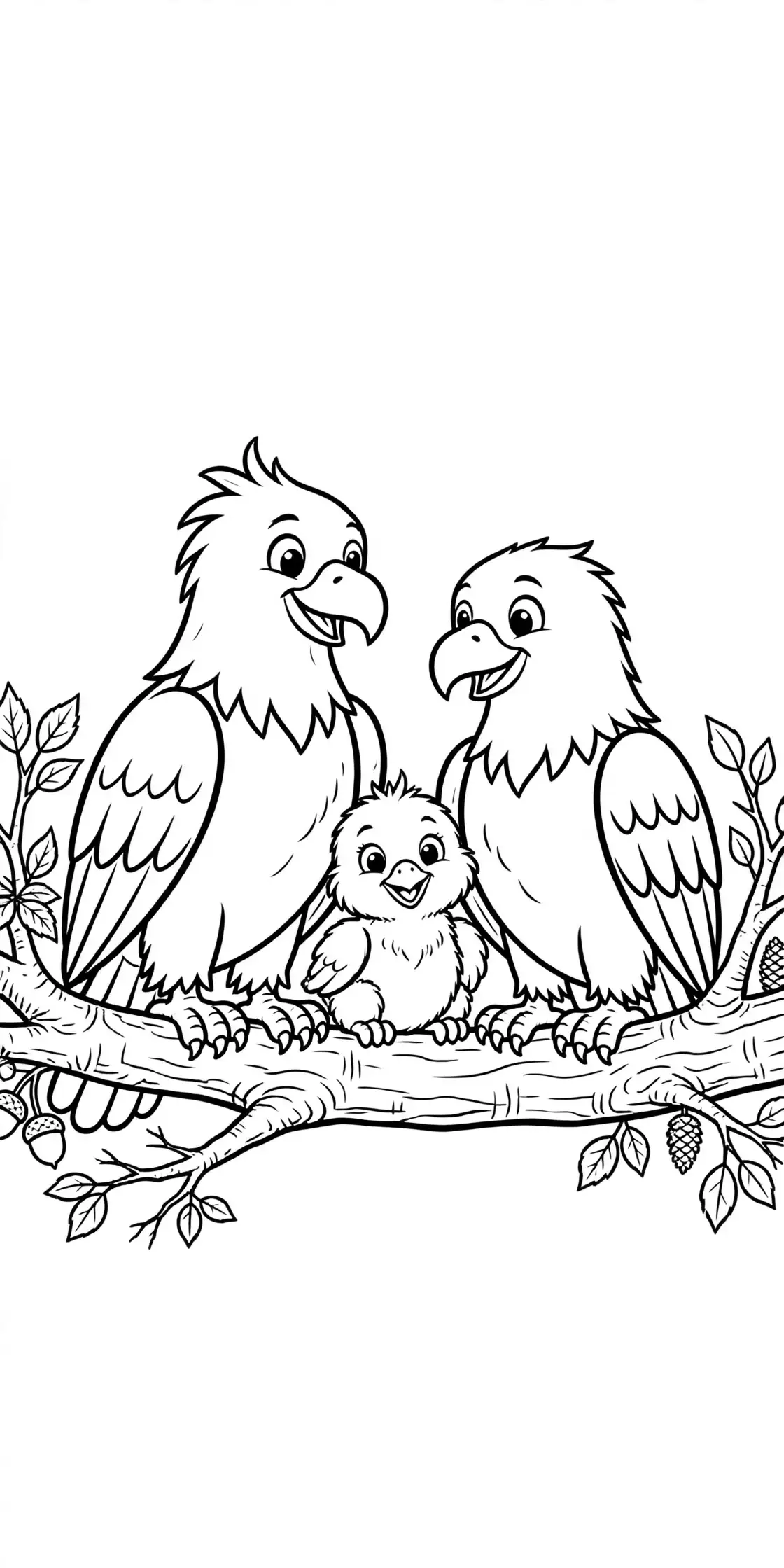
An eagle family sits together on a wide tree branch, two adult eagles and one small chick between them.
Colouring tip: Colour the chick a soft light brown and the adults a darker brown with white heads, so the young one looks younger than its parents.
Age: Best for ages 3 to 5.
28. Baby Eagle Hatching from a Cracked Egg
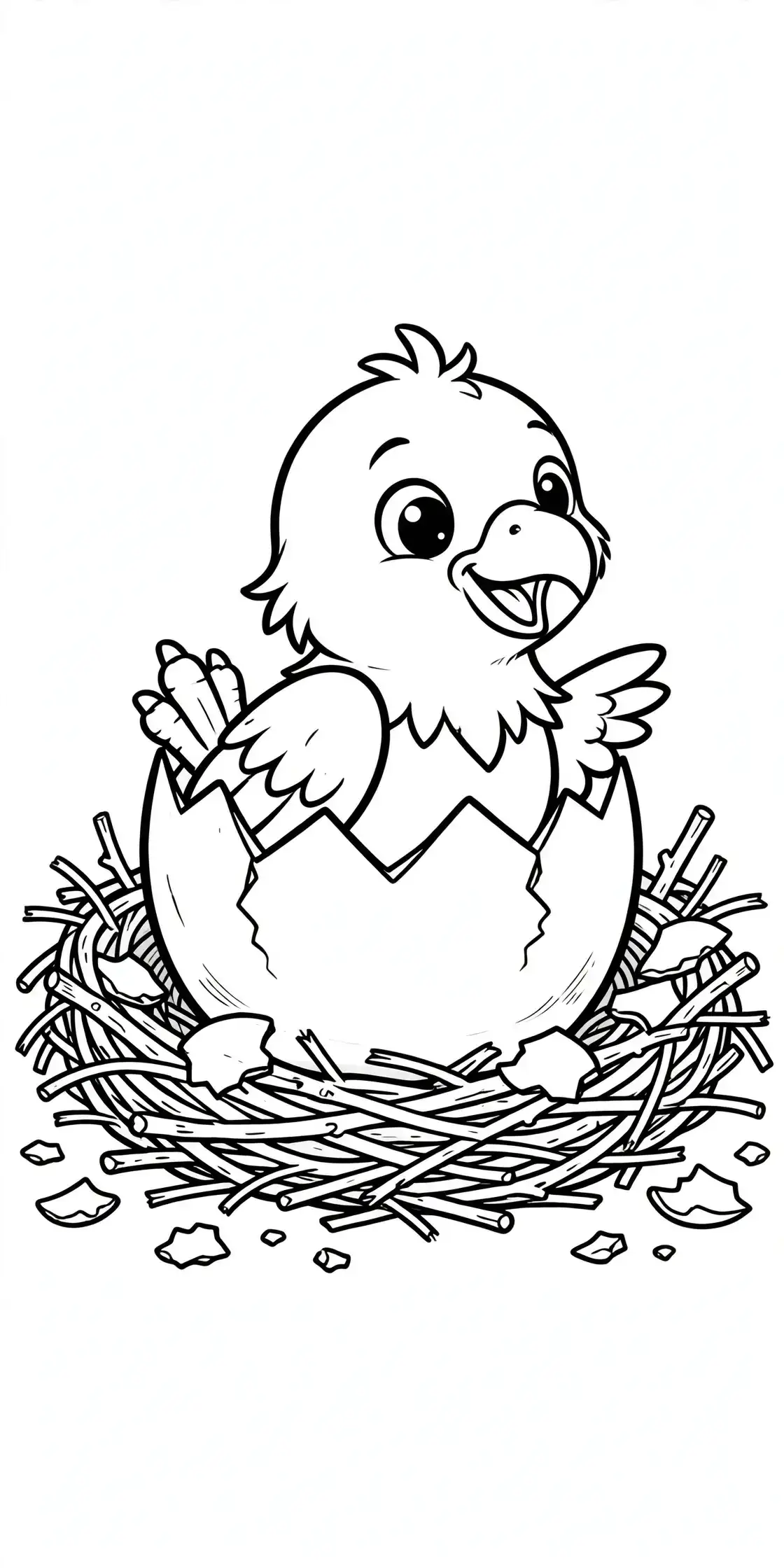
A baby eagle hatches from a cracked egg in a nest, small pieces of shell lying around it.
Colouring tip: Colour the egg shell a pale cream and the chick a fluffy light grey, because a newborn eagle is soft and pale, not brown yet.
Age: Best for ages 3 to 5.
36. Eagle Sitting in a Nest on a Cliff Edge
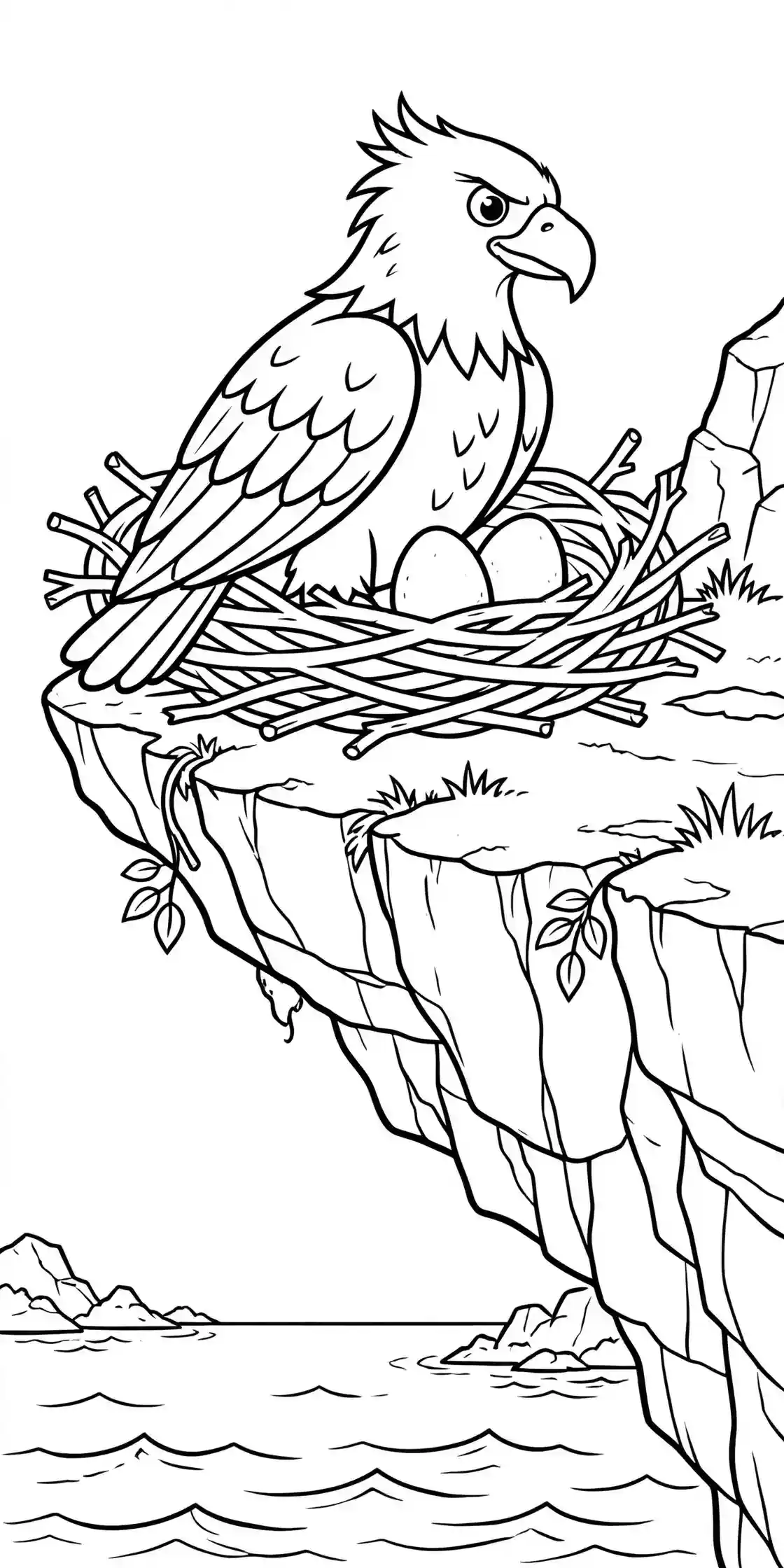
An eagle sits in a nest on a cliff edge with two eggs beside it, the sea stretching far below.
Colouring tip: Colour the eggs a pale speckled cream and the sea a deep blue, so the high nest and the far water feel a long way apart.
Age: Best for ages 6 to 8.
Perched and Proud
When an eagle is not flying, it perches somewhere high and watches. The next six pictures in these eagle coloring pages show it doing just that, on pine branches, on a cliff, on a rock, and once in front of an American flag. An eagle perched is an eagle thinking about its next flight, and the stillness of these pictures is part of their charm.
2. Bald Eagle Perched on a Pine Tree Branch
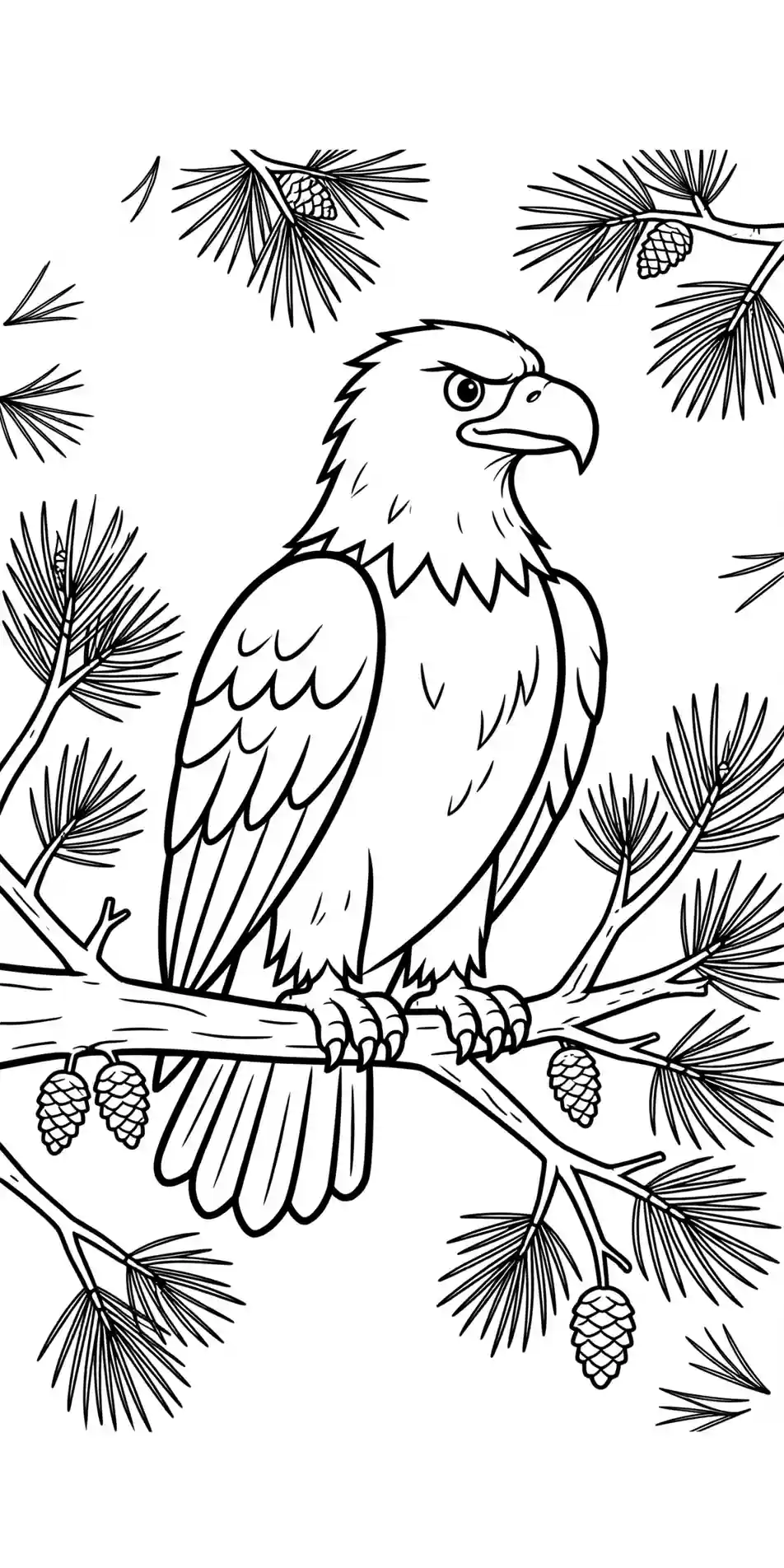
A bald eagle perches on a pine tree branch, pine needles and small pine cones all around it.
Colouring tip: Colour the pine needles dark green and the cones a warm brown, and leave the eagle’s head white, so the bird stands out from the tree.
Age: Best for ages 6 to 8.
7. Eagle Landing on a Tree Branch
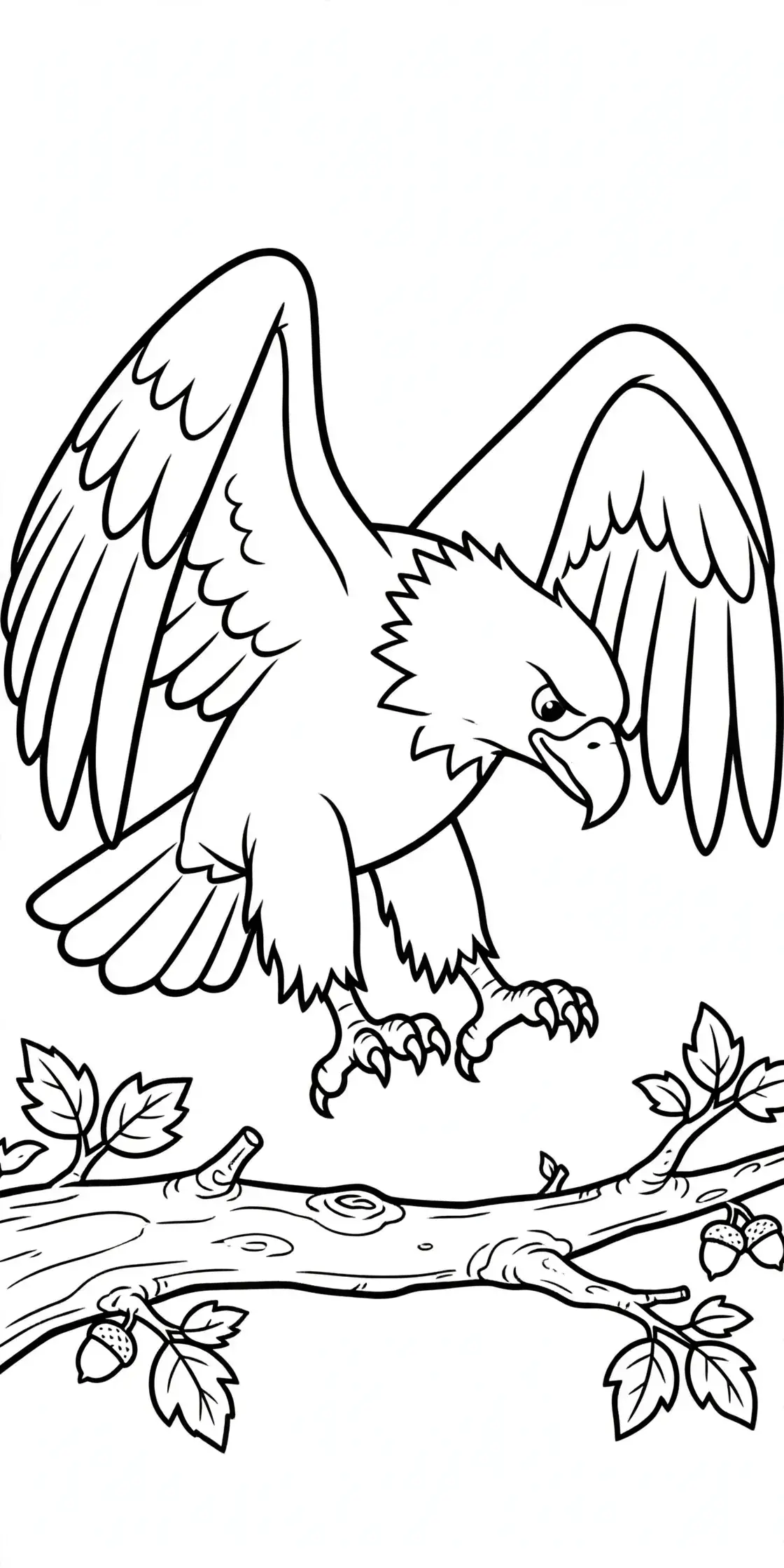
An eagle lands on a tree branch with its wings half open and its talons reaching down for the wood.
Colouring tip: Colour the wings a lighter brown at the top and darker at the tips, because a landing eagle catches the light on its wings.
Age: Best for ages 6 to 8.
8. Bald Eagle Perched in Front of an American Flag
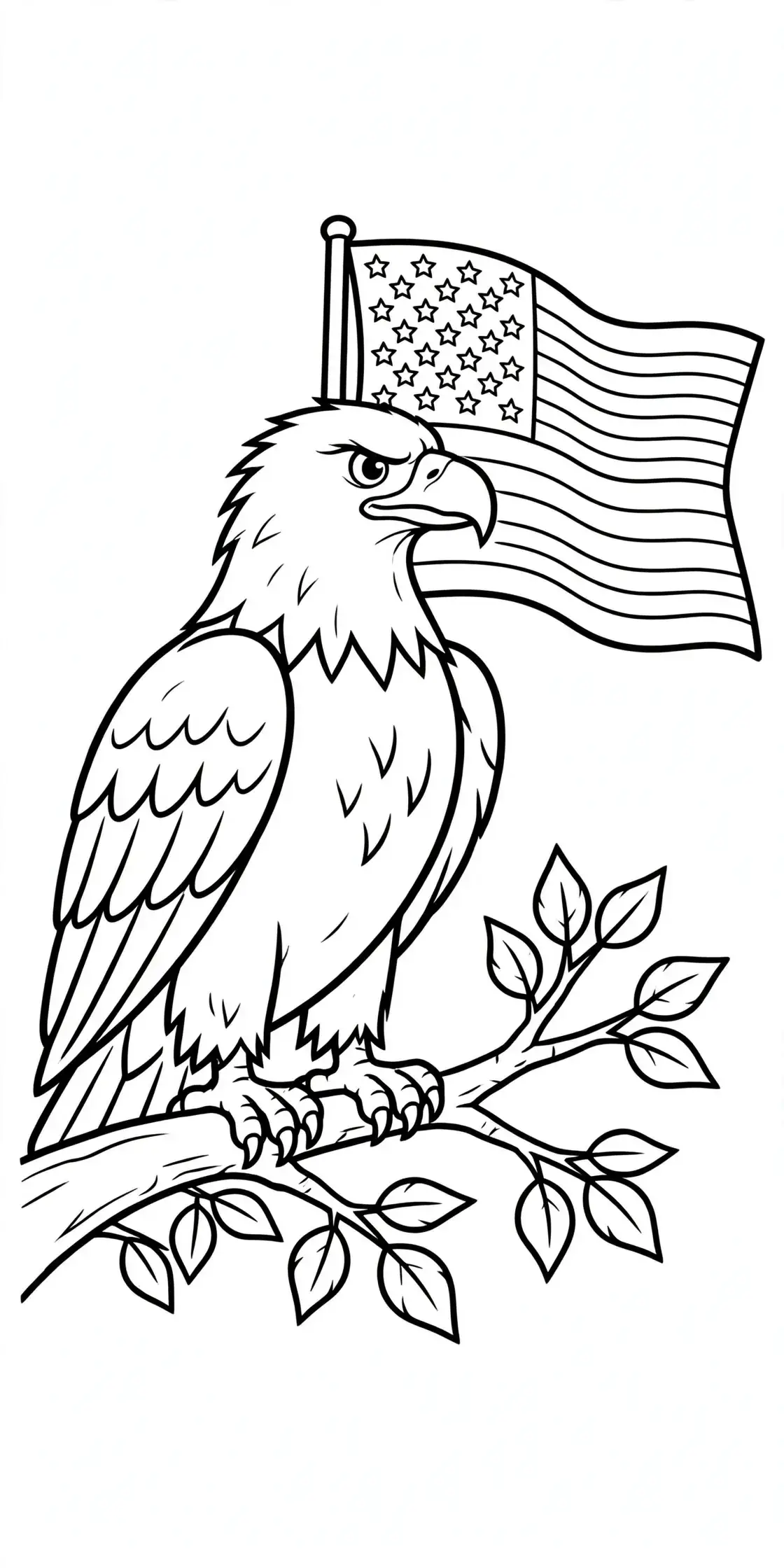
A bald eagle perches proudly with a simple American flag waving gently behind it.
Colouring tip: Colour the flag red and white stripes with a blue corner and white stars, and keep the eagle dark brown with a white head, because the flag and the bird share the picture.
Age: Best for ages 9 to 12.
12. Eagle Standing on the Edge of a Tall Rocky Cliff
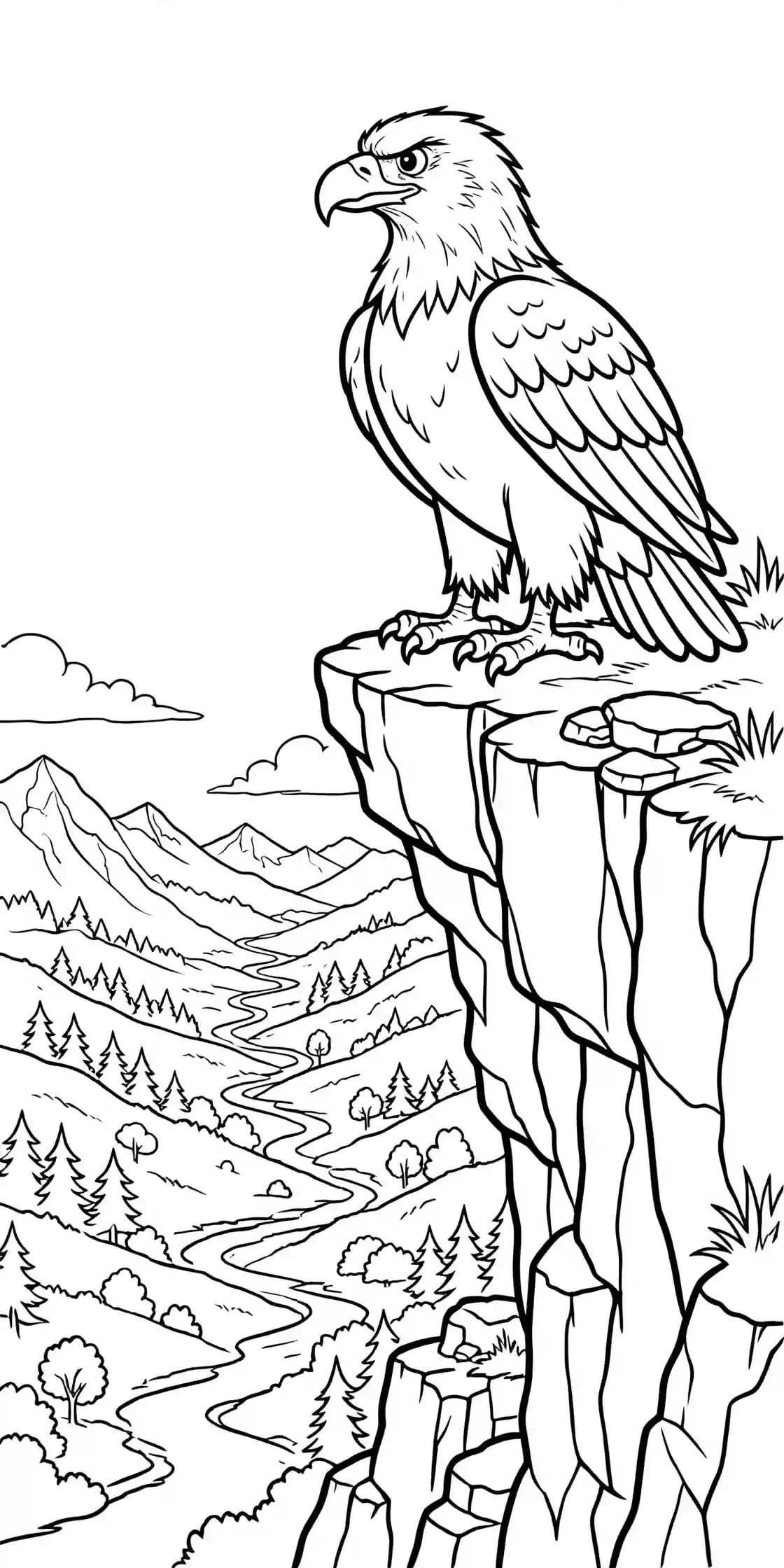
An eagle stands on the edge of a tall rocky cliff and looks out over the valley below.
Colouring tip: Colour the cliff rock grey with brown shadows in the cracks, and the valley green far below, so the height of the cliff shows.
Age: Best for ages 3 to 5.
24. Eagle Perched on a Large Round Rock
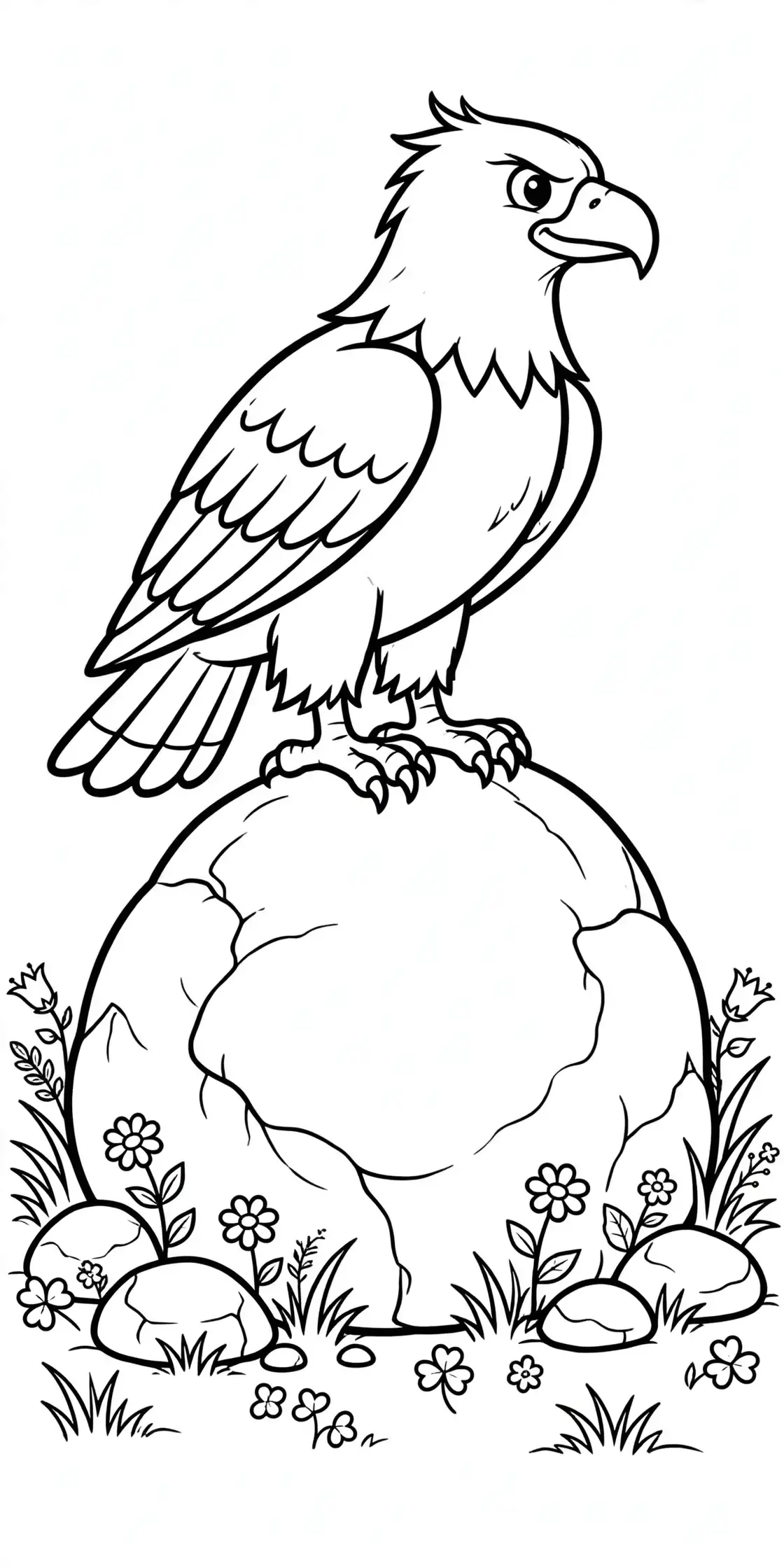
An eagle perches on a large round rock, small wildflowers and grass growing around the base.
Colouring tip: Colour the wildflowers in three bright colours, pink, yellow and purple, so the rock looks like a little garden.
Age: Best for ages 3 to 5.
31. Eagle Perched on a Pine Branch with Pine Cones
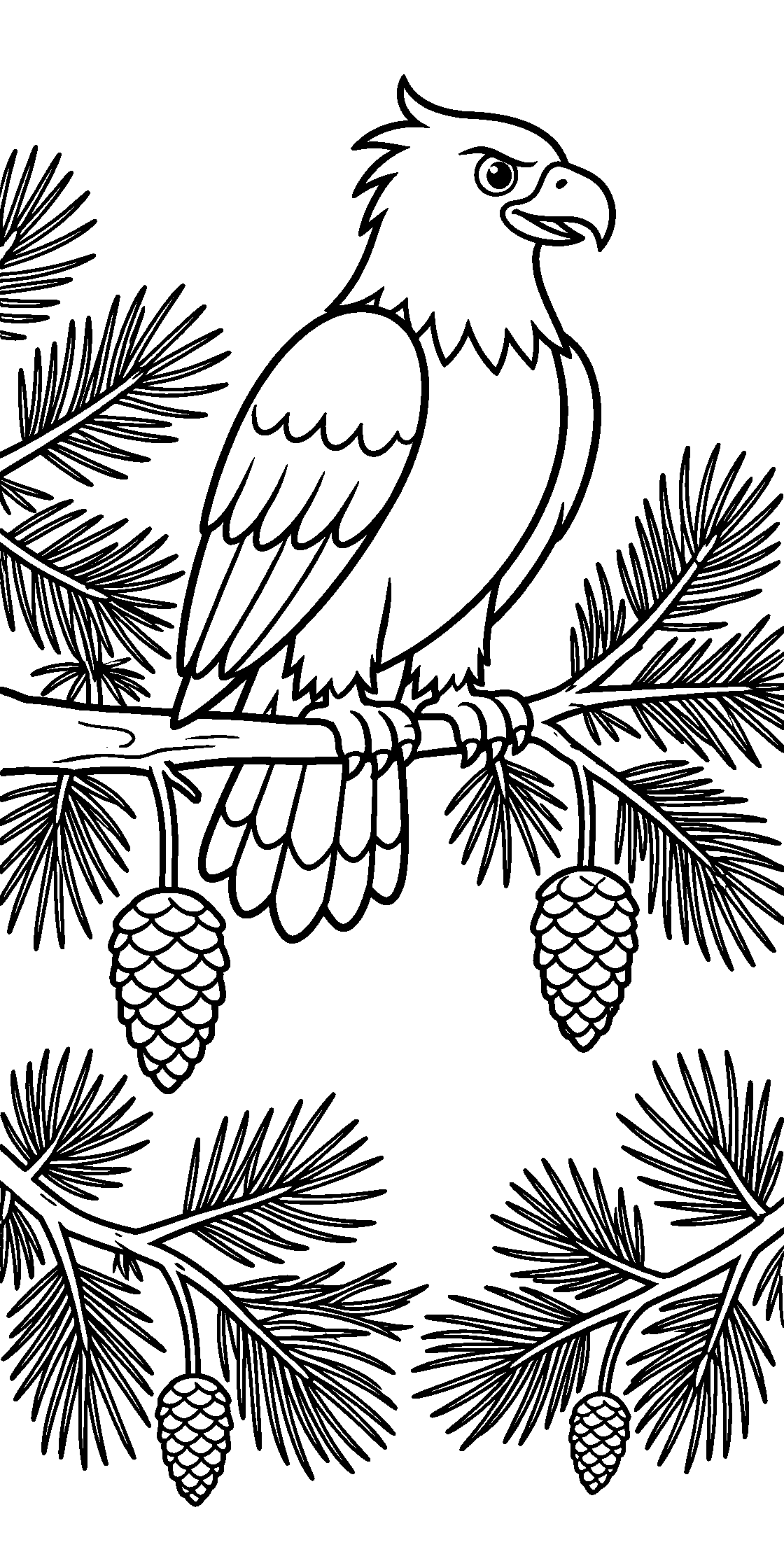
An eagle perches on a pine branch with pine cones hanging nearby and pine needles all around.
Colouring tip: Colour each pine cone a slightly different brown, because no two cones on a real tree are ever the same shade.
Age: Best for ages 6 to 8.
Seasons and Skies
An eagle flies in every season, and the next seven pictures show what that looks like. A sunset, a dawn, a snowy branch, autumn leaves, a storm, a starry night and a sunrise over a valley. These are the pictures in these eagle coloring pages where the sky does most of the talking, so the sky colours matter as much as the bird.
9. Eagle Flying in Front of a Large Setting Sun
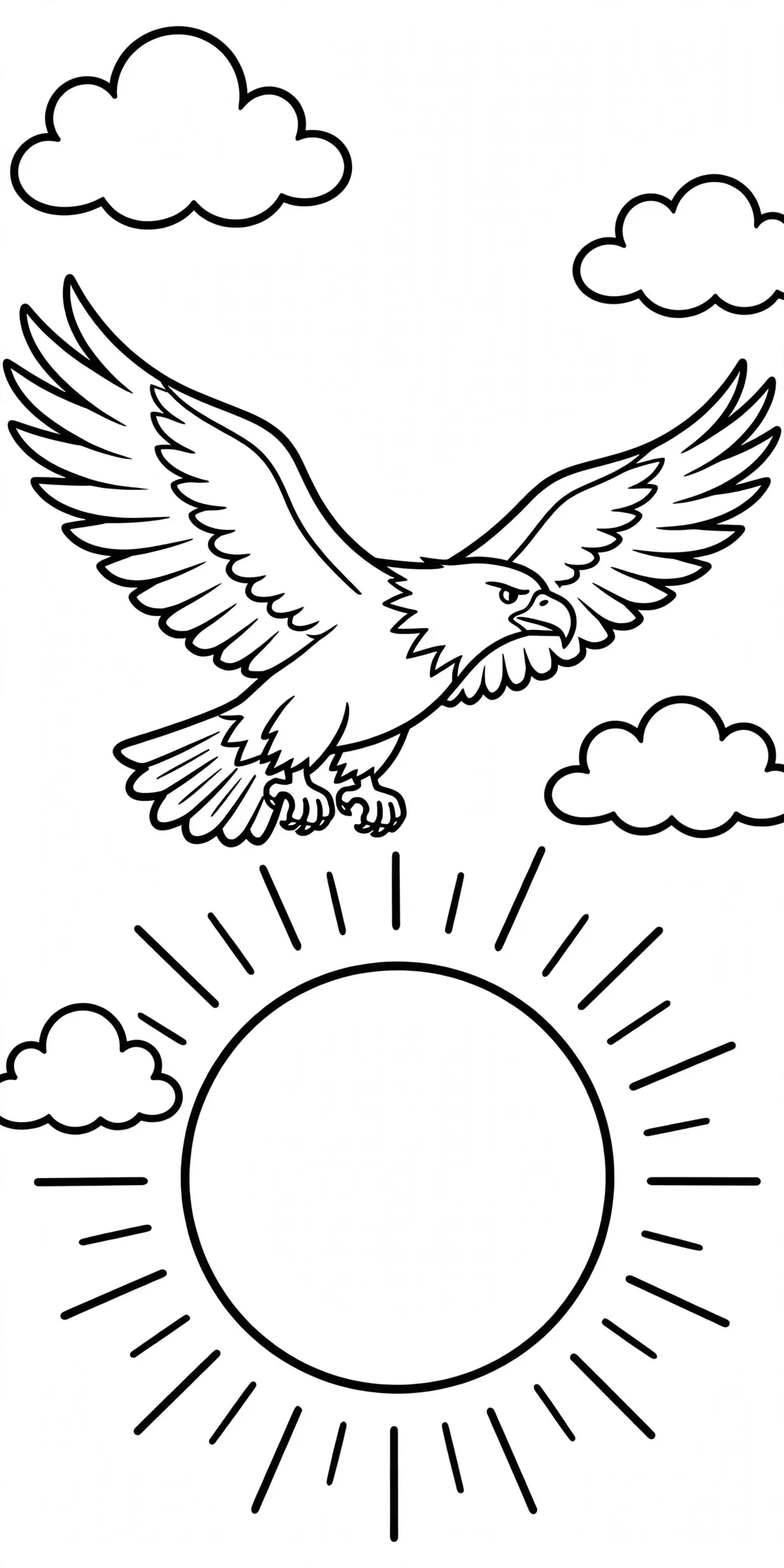
An eagle flies in front of a large setting sun, simple sun rays spreading out and a few clouds nearby.
Colouring tip: Colour the sun orange and yellow and the sky around it pink, then colour the eagle dark, because a bird against a sunset looks almost black.
Age: Best for ages 6 to 8.
18. Eagle Flying at Dawn Over a Quiet Forest
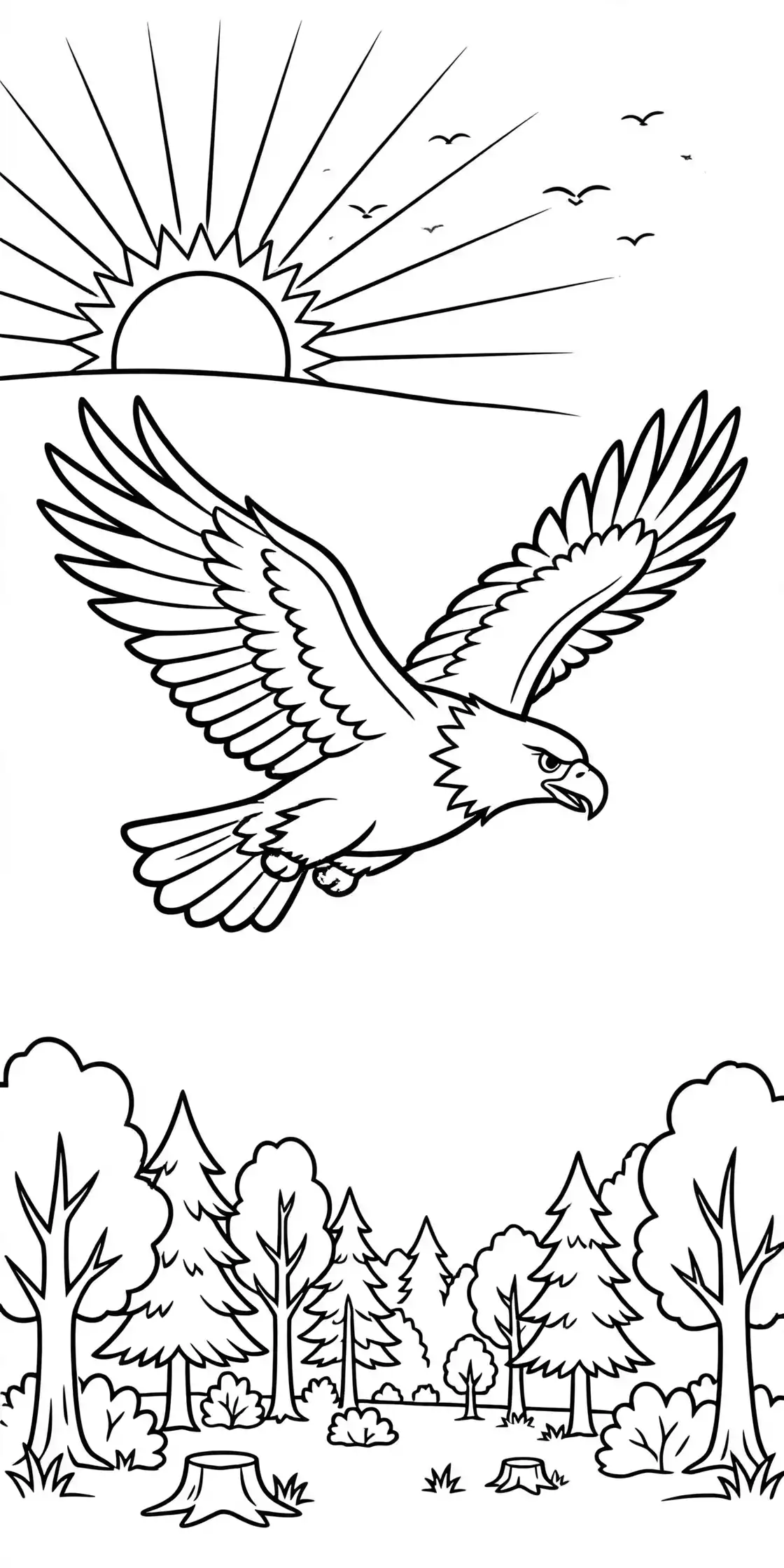
An eagle flies at dawn over a quiet forest, the sun rising and a few small birds flying in the distance.
Colouring tip: Colour the rising sun pale gold and the forest a soft green, because dawn light is gentle and the whole picture should feel quiet.
Age: Best for ages 6 to 8.
20. Eagle Perched on a Snowy Pine Branch in Winter
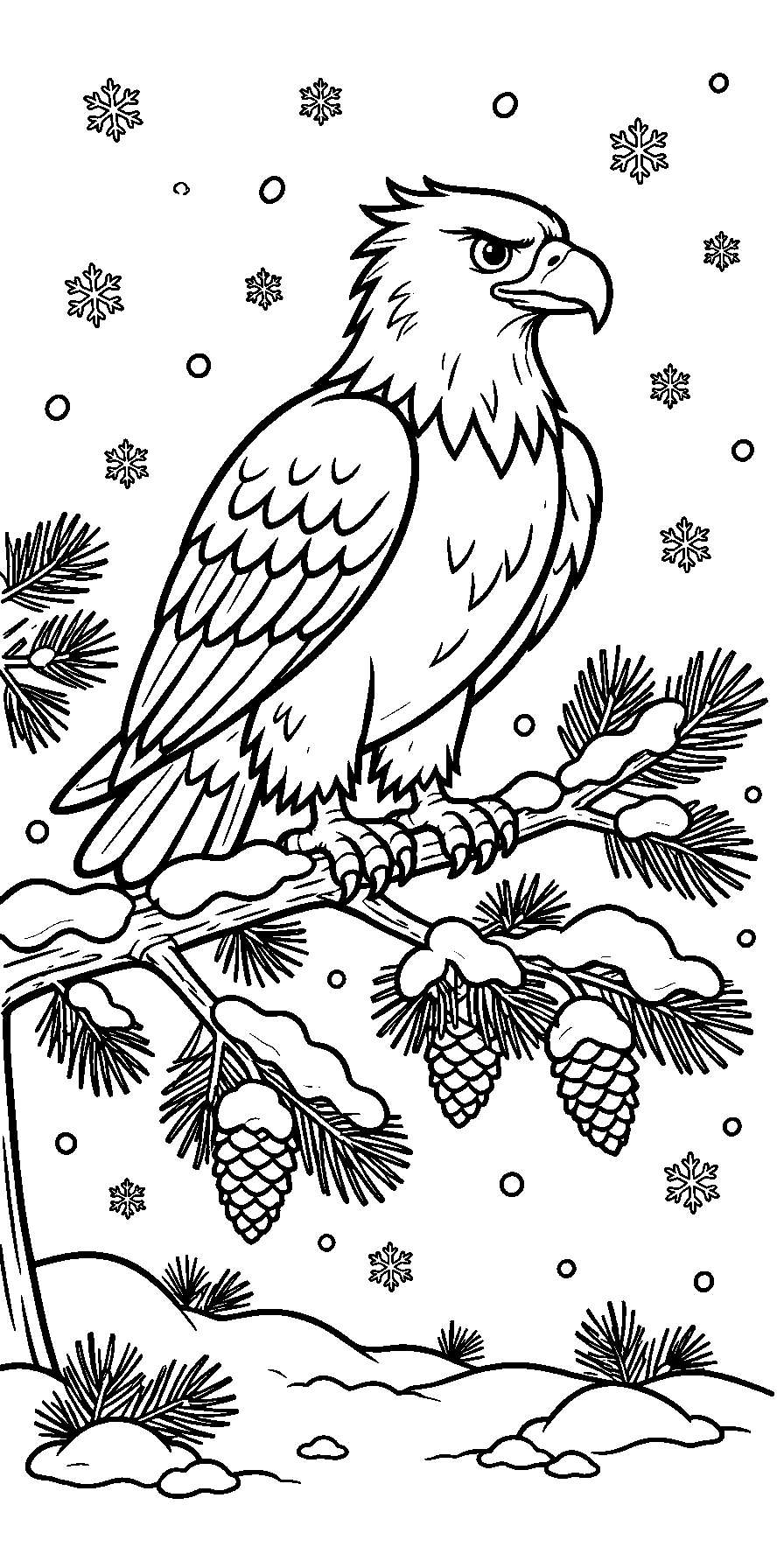
An eagle perches on a snowy pine branch in winter, snowflakes falling around it and snow lying on the ground.
Colouring tip: Colour the snow a very pale blue, not white, so it shows up against the white paper, and leave the eagle’s head white too.
Age: Best for ages 6 to 8.
27. Eagle Perched on an Autumn Tree Branch
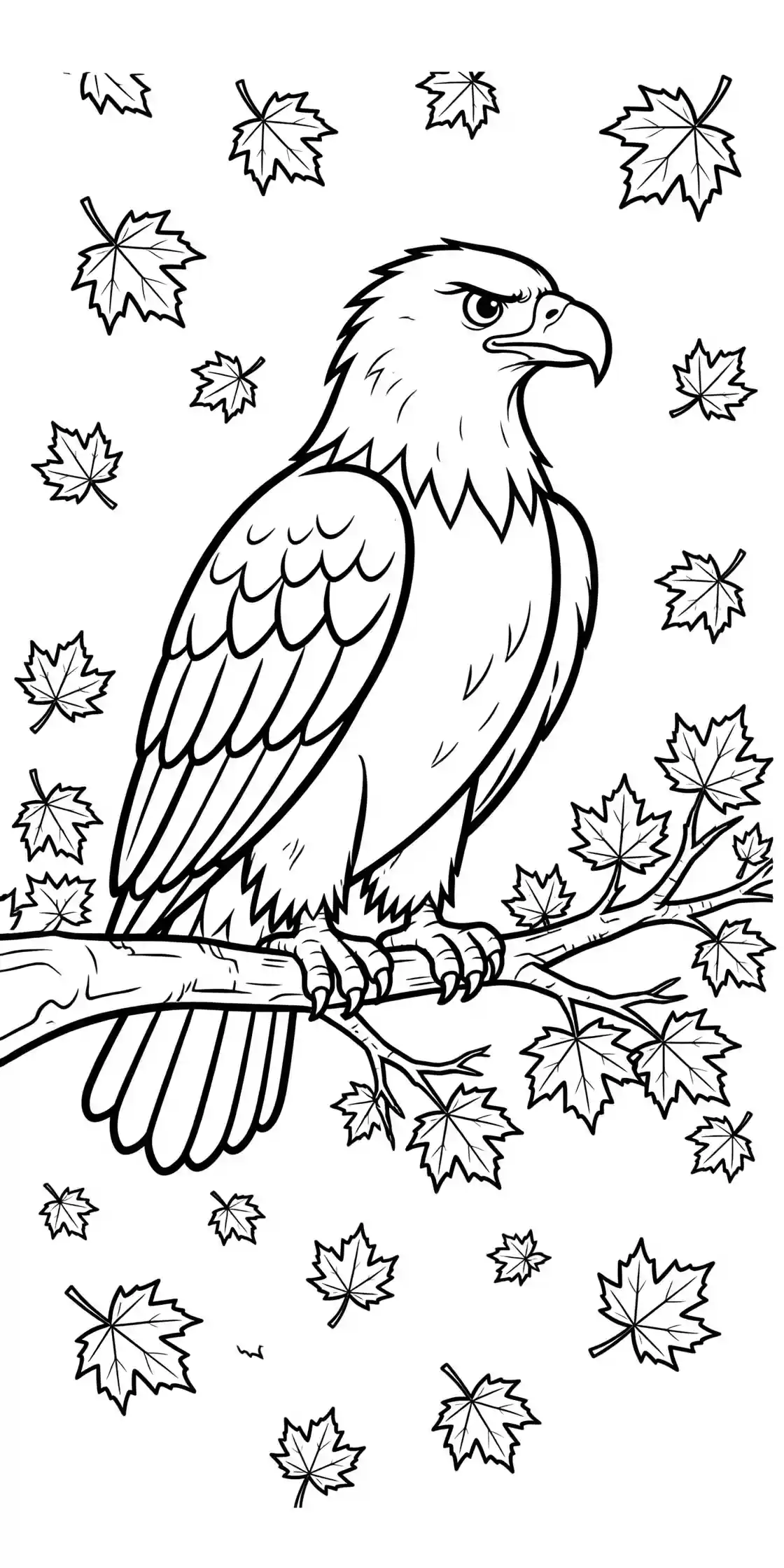
An eagle perches on an autumn tree branch, maple leaves falling around it in the crisp air.
Colouring tip: Colour the maple leaves red, orange and gold, one colour per leaf, because autumn is the one season where every leaf is different.
Age: Best for ages 9 to 12.
29. Eagle Flying Through a Storm Cloud
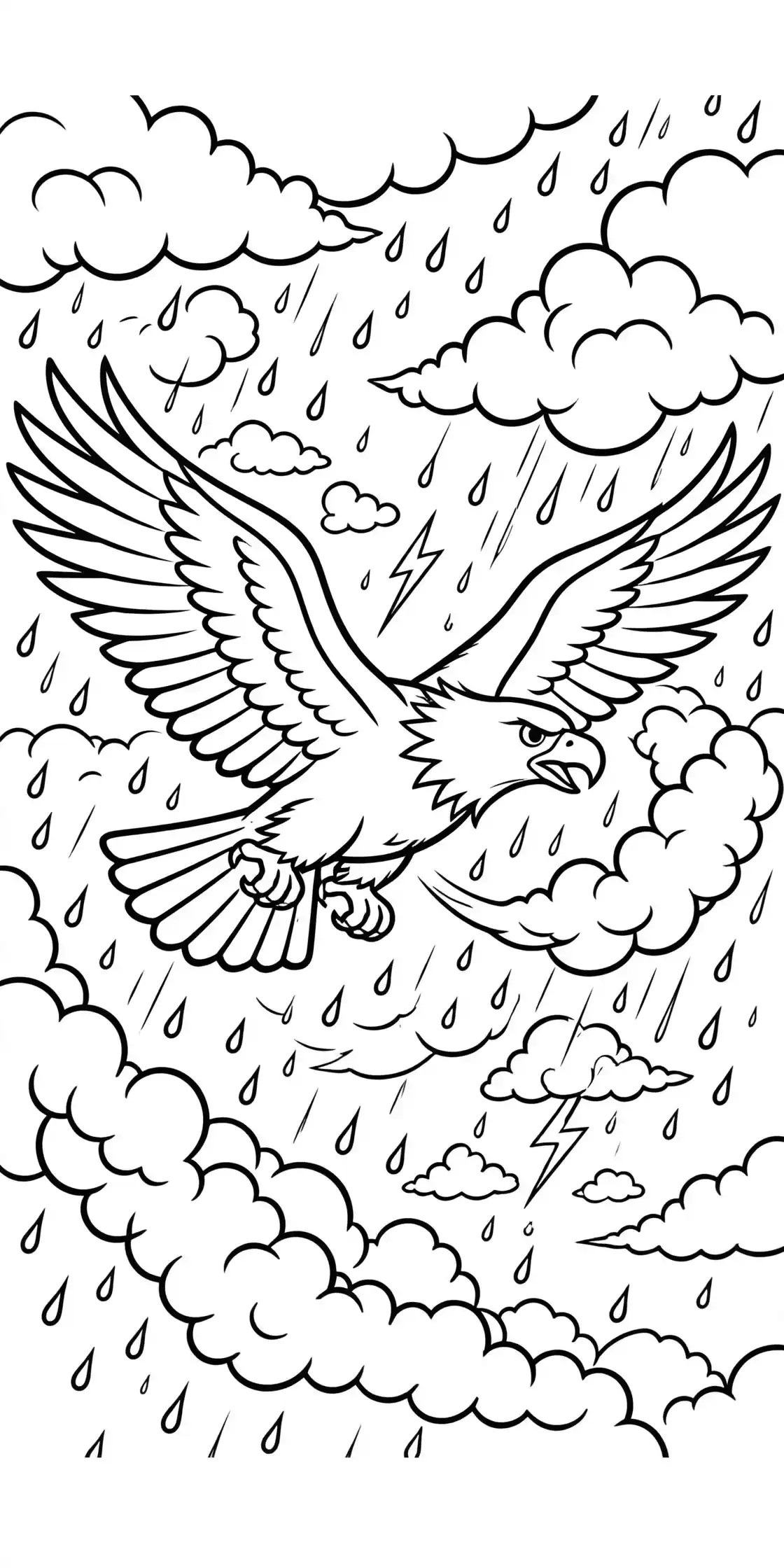
An eagle flies through a storm cloud, rain drops falling and lightning flashing in the distance.
Colouring tip: Colour the storm cloud dark grey and the lightning bright yellow, so the flash is the brightest thing on the page.
Age: Best for ages 9 to 12.
35. Eagle Flying in a Night Sky Full of Stars
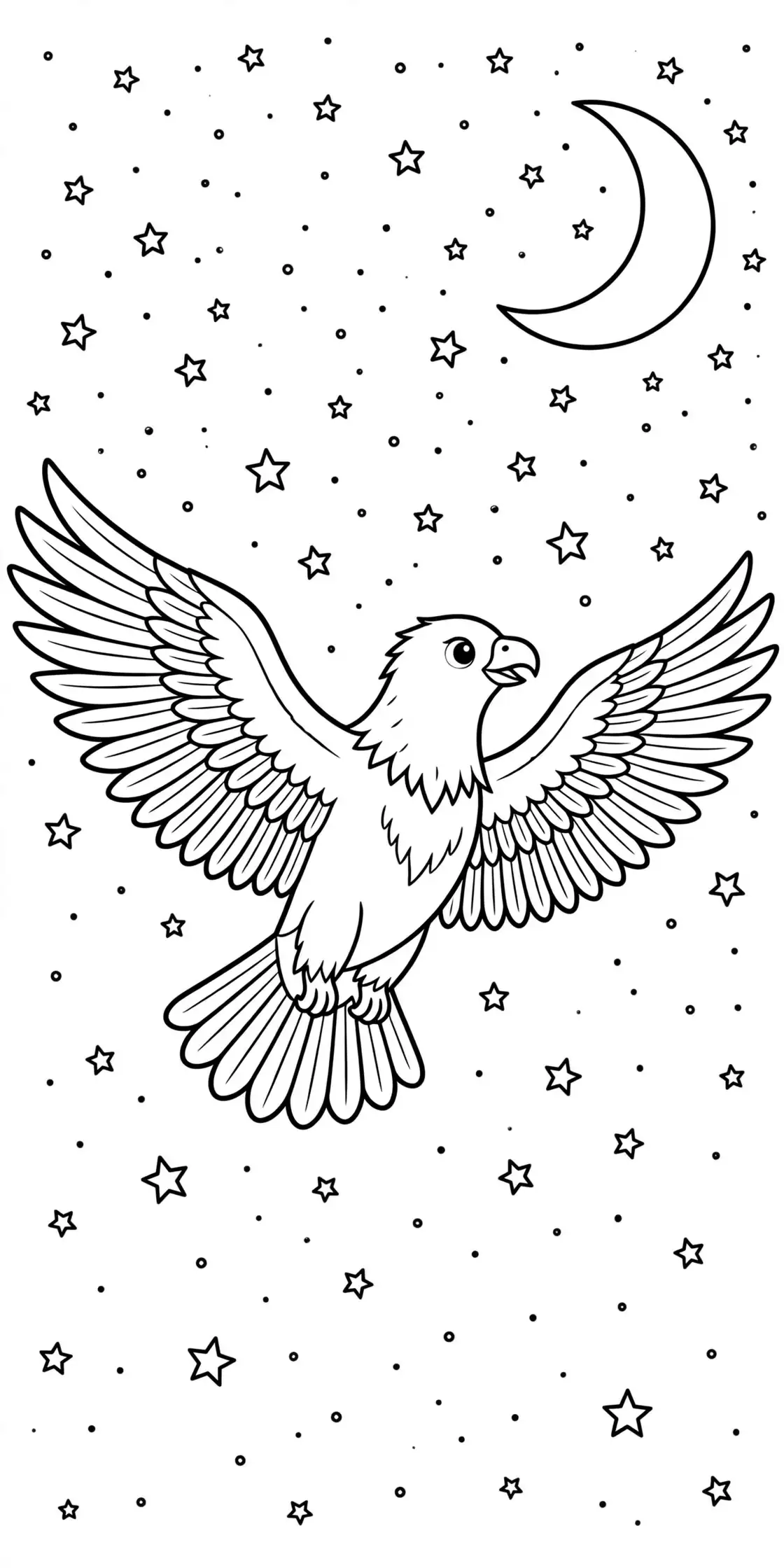
An eagle flies in a night sky filled with stars, a crescent moon shining above it.
Colouring tip: Colour the night sky a deep blue and the stars pale yellow, and leave the moon white, so the eagle flies through a real night.
Age: Best for ages 3 to 5.
40. Eagle at Sunrise Over a Wide Green Valley
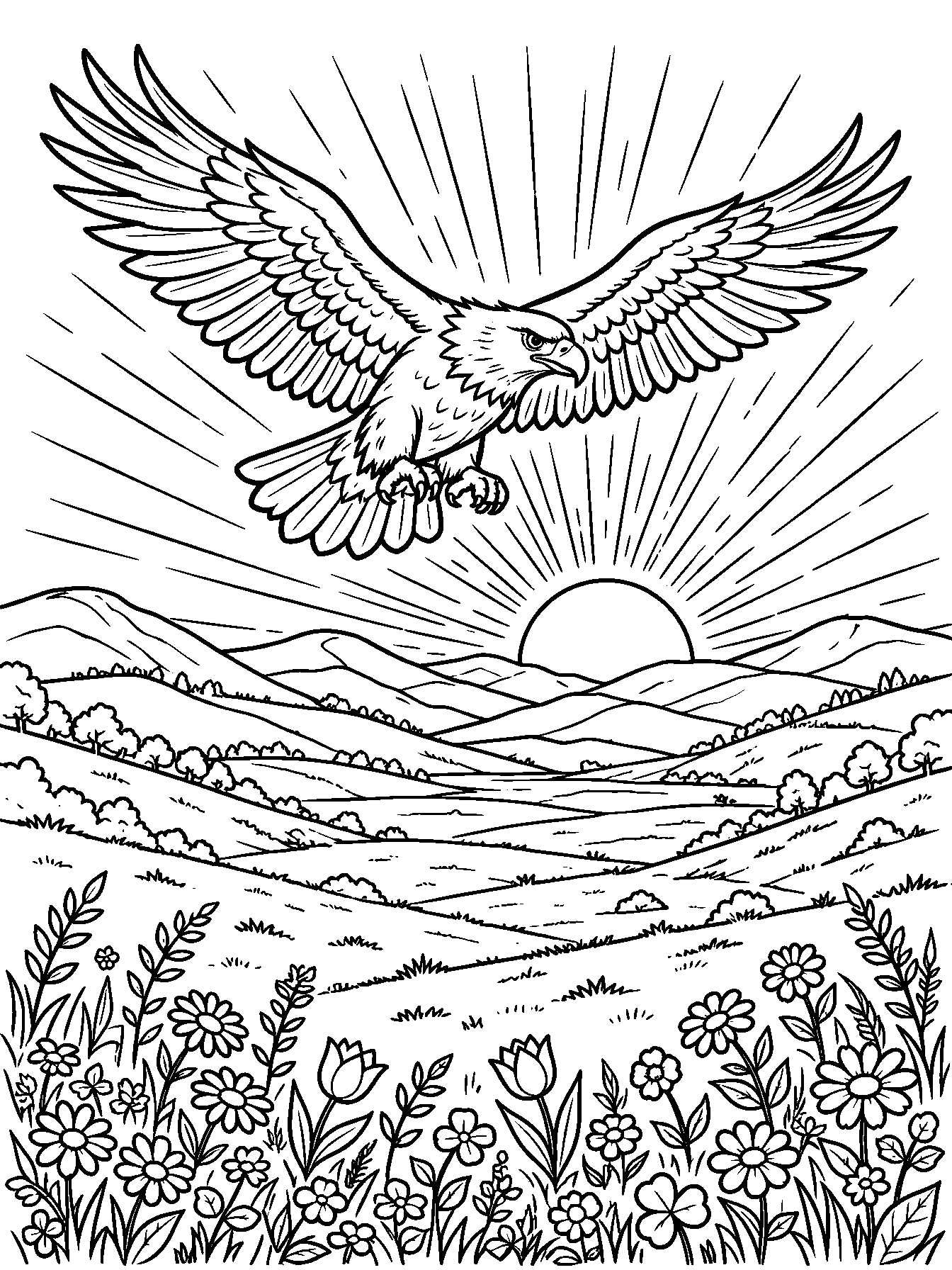
An eagle flies at sunrise over a wide green valley, sun rays rising behind the hills and flowers blooming in the foreground.
Colouring tip: Colour the valley green, the flowers pink and yellow, and the sunrise gold, because this is the brightest picture in the whole set.
Age: Best for ages 3 to 5.
Young Eagles and Quiet Places
Not every eagle picture needs drama. The next three pictures in these eagle coloring pages are quiet ones: a fluffy chick, a forest full of pine trees, and a meadow full of flowers and butterflies. They suit a slow afternoon and a small child who wants to colour without rushing.
10. Cute Fluffy Baby Eagle Chick in Soft Grass
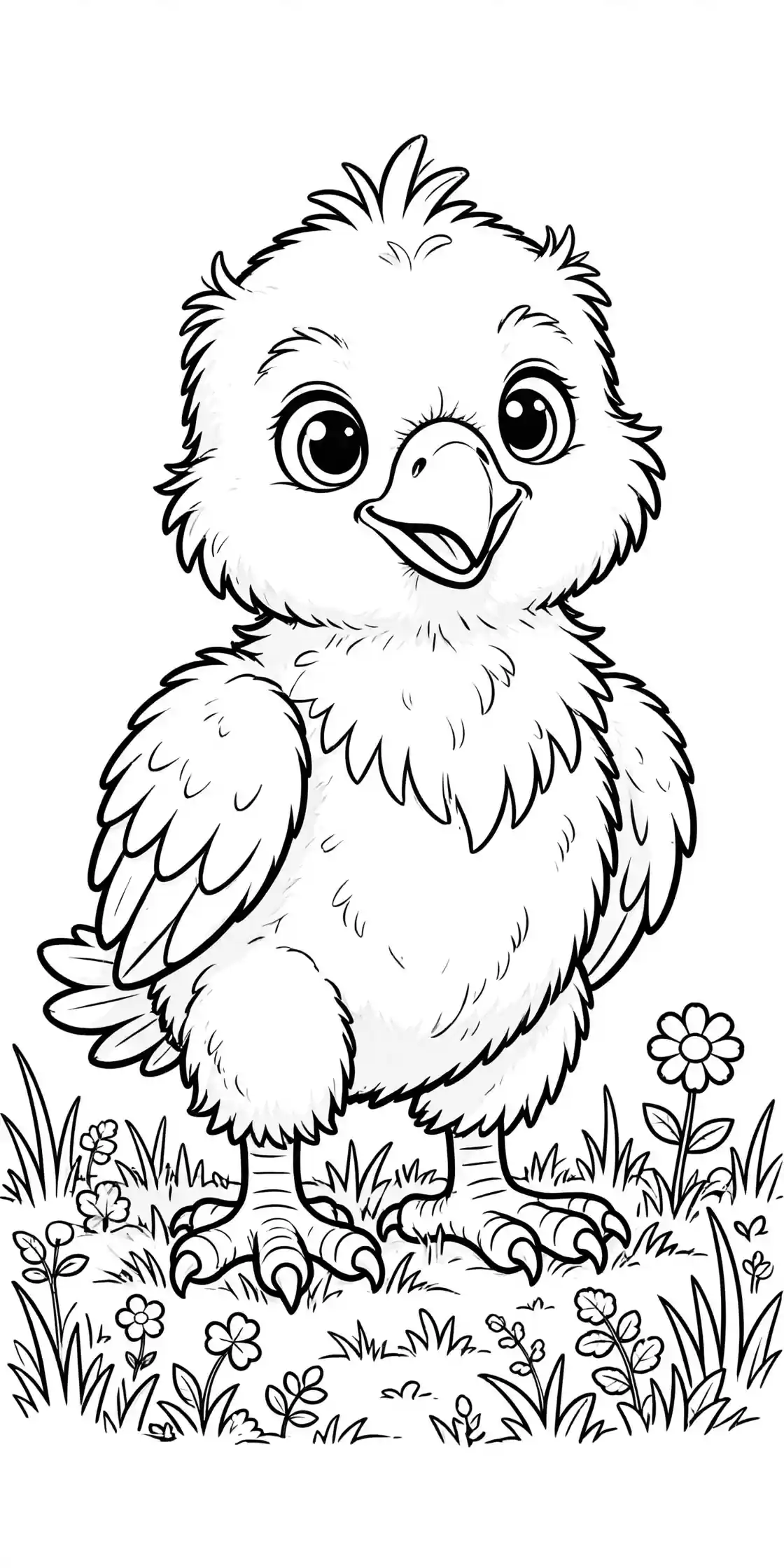
A cute fluffy baby eagle chick stands in soft grass, with a small flower growing beside it.
Colouring tip: Colour the chick a soft light grey brown and the flower pink, because a baby eagle is pale and fluffy, not dark like its parents.
Age: Best for ages 3 to 5.
19. Eagle Flying Over a Thick Pine Forest
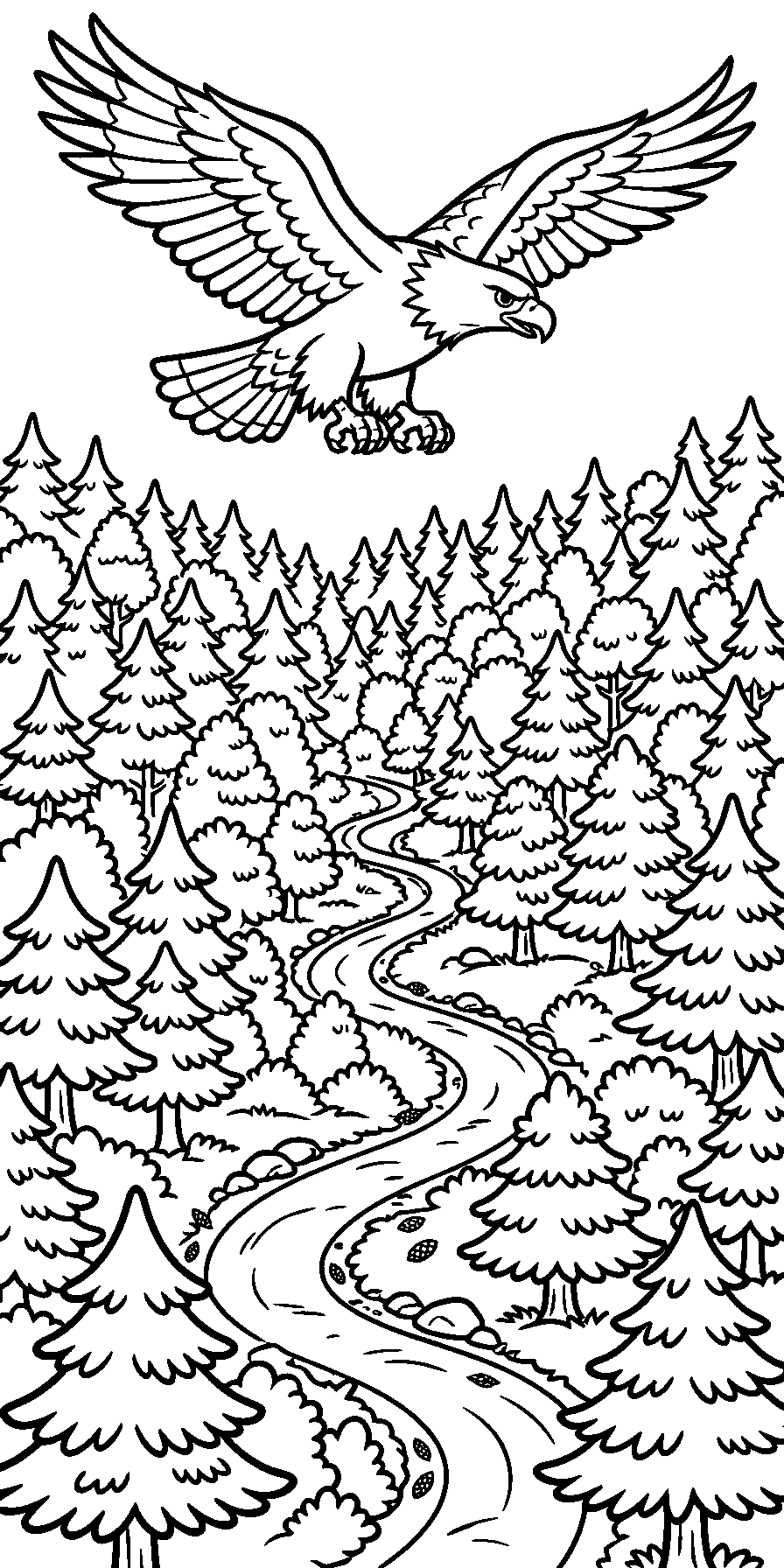
An eagle flies over a thick pine forest, treetops stretching below and a winding path curving through them.
Colouring tip: Colour the treetops in two greens, dark and light, so the forest looks deep, and follow the winding path with a sandy brown.
Age: Best for ages 6 to 8.
32. Eagle Flying Low Over a Flower Meadow
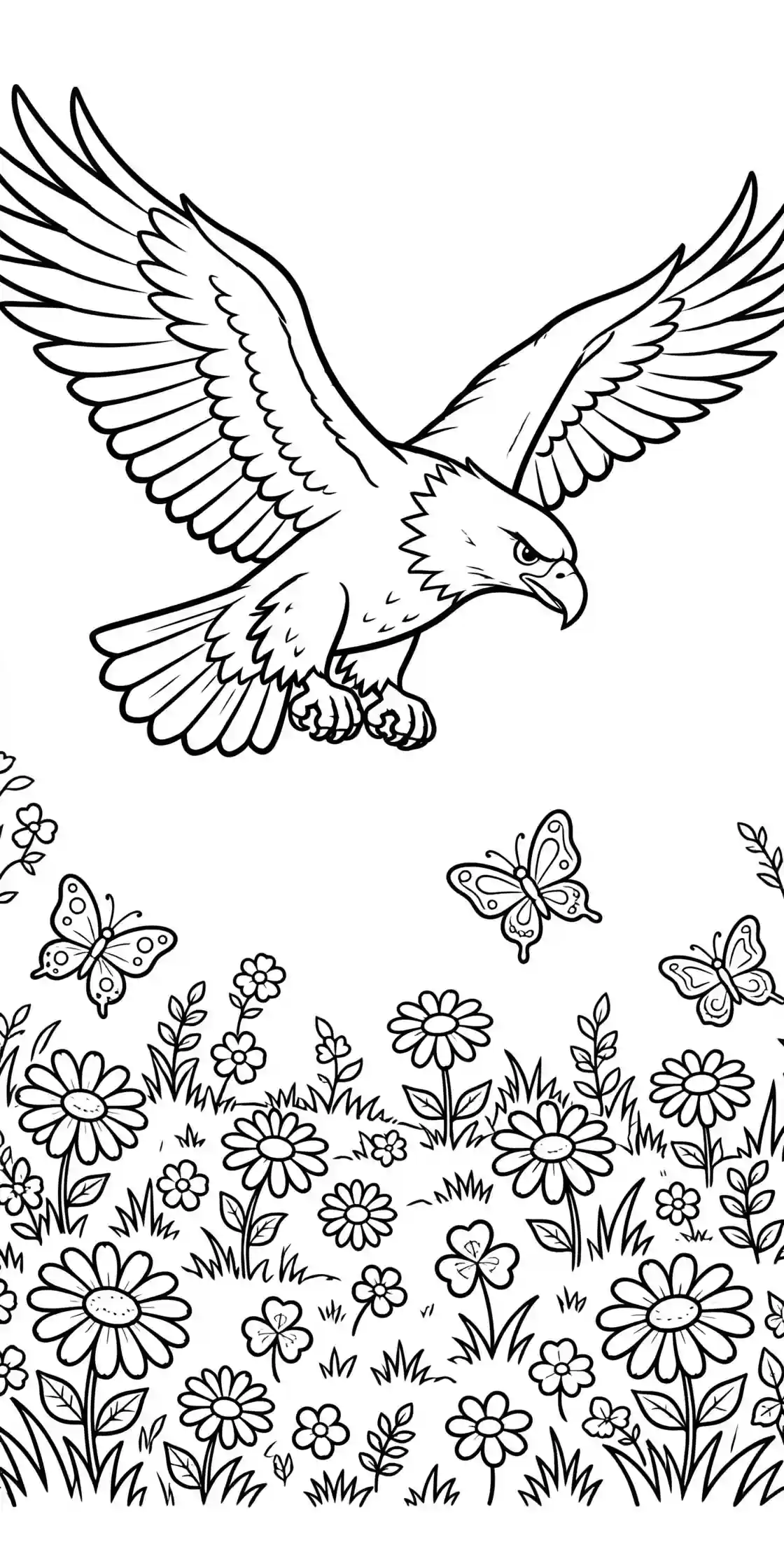
An eagle flies low over a flower meadow, butterflies fluttering and daisies blooming below.
Colouring tip: Colour the butterflies orange and blue, the daisies white with yellow centres, and the grass a fresh green, so the meadow feels alive.
Age: Best for ages 6 to 8.
Close Up: Heads, Feathers and Talons
The last three pictures zoom right in. A bald eagle’s head, a single feather, and a portrait full of layered feathers. These are the most detailed pages in these eagle coloring pages, and they suit a child who likes to take it slow and fill in small spaces with care.
3. Close Up Portrait of a Bald Eagle Head
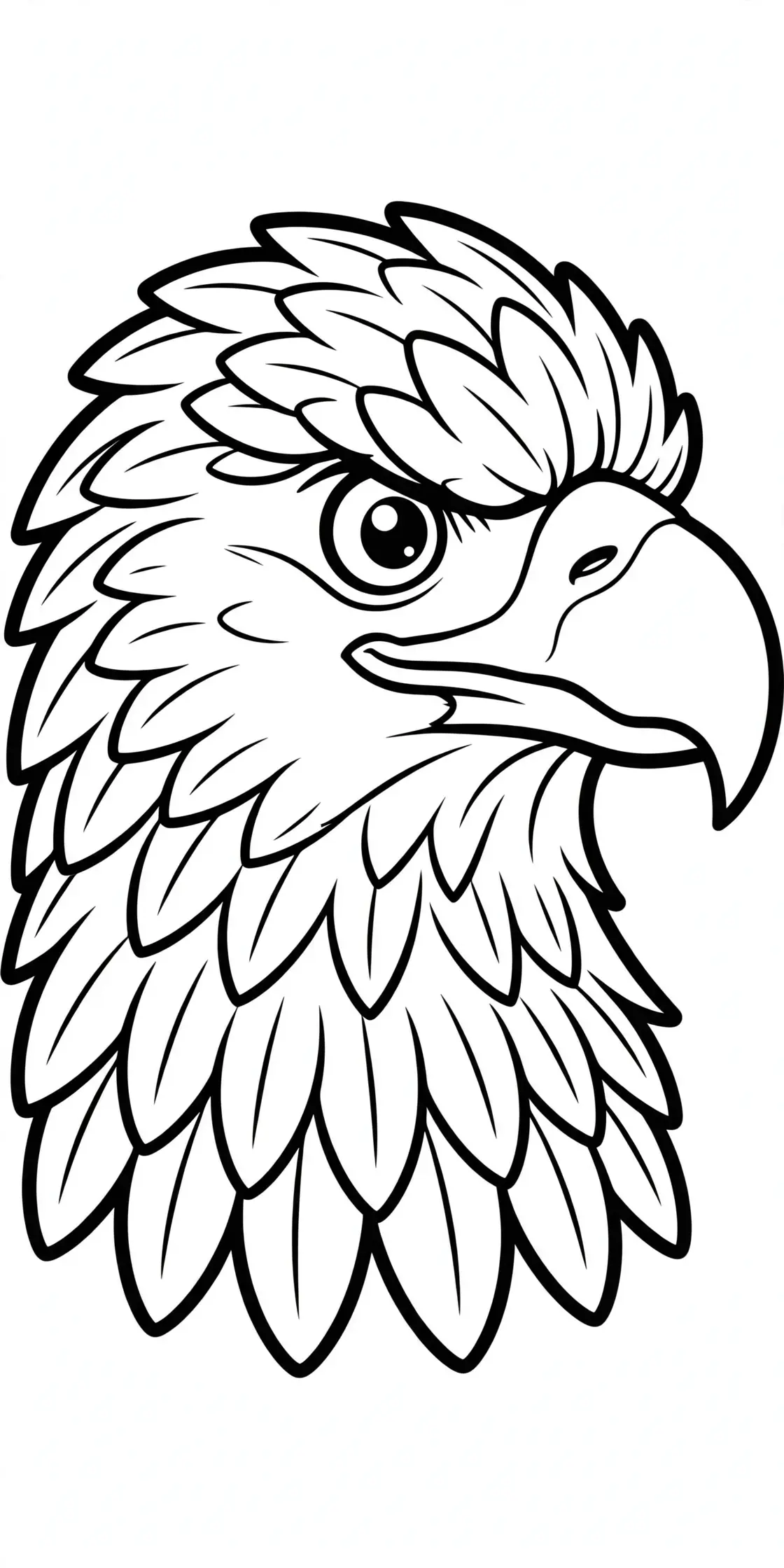
A close up portrait shows a bald eagle’s head facing slightly to the side, with a detailed hooked beak and layered feathers.
Colouring tip: Colour the head white, the beak bright yellow with a darker tip, and the eye pale yellow with a black pupil, because the face is everything in this picture.
Age: Best for ages 9 to 12.
13. Close Up of a Single Large Eagle Feather
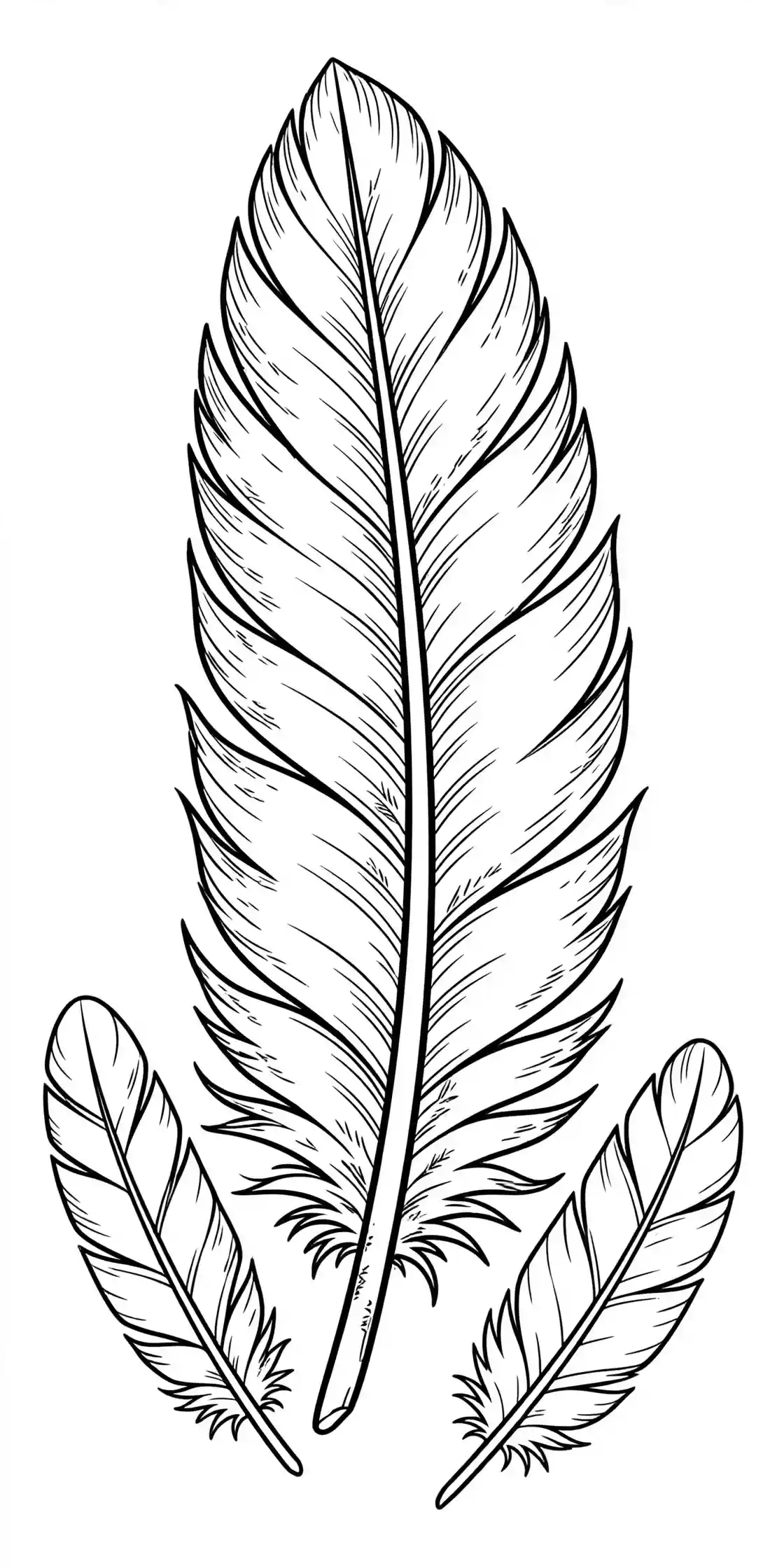
A close up shows a single large eagle feather with detailed lines, two smaller feathers lying beside it.
Colouring tip: Colour the big feather dark brown with a lighter shaft down the middle, and the two small feathers a soft grey, so each feather has its own shade.
Age: Best for ages 9 to 12.
38. Detailed Portrait of an Eagle Showing Layered Feathers
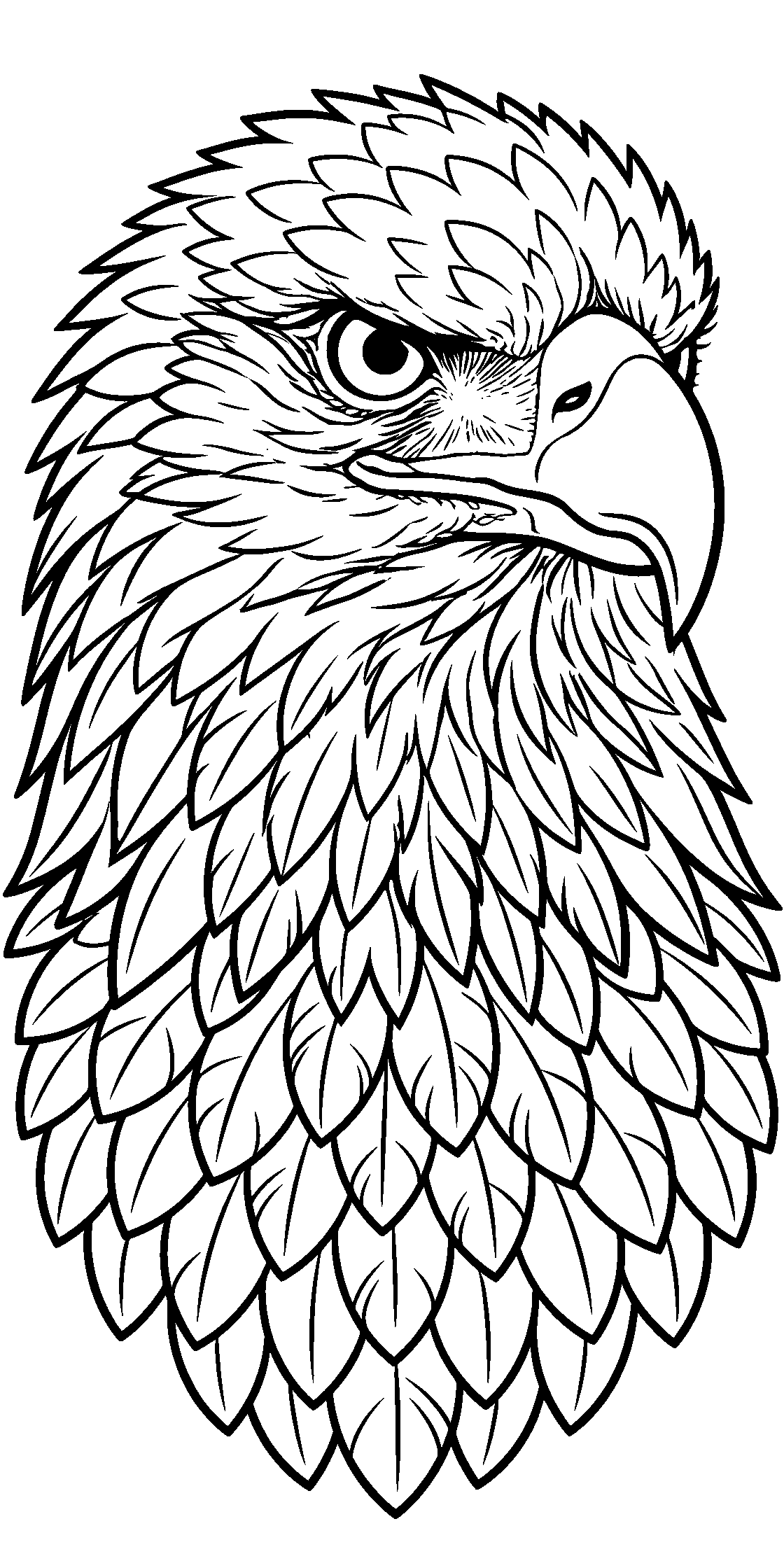
A detailed portrait shows an eagle’s layered feathers on its head, neck and chest, each feather drawn on its own.
Colouring tip: Colour the feathers row by row, light brown then dark brown, so the layers stack up like roof tiles.
Age: Best for ages 9 to 12.
Colouring a Bald Eagle So It Looks Real
Lay out your colours before you start: a dark brown for the body and wings, white for the head and tail, bright yellow for the beak and feet, and a pale yellow for the eye. The fun of these eagle coloring pages is getting those four colours in the right places, because that is what makes a bald eagle look like a bald eagle.
Start with the head, because it is the bird’s signature. A grown bald eagle has a white head and a white tail, and the rest of the body is dark brown. Colour the head white first, then the tail, then fill the body and wings with dark brown. The contrast between the white and the brown is what people notice first.
The beak is bright yellow with a darker tip, and the feet are the same bright yellow. A real bald eagle has a hooked beak, which means it curves down at the end like a hook. Colour the hook a slightly darker yellow or a touch of orange at the very tip.
For a golden eagle, change the recipe. A golden eagle is dark brown all over, with a golden wash on the back of its neck. Colour the neck gold or amber, keep the body dark brown, and give it feathered legs down to its talons. Its beak is darker than a bald eagle’s, with only a yellow base.
For the skies in these eagle coloring pages, keep three blues close by. Use a pale blue for a calm daytime sky, a deeper blue for the ocean and the night sky, and a pink or orange for sunsets and sunrises. Picture 9, the eagle in front of the setting sun, is the one to practise on, because it holds the sunset colours all at once.
Try a rainbow eagle if you like. Nature paints this bird brown, white and yellow. A purple eagle with a green tail still reads as an eagle, once the hooked beak and the wide wings are in place.
Slow colouring pays off here: look at the head first, then the wings, and the rest of the picture falls into place. That order works across all of these eagle coloring pages, from the mountain skies to the nest.
How to Print These Pages
Before you print all 40, look at what the printer does with the hardest lines. Picture 3 has the finest lines in the set, the little feathers around the eagle’s eye. Picture 13 has the smallest details, the thin lines running down the feather.
Run those two through first. Those two pages carry the hardest lines in these eagle coloring pages, so if they print clean, the rest will too. Look for dark, clear lines on the feather barbs and the thin beak edge.
A pale test page means the printer is still on its draft setting. Open the printer settings, change draft to normal or best, and run the test page once more.
One test page is enough to judge the printer, because every line in these eagle coloring pages was drawn thick enough to survive a faint ink cartridge. On draft mode the thin feather lines fade first, so look closely at picture 38, the detailed portrait, before you print the whole set.
Plain white paper from the tray does the job, Letter or A4, nothing fancy needed. Tick fit to page before you press print, so a wingtip or a tail feather sitting close to the edge stays on the sheet. Most pages in these eagle coloring pages leave big spaces open, and a crayon or a coloured pencil fills those spaces cleanly on plain copy paper.
Markers bleed through thin sheets, so use thicker card for marker pages and put an old newspaper under the page. Print picture 8 on card for the flag card game below, because card holds its shape once cut where paper would flop.
Put the printed pile in gallery order, flying first and close ups last. Then a child can colour through these eagle coloring pages from the open sky to the fine feather work at the end. Keep coloured pages in one stack and blank ones in another, and the set stays tidy all week.
Which Pictures Suit Each Age
Sort the printed pile of these eagle coloring pages into three stacks before you hand it out. The first stack, for ages 3 to 5, holds the big open pictures that a fat crayon can fill without fuss.
The middle stack, for ages 6 to 8, holds pictures that ask for two or three colours in one place. The last stack, for ages 9 to 12, holds the pages packed with small feathers, fine lines and tiny details.
Start the 3 to 5 year olds on the widest, emptiest shapes in these eagle coloring pages. The numbers are 1, 5, 10, 12, 15, 17, 23, 24, 28, 33, 35, 39 and 40.
Chunky crayons work best here. The eagle soaring above the clouds in picture 1 and the fluffy chick in the grass in picture 10 are simple enough to finish in one go. So are the baby eagle hatching in picture 28 and the eagle flying through the clouds in picture 39.
For 6 to 8 year olds, pick pages from these eagle coloring pages that ask for a few more choices, like two blues for one sky. The numbers are 2, 4, 6, 7, 9, 11, 14, 18, 19, 20, 21, 26, 30, 31, 32, 34, 36 and 37.
Try the eagle perched on the pine branch in picture 2 first. The eagle catching a fish in picture 4 and the eagle over the ocean in picture 30 are just as rewarding. Each one suits a child who enjoys colouring at a gentle pace.
Ages 9 to 12 take the hardest nine pages in these eagle coloring pages: numbers 3, 8, 13, 16, 22, 25, 27, 29 and 38. Plan a long, slow session for those nine.
The close up head in picture 3 and the feather in picture 13 are full of small lines. So are the flag in picture 8 and the storm in picture 29, so take them slowly.
Between the three piles, every one of these eagle coloring pages has a place, and none is left over. Sort the piles by age before handing them out, so each child starts with pictures that suit them.
Five Things to Make with Finished Pages
The colouring does not have to stop when the crayons go down. Five pictures in these eagle coloring pages can become a kite, a nest, a bookmark, a classroom sky and a greeting card. Each idea takes less than an hour.
Fly an eagle kite. Colour picture 1, the eagle soaring above the clouds, in these eagle coloring pages, and cut carefully around the bird.
Glue the cut out eagle onto a diamond of thin card, tie a string to the middle, and add a tail of ribbon strips. Hold the string and run, and your eagle flies for real.
Build an eagle nest. Colour pictures 5, 28 and 36 from these eagle coloring pages in order. They show the nest with eaglets, the hatching chick, and the nest on the cliff with two eggs.
Line a shallow bowl with brown paper strips, stand the three pages up behind it like a little stage, and add cotton wool for the nest lining. You have an aerie you can hold in your hands.
Make a feather bookmark. Colour picture 13, the single large feather, in these eagle coloring pages, and cut carefully around it.
Glue the feather onto a strip of card, punch a hole at the top, and thread a ribbon through it. Slip it into a book, and the feather marks your place.
Hang a classroom sky. Colour pictures 6, 14, 30, 34 and 37 from these eagle coloring pages in order. They show the mountains, the lake, the ocean, the river valley and the waterfall.
Pin the five pages in a row on a wall or a board, and add a paper sun in the corner. You have five places an eagle flies, all in one line.
Make a flag greeting card. Colour picture 8, the eagle in front of the American flag, in these eagle coloring pages, on card so it holds its shape.
Fold a sheet of card in half, glue the coloured page to the front, and write a message inside. It suits a birthday, a thank you, or a welcome home.
Frequently Asked Questions
Are these eagle coloring pages free?
Yes. Every sheet in this collection is free to download, and you can print as many copies as you need at home, in a classroom, or for a group activity. The whole set of 40 pictures comes in one PDF, and these eagle coloring pages need no sign up and no email.
What is the difference between a bald eagle and a golden eagle?
A grown bald eagle has a white head and tail, a dark brown body, and bare yellow legs. A golden eagle is dark brown all over with a golden wash on the back of its neck and feathers running down its legs to its talons. Bald eagles live near water in North America and eat mostly fish, while golden eagles live in mountains and open country across the northern half of the world and hunt rabbits and ground squirrels. Picture 3 in these eagle coloring pages shows a bald eagle’s head up close, so you can see the white head and the hooked yellow beak.
How big is a bald eagle?
A bald eagle measures 28 to 38 inches from beak to tail, with a wingspan of up to 80 inches, and weighs 6 to 14 pounds, according to the U.S. National Park Service. Females are bigger than males. Its scientific name is Haliaeetus leucocephalus, which means white-headed sea eagle. A bald eagle can live 20 to 30 years in the wild, according to National Geographic Kids.
Why is it called a bald eagle if it has feathers?
The word bald comes from an old word, piebald, which meant white-headed. The U.S. National Park Service explains that the name refers to the white head and tail against the dark body. Young bald eagles are brown all over and do not grow their white head until they are about five years old, so a brown eagle in a picture might be a young bald eagle, not a golden eagle.
How big can an eagle’s nest get?
An eagle’s nest is called an aerie, and it is the biggest nest of any bird in North America. The Smithsonian says a typical nest spans 4 to 6 feet across and about 3 feet deep. The biggest nest ever measured was 9 feet 6 inches wide and 20 feet deep, and weighed two tons. It stood near St Petersburg in Florida and was recorded in 1963. Eagles return to the same nest year after year and add more sticks each time, which is how the nest grows so large.
Which picture should a small child start with?
Hand a young child picture 1 first, the eagle soaring above the clouds, or picture 10, the fluffy chick in the grass. Both have wide shapes that are simple to stay inside, and either one finishes fast, which feels like a real win for small hands.
Picture 3, the close up head, is the one to save. It is full of fine lines and small feather details, so it suits a day when the child is ready for fiddly work.
Wings Down, Crayons Out
Colour the last picture and step back. The pile on the table is a whole sky, from the open clouds to the river, from the nest to the storm, from the dawn to the night stars. These eagle coloring pages hold all of it, and every page started as a blank sheet and a box of crayons.
One finished eagle soon turns into two, and the pile grows fast. When the eagles are all coloured, more birds wait on the shelf: our owl coloring pages hold 42 owls and owlets to colour. Our penguin coloring pages hold 39 penguins waddling on ice and snow.
Our parrot coloring pages hold 36 parrots with bright feathers and jungle leaves. Each set prints free, any time you like, so the bird shelf never runs dry.
More Birds fun: keep coloring with our duck coloring pages and swan coloring pages.