
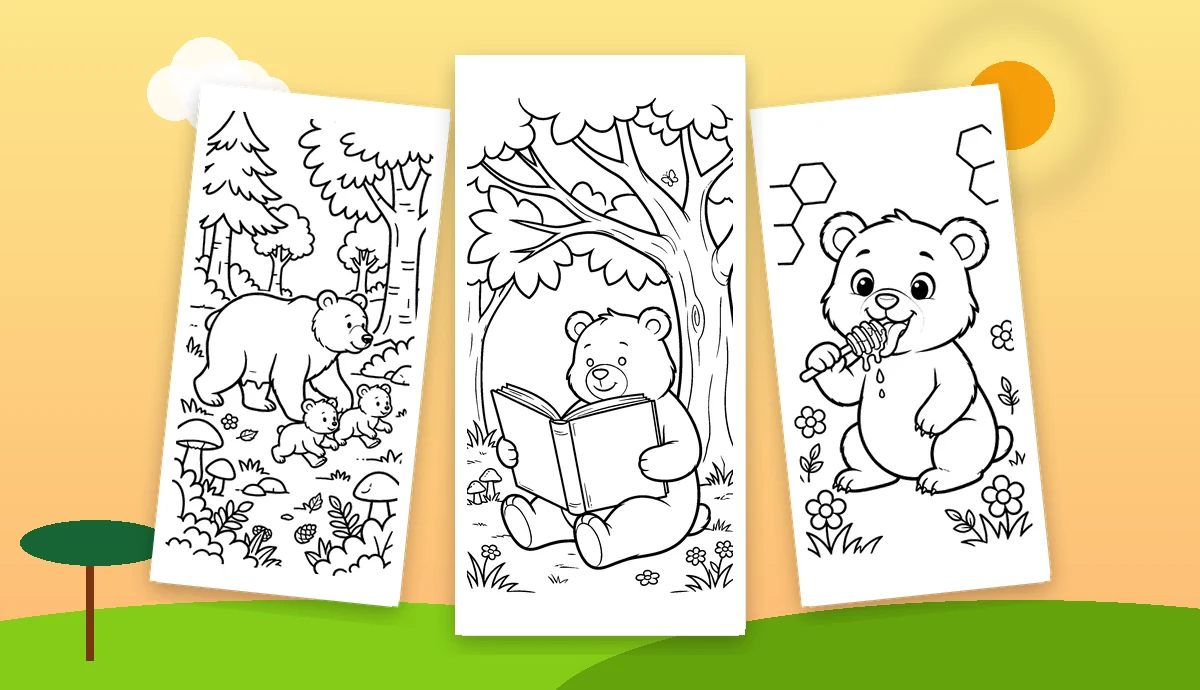
A bear was fishing at the river when I first saw one properly. It was not in a zoo and not on a screen, but standing in the water with its paws out, waiting for a salmon to jump. That bear is the first one you will meet in these bear coloring pages.
It did not look like the bears in storybooks. It looked bigger, shaggier and far more serious about its dinner. These bear coloring pages start with that bear and go on to meet the whole family, all eight kinds that live in the world today.
There are 44 pictures in the set, and they are grouped the way real bears live. Forest bears come first, then the bears from far away places. Then come the ones eating honey and catching fish, then the cubs, then the bears having fun, and last of all the bears settling down for the night.
A child can colour them in order and travel from a pine forest to the Arctic ice, or jump straight to a favourite bear.
All 44 pictures in these bear coloring pages fit in one free PDF, one picture per page, and you can print as many copies as you like. Download all 44 pages as one free PDF. No email, no payment, no sign up.
The river is waiting, and the first bear is already fishing.
Eight Bears, One Family
There are only eight kinds of bear in the whole world, which is a small family for such a famous animal. They live in North and South America, across Europe and Asia, and out on the Arctic sea ice. There are no wild bears in Africa and none in Australia.
South America has exactly one, and you will meet it below.
Most bears eat both plants and meat. Berries, roots, grasses, nuts and insects make up the larger share of what they eat, with fish and the odd dead animal filling in the rest. Two bears break that pattern completely.
The polar bear eats almost nothing but seals, and the giant panda eats almost nothing but bamboo, even though its stomach is still built like a meat eater’s. You can read the full list in this guide to all eight living bear species, which names each one and where it lives.
Here is the family, shortest first, and every one of them has a picture in these bear coloring pages. The sun bear is the smallest bear alive, about the size of a large dog, and it lives in the rainforests of Southeast Asia. Its tongue is long enough to lick honey and insects out of hollow trees, and its chest carries a pale golden patch shaped a little like a rising sun.
The sloth bear lives in India, and it eats ants and termites by sucking them up like a vacuum cleaner. It is missing a set of upper front teeth, and the gap they leave is exactly what makes the sucking work.
The spectacled bear lives in the Andes mountains of South America, and it is the only bear on that whole continent. Pale rings round its eyes look like a pair of glasses, and that is how it got its name. If the bear in the stories of Paddington feels familiar, that is because Paddington was written as a spectacled bear from Peru.
The Asiatic black bear lives in the forests of Asia, and the pale crescent across its chest has earned it the name moon bear.
Then come the three bears most children know best. The American black bear is the most common bear in North America, and it climbs trees like a cat. The brown bear is the most widespread bear of all, and a grizzly is simply a brown bear that lives inland.
The polar bear is the great white hunter of the Arctic ice. And the giant panda, black and white and round as a cushion, sits in the bamboo forests of central China eating its way through the day. The panda pictures in these bear coloring pages show it at its dinner.
These bear coloring pages give each of them a picture, so you can learn their faces as you colour.
Brown Bear, Black Bear or Polar Bear?
Colour can fool you with bears, so here is how to tell the three big northern bears apart without it. A black bear is often not black at all. It can be brown, cinnamon or blond, and along one stretch of the coast of British Columbia some are almost white.
Those white ones are called spirit bears, or Kermode bears. A brown bear can run from cream to nearly black. So the coat alone will not tell you which bear you are looking at.
That is why the bears in these bear coloring pages come in so many shades of brown, and why almost any brown you pick has a real answer behind it.
Look at the shoulders instead. A brown bear carries a big hump of muscle above its shoulders, and it has long, almost straight claws built for digging. A black bear has no hump, a straighter face and taller, more pointed ears.
Black bears are the climbers of the family, and a cub can run up a tree trunk faster than a person can run across a field.
The polar bear is easier. Its coat is not really white at all. Each hair is clear and hollow, and it only scatters light in a way that looks white to our eyes.
The skin underneath is black, which helps it soak up what little warmth the Arctic sun gives. A polar bear is the only bear that is almost entirely a meat eater. It spends so much of its life on the sea ice that it counts as a marine mammal.
Its paws are broad and partly webbed, which spreads its weight on snow and pushes it through water like a paddle.
Bears walk on the whole sole of the foot, the way people do, and that is why a bear’s hind print can look so much like a human footprint. Hikers have mistaken one for the other for years. A newborn cub is startlingly small.
It arrives blind and nearly hairless, weighing about half a kilogram. That means a polar bear mother can be roughly four hundred times heavier than the cub she has just given birth to. That birth happens in the middle of winter, inside the den, during a rest that is not quite true hibernation.
A bear’s body temperature drops only a few degrees, and it can wake at almost any point, which is more than a truly hibernating animal can say.
The Bear That Got Its Name from a President
The teddy bear in pictures 11 and 37 has a story too, and it starts with a president who refused to shoot a bear. The hunt took place in Mississippi, in November 1902, and Theodore Roosevelt was the guest of honour. His companions found an old bear, tied it to a tree, and sent for the president to come and shoot it.
Roosevelt would not do it. Shooting an animal that could not run away struck him as unfair, so he asked them to end the bear’s suffering another way.
Clifford Berryman, a cartoonist at the Washington Post, turned the moment into a drawing on 16 November 1902. Readers across the country laughed at it, and the joke stuck.
In Brooklyn, a sweet shop owner named Morris Michtom saw Berryman’s drawing and spotted a chance. He and Rose, his wife, stitched a little stuffed cub together and set it in the window of their shop. They asked Roosevelt first, and with his blessing they named the toy Teddy’s Bear.
Shoppers bought it straight away, and the Michtoms were soon making bears full time. In 1903 they set up the Ideal Toy Company to keep up with the orders. The Smithsonian Magazine tells the teddy bear’s history in full, from the hunt to the shop window.
Over in Germany, a company called Steiff was busy making a stuffed bear of its own at the very same time, and neither side knew the other existed. Two small workshops on two sides of the ocean had landed on the same toy, and within a few years there was hardly a nursery without one. That is why the teddy bear is still the first toy most children reach for.
It is also why the cubs in these bear coloring pages carry honey pots instead of shopping lists.
The Real Bear Behind Winnie-the-Pooh
There is a second famous bear with a real story behind it, and it is one of the two true tales tucked into these bear coloring pages. It begins on a railway platform in Canada. In August 1914, just after the First World War broke out, a Canadian veterinarian and soldier named Harry Colebourn was travelling by train to an army camp.
At a stop in White River, Ontario, he met a hunter with an orphaned black bear cub, and he paid 20 dollars for her.
He named her Winnipeg, Winnie for short, after his hometown. Winnie travelled with the soldiers to England and became the mascot of their brigade, sleeping under Harry’s bunk and marching with the men on Salisbury Plain. When the troops were sent to fight in France, a bear could not follow them into the trenches.
So on 9 December 1914 Harry left Winnie at London Zoo, meaning to fetch her back after the war.
He visited her when he was on leave, but Winnie had become a favourite with London families. In 1919 he decided she should stay and gave her to the zoo for good. She lived there until 1934.
Among the children who came to see her was Christopher Robin Milne, who liked Winnie so much that he renamed his own teddy bear after her.
His father, A. A. Milne, put the toy into stories, and the first Winnie-the-Pooh book appeared in 1926.
You can read the whole journey in this account of the real Winnie and her road to London Zoo.
The real Winnie was a girl, and the book bear was a boy, but the two are joined for ever now. When you colour picture 37, the cub licking honey from a dipper, you are colouring the same sweet tooth that made Pooh famous.
Forest Bears: Walking, Climbing and Eating
Eight pictures open the set in the forest, where the brown bears and black bears live. Pine trees stand tall, the ground is soft with fallen leaves, and every bear here is doing what forest bears do: walking, climbing, eating and looking after cubs. These are the bears of the northern woods, and they are the ones most children will picture first when they hear the word bear.
That is why the forest opens these bear coloring pages.
1. Big Brown Bear in a Forest Clearing
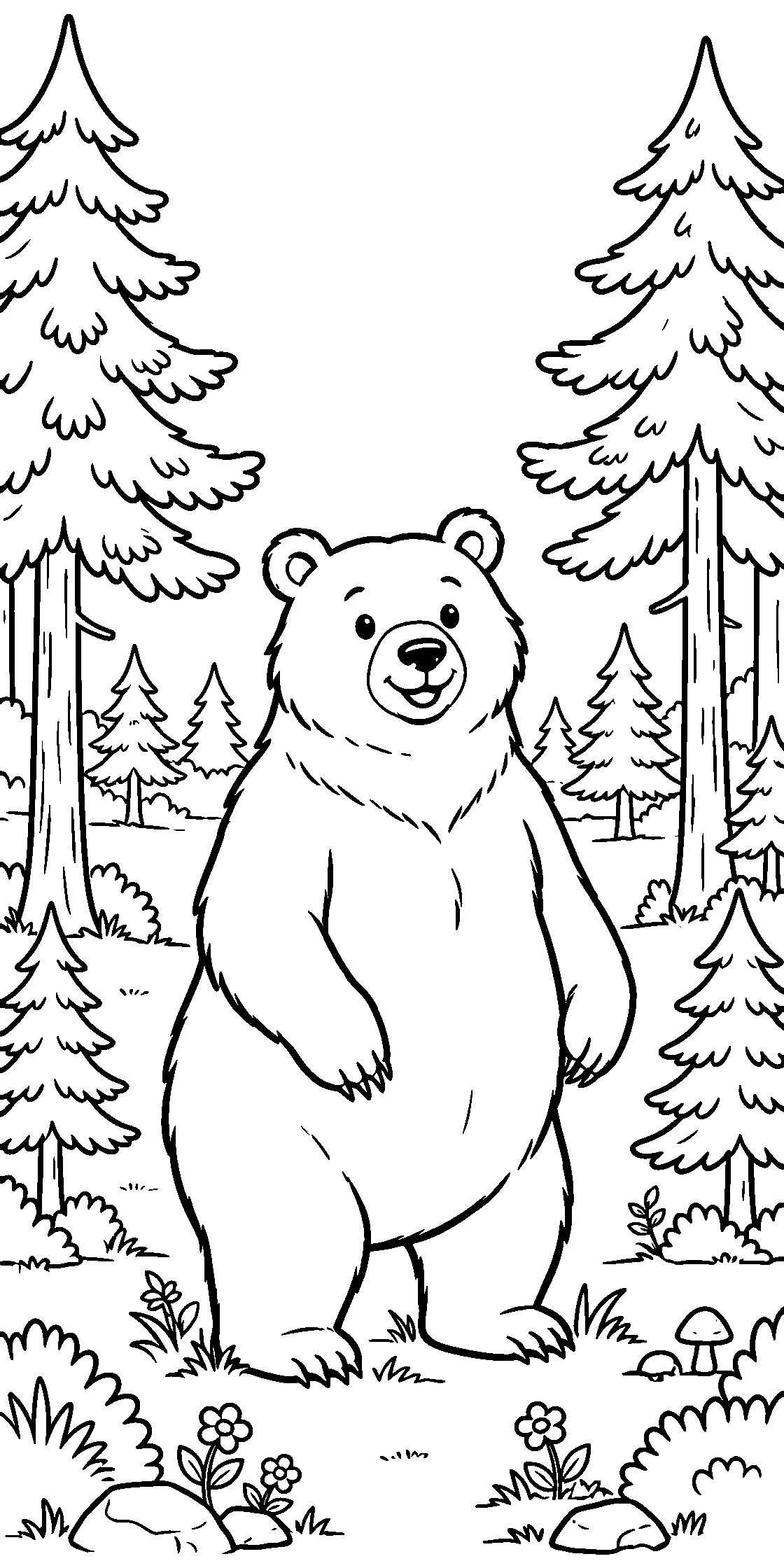
A big brown bear stands in a forest clearing with pine trees, ferns and a fallen log behind it.
Colouring tip: Colour the bear a warm honey brown with a paler muzzle, then give the pine trees a deep green so the bear stands out against them.
Age: Best for ages 6 to 8.
6. Black Bear Climbing a Tall Pine Tree
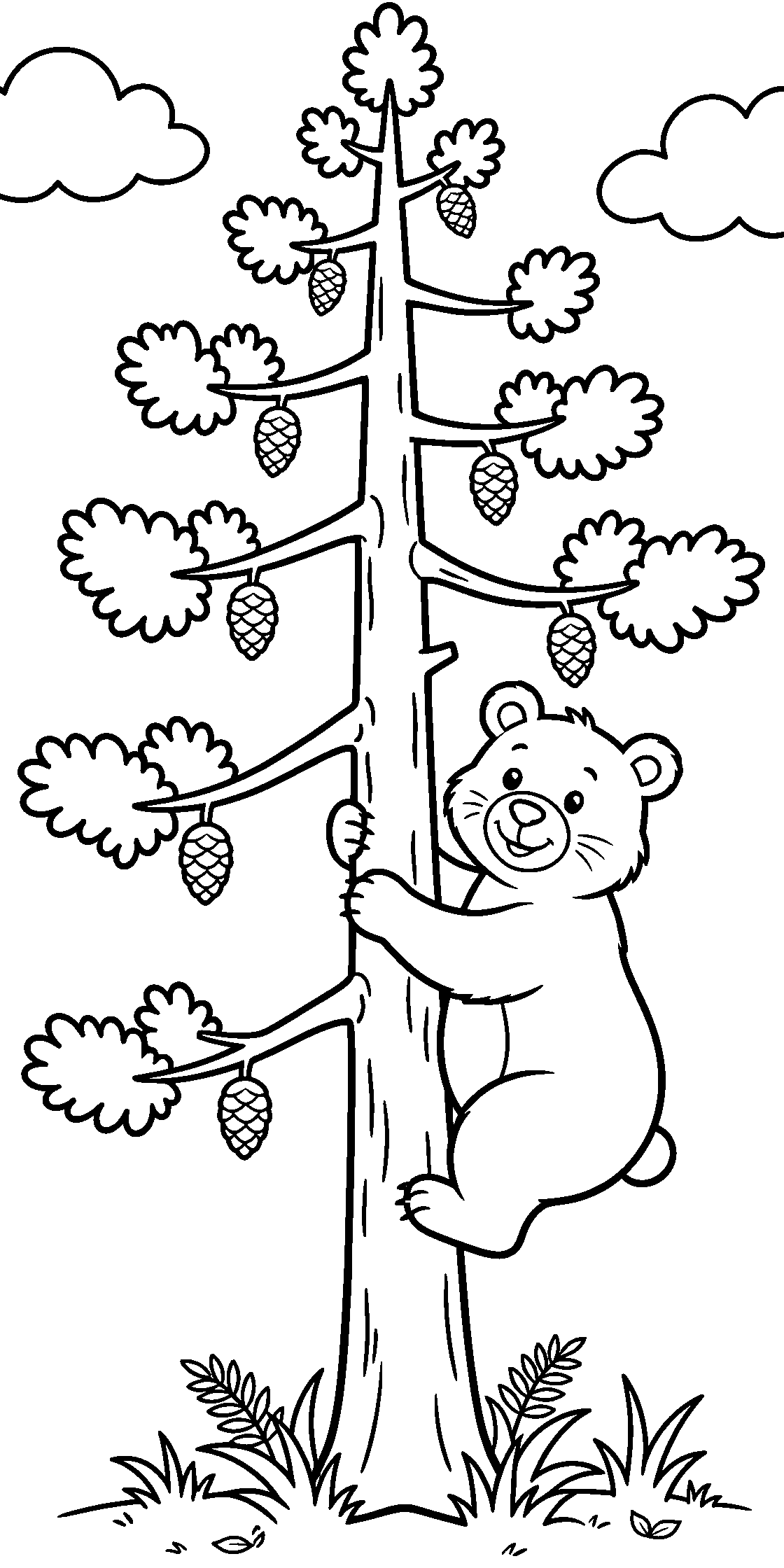
A black bear climbs a tall pine tree, gripping the bark with its claws, with branches and pine cones all around.
Colouring tip: Colour the bear dark brown rather than flat black, because real black bears are often brown, and give the pine cones a warm tan.
Age: Best for ages 9 to 12.
8. Mama Bear Walking with Two Cubs
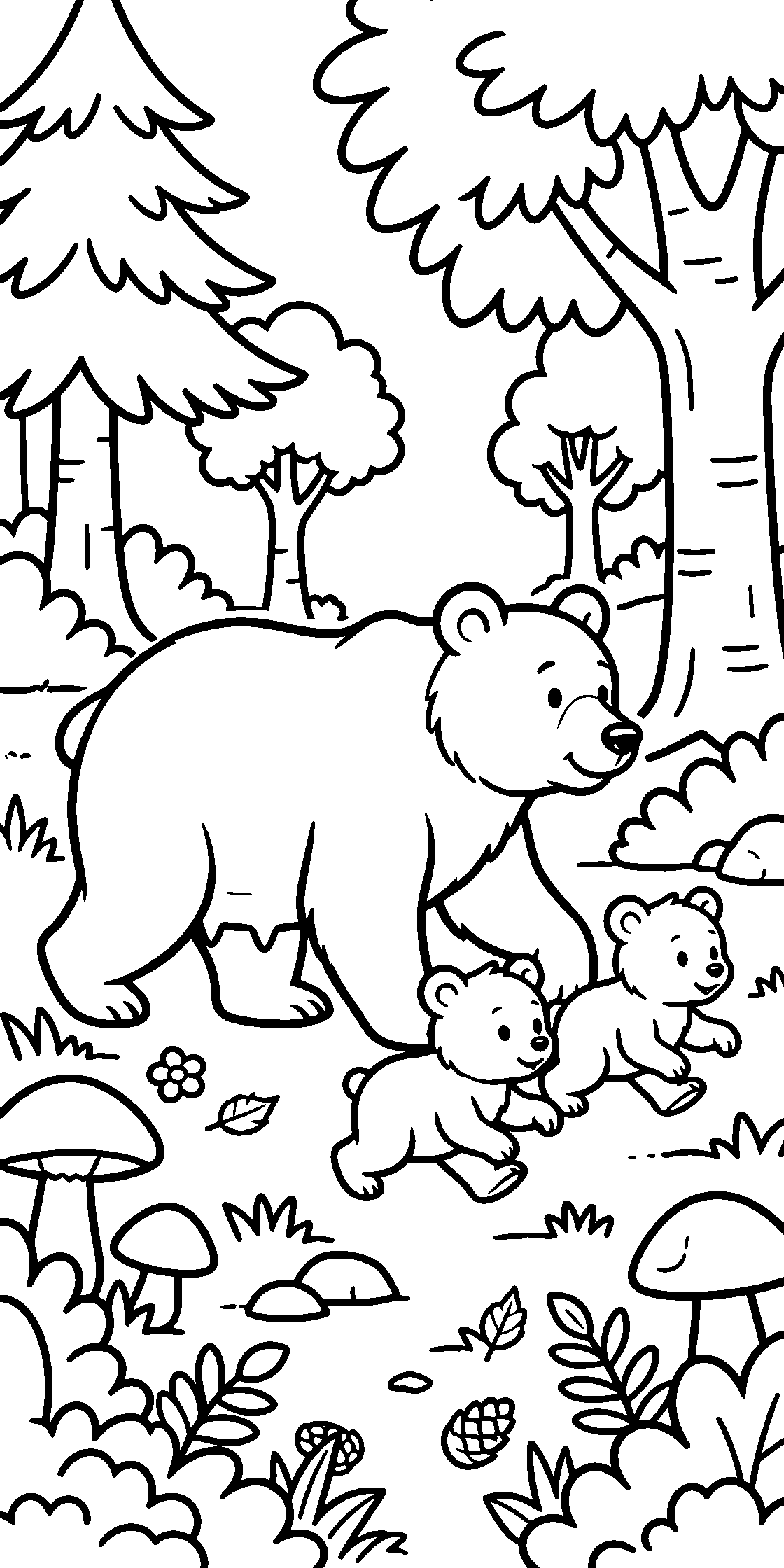
A mama bear walks through the forest with two small cubs close behind her, past ferns and wildflowers.
Colouring tip: Colour the mama bear a darker brown and the cubs a lighter honey shade, so the family looks like one group with three different coats.
Age: Best for ages 6 to 8.
14. Bear Eating Berries from a Bush
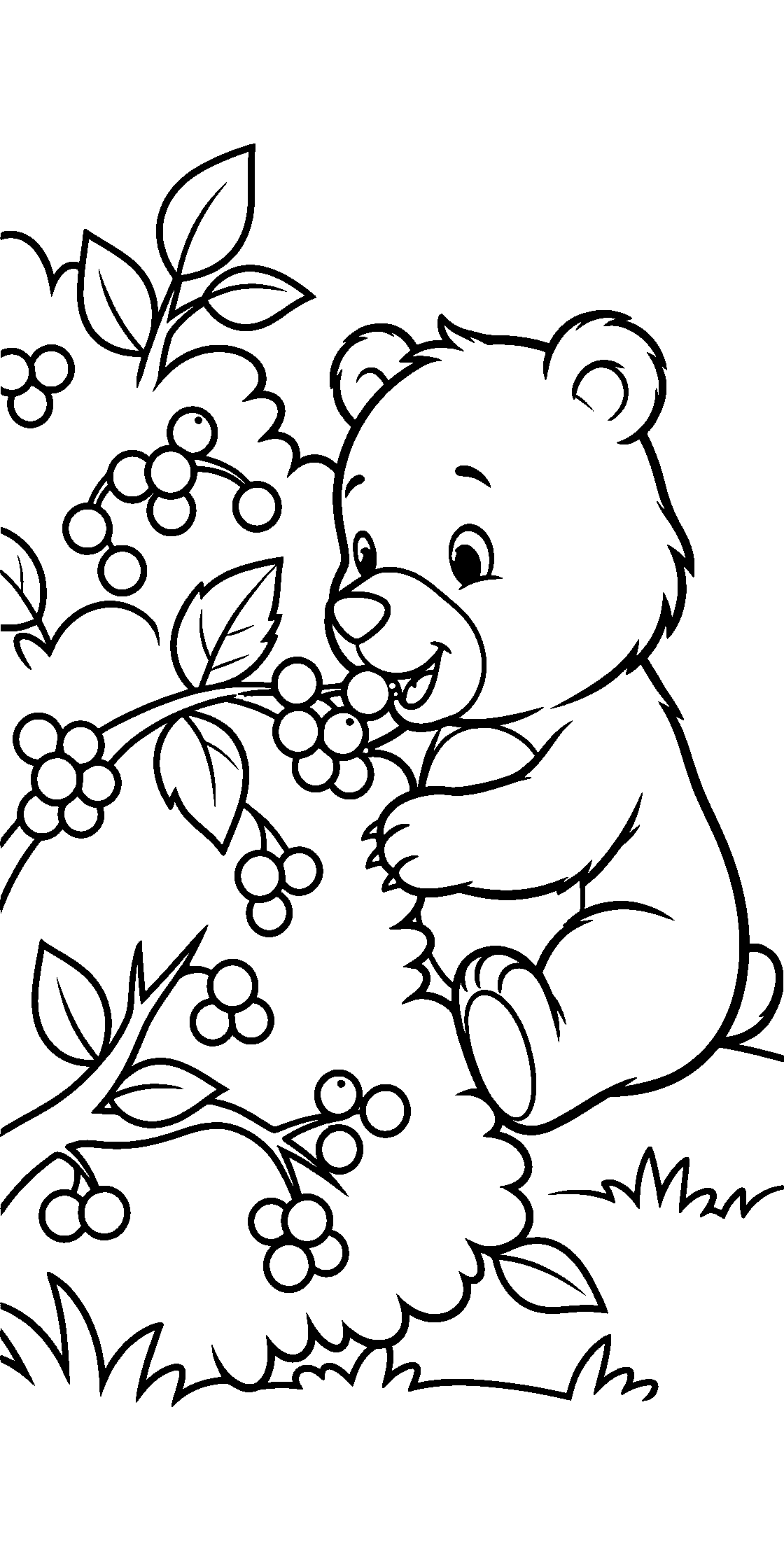
A bear pulls down a branch of a berry bush and eats the round berries, with leaves and fallen berries on the ground.
Colouring tip: Colour the berries a deep purple blue and the leaves two shades of green, then leave the bear’s muzzle pale so the berries show up against it.
Age: Best for ages 6 to 8.
19. Bear Cub Hugging a Tree Trunk
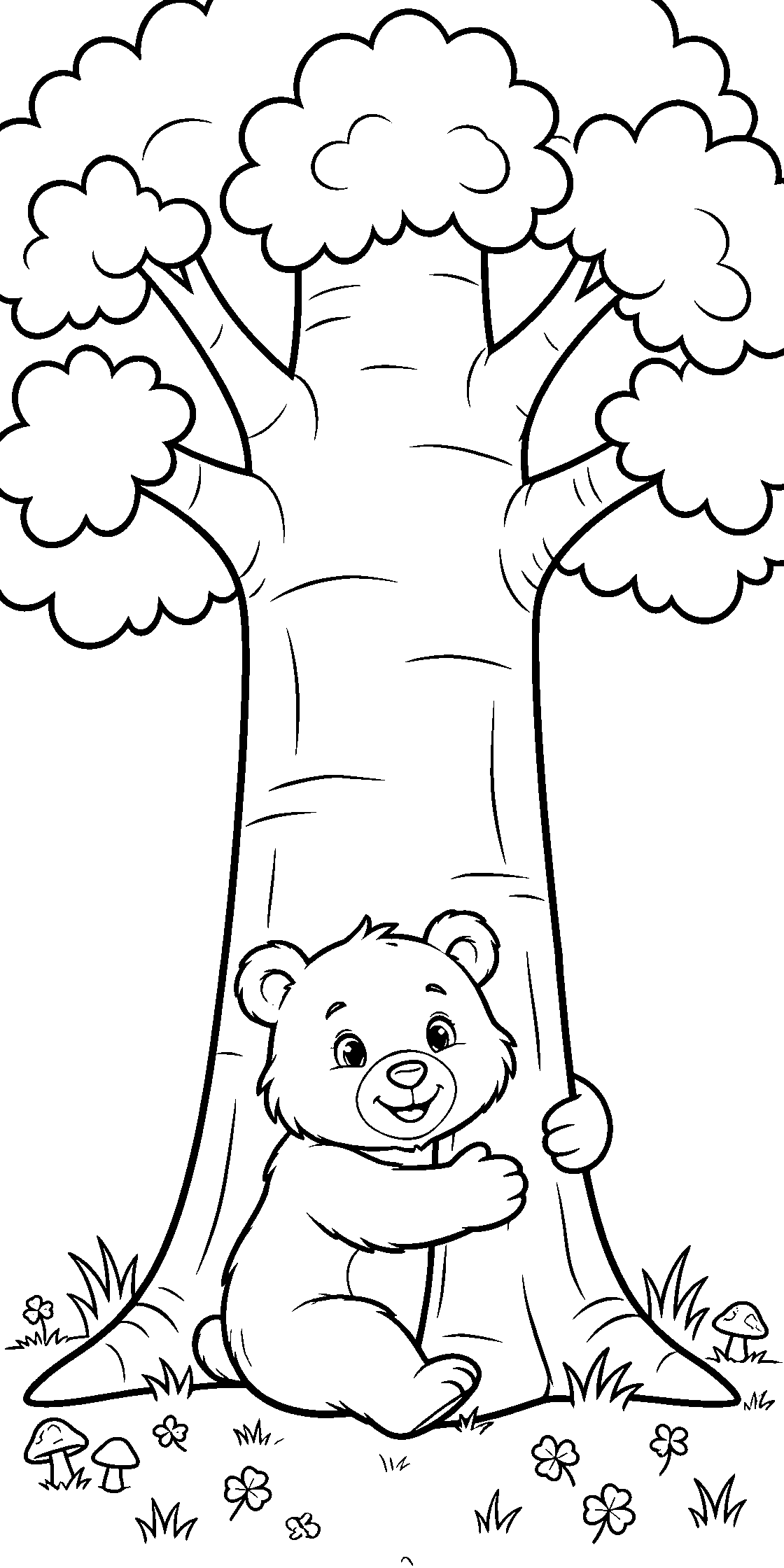
A little bear cub hugs the trunk of a big tree with both paws, looking up at the branches above.
Colouring tip: Colour the cub a soft golden brown and the tree bark a grey brown, then add a few green leaves at the top for a small pop of colour.
Age: Best for ages 3 to 5.
34. Bear Cub Peeking from Behind a Tree
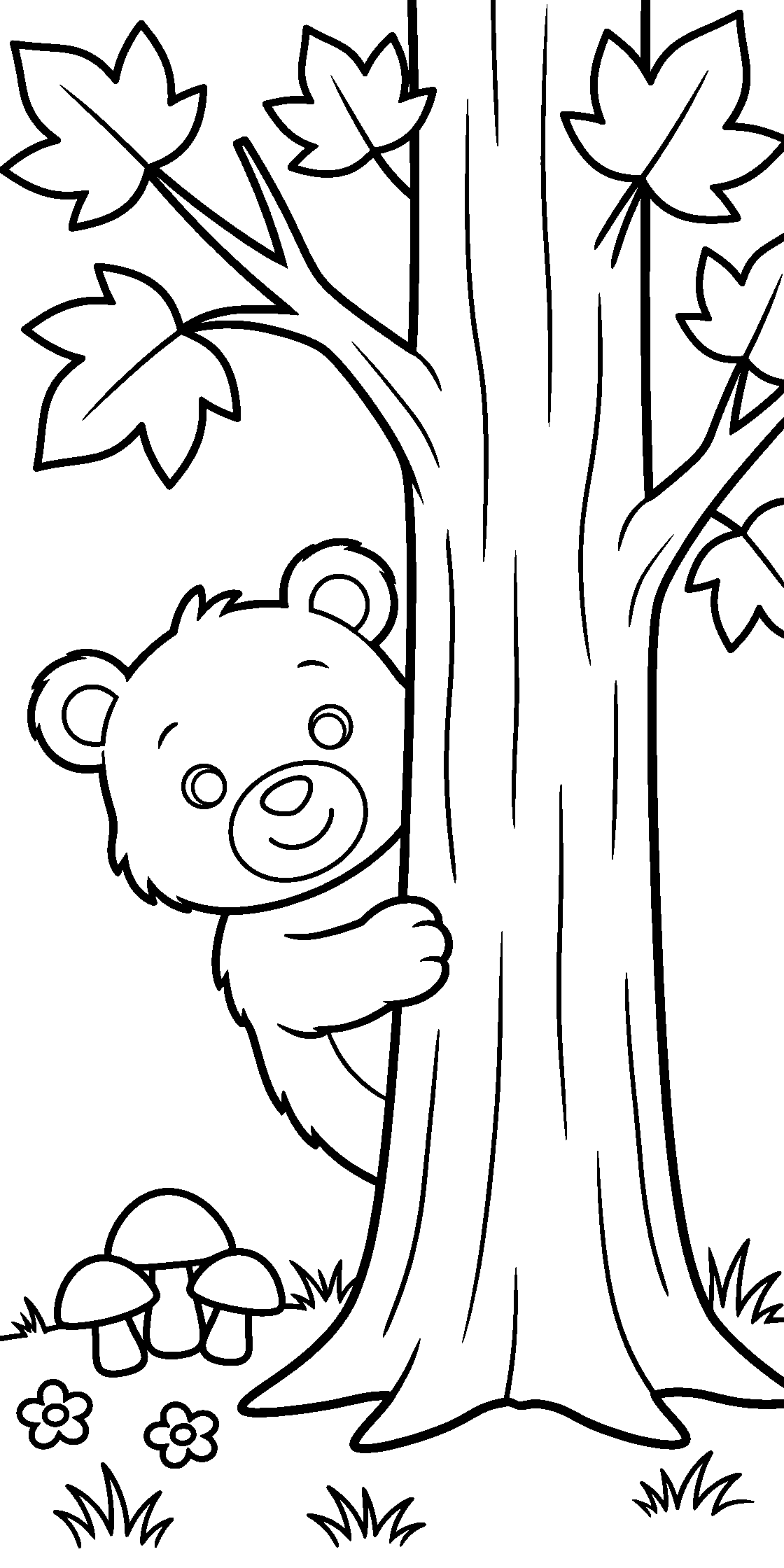
A shy bear cub peeks out from behind a wide tree trunk, with only its face and one paw showing.
Colouring tip: Colour the cub’s face a pale honey and its nose dark brown, and leave the tree trunk a plain wood brown so the cub’s face is the first thing you see.
Age: Best for ages 6 to 8.
38. Bear Family Crossing a Wooden Bridge
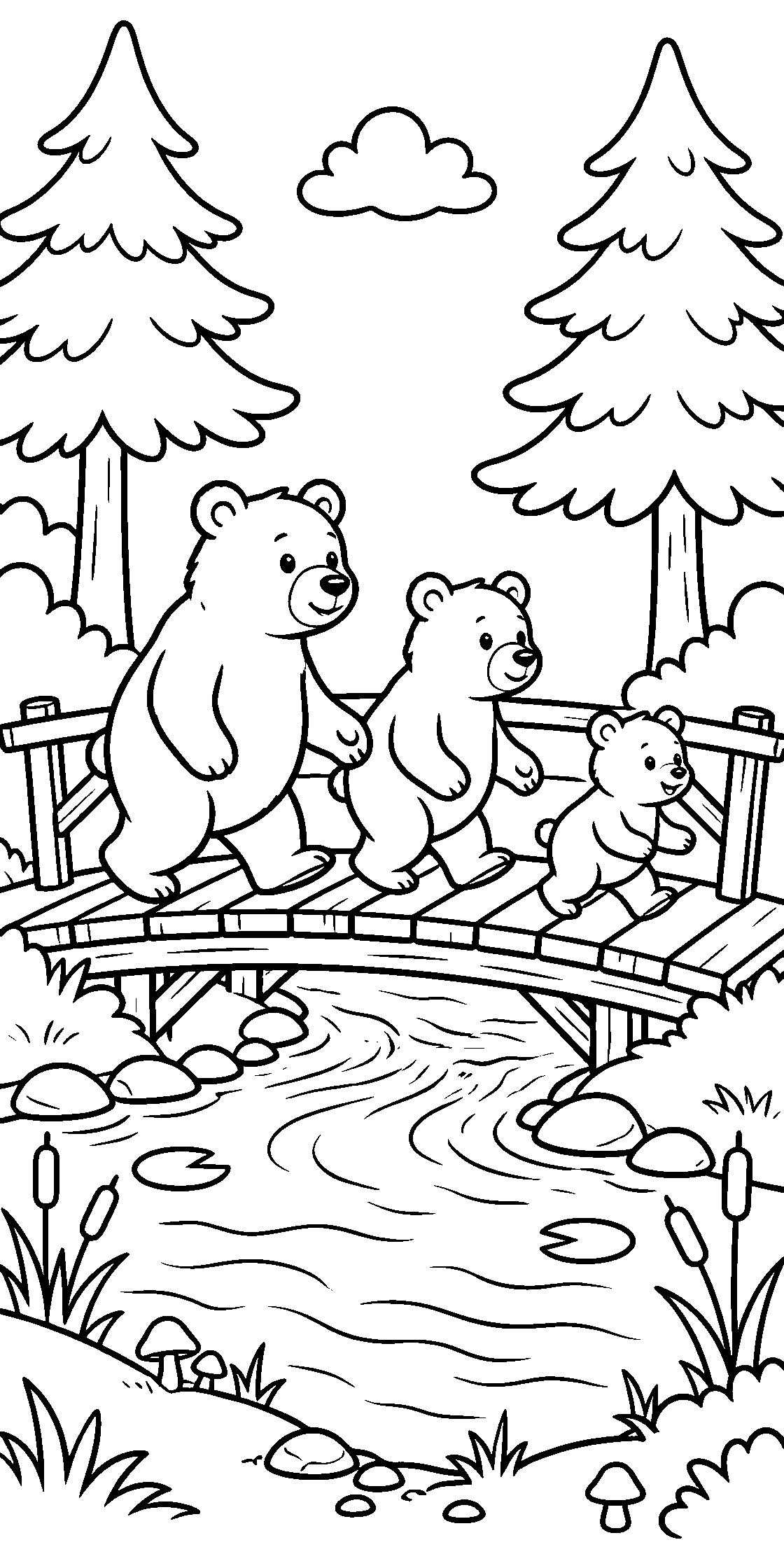
A mama bear and two cubs cross a small wooden bridge over a stream, with reeds and stones along the banks.
Colouring tip: Colour the bridge planks a warm wood brown and the stream a pale blue, then give each bear a slightly different shade of brown.
Age: Best for ages 6 to 8.
44. Bear Family in a Forest Clearing at Sunset
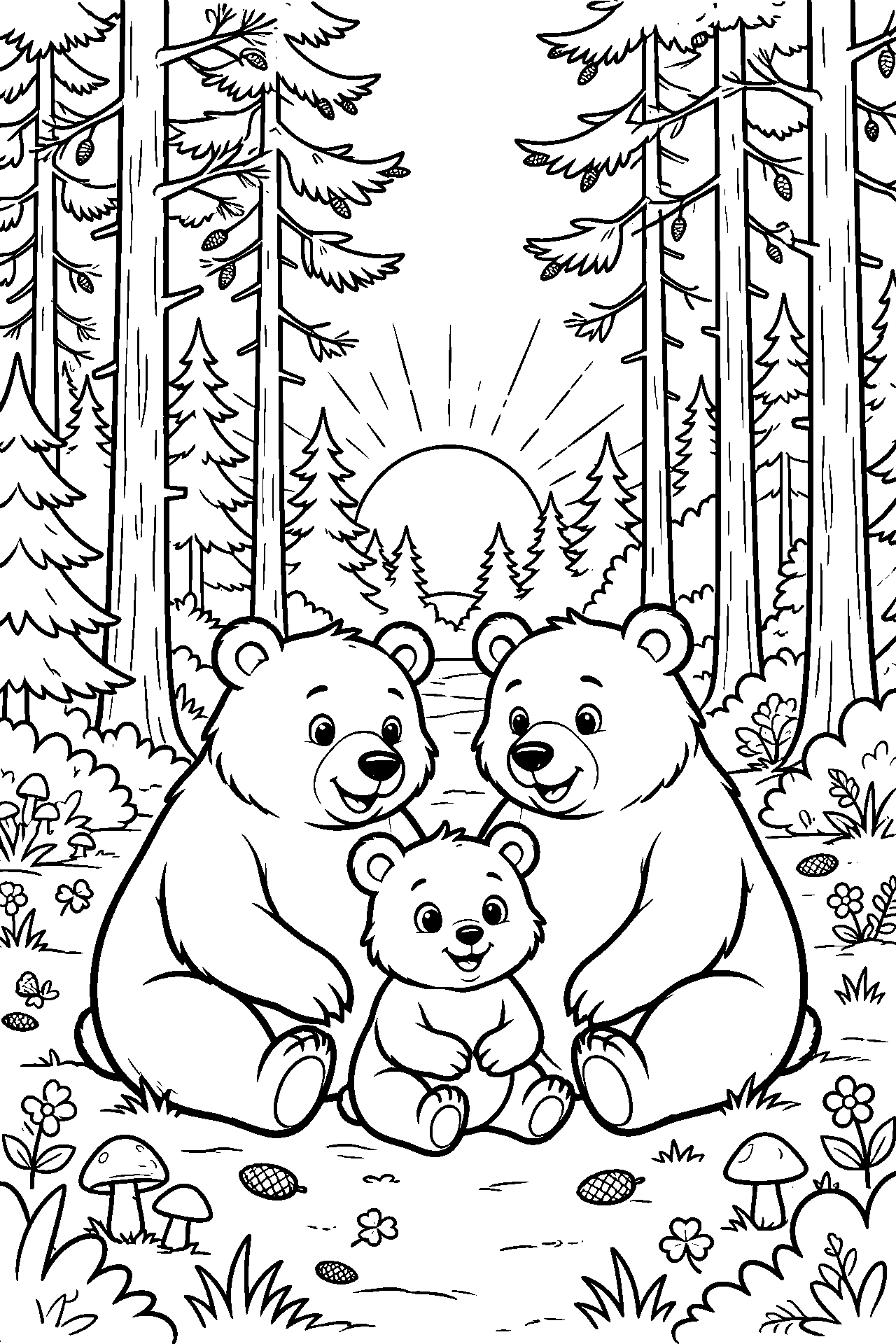
A whole bear family rests in a forest clearing at sunset, with tall trees, long shadows and a low golden sun.
Colouring tip: Keep this sunset scene for last, because the sky, the trees and the whole bear family give you the most to colour. Give the sky a soft orange, the trees a deep green, and each bear its own brown, dark for the father, warm for the mother and pale for the cubs.
Age: Best for ages 9 to 12.
Polar Bears and Pandas from Far Away
Seven pictures travel far from the forest, to the Arctic ice and the bamboo mountains of China. These bears live in places where most children will never go, and that is what makes them worth colouring slowly. The polar bear hunts on ice that floats on the sea, and the panda spends its whole day eating a plant that gives it almost no energy at all.
Both of them are bears, and the far away pictures in these bear coloring pages show how different one family can look.
3. Polar Bear on an Ice Floe
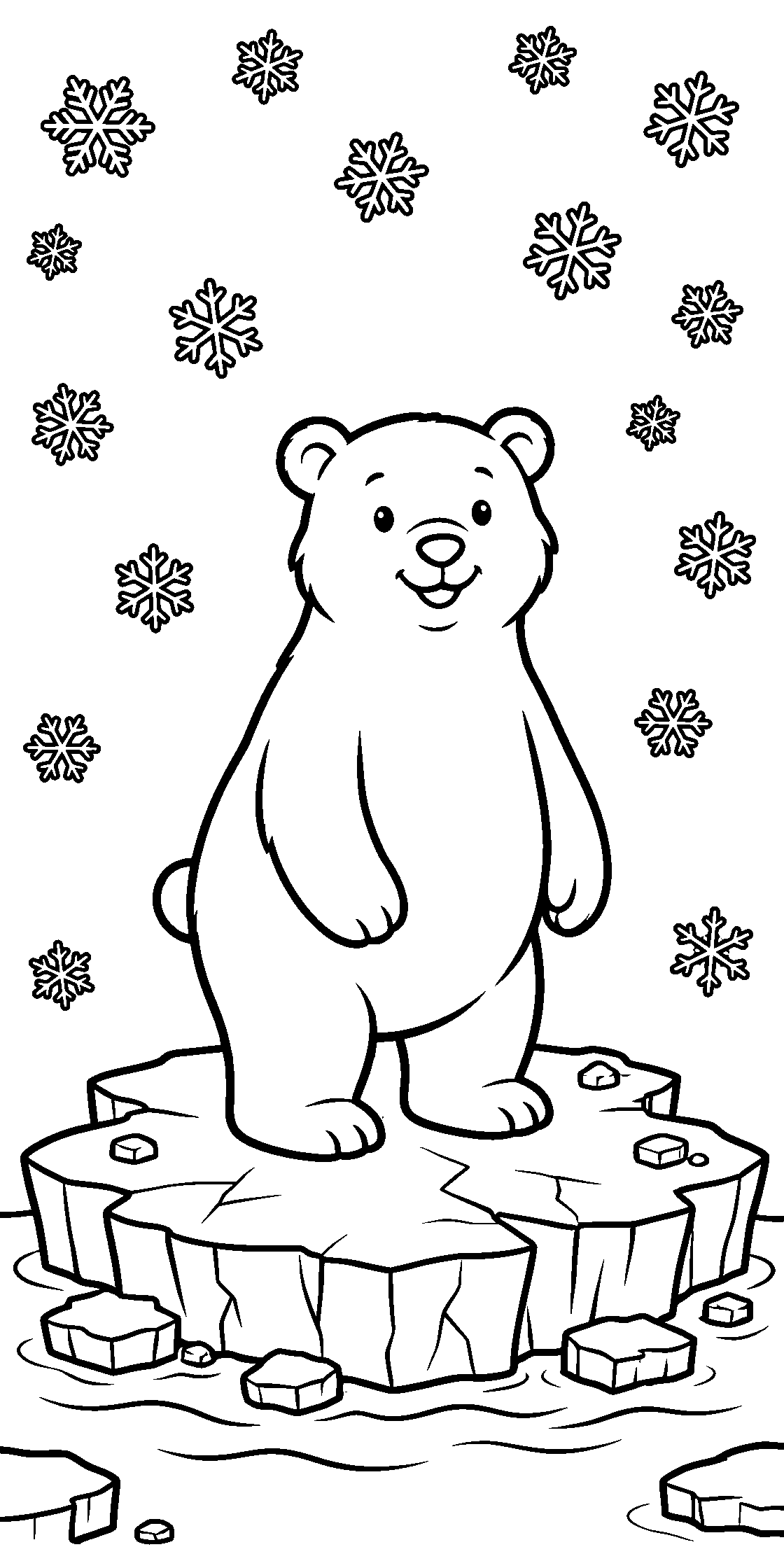
A polar bear stands on a drifting ice floe with snowflakes falling, ice cliffs and open water behind it.
Colouring tip: Colour the bear a creamy white with a touch of pale blue in the shadows, and the ice floe a pale blue grey, so the white bear still shows up against the ice.
Age: Best for ages 6 to 8.
4. Giant Panda Eating Bamboo
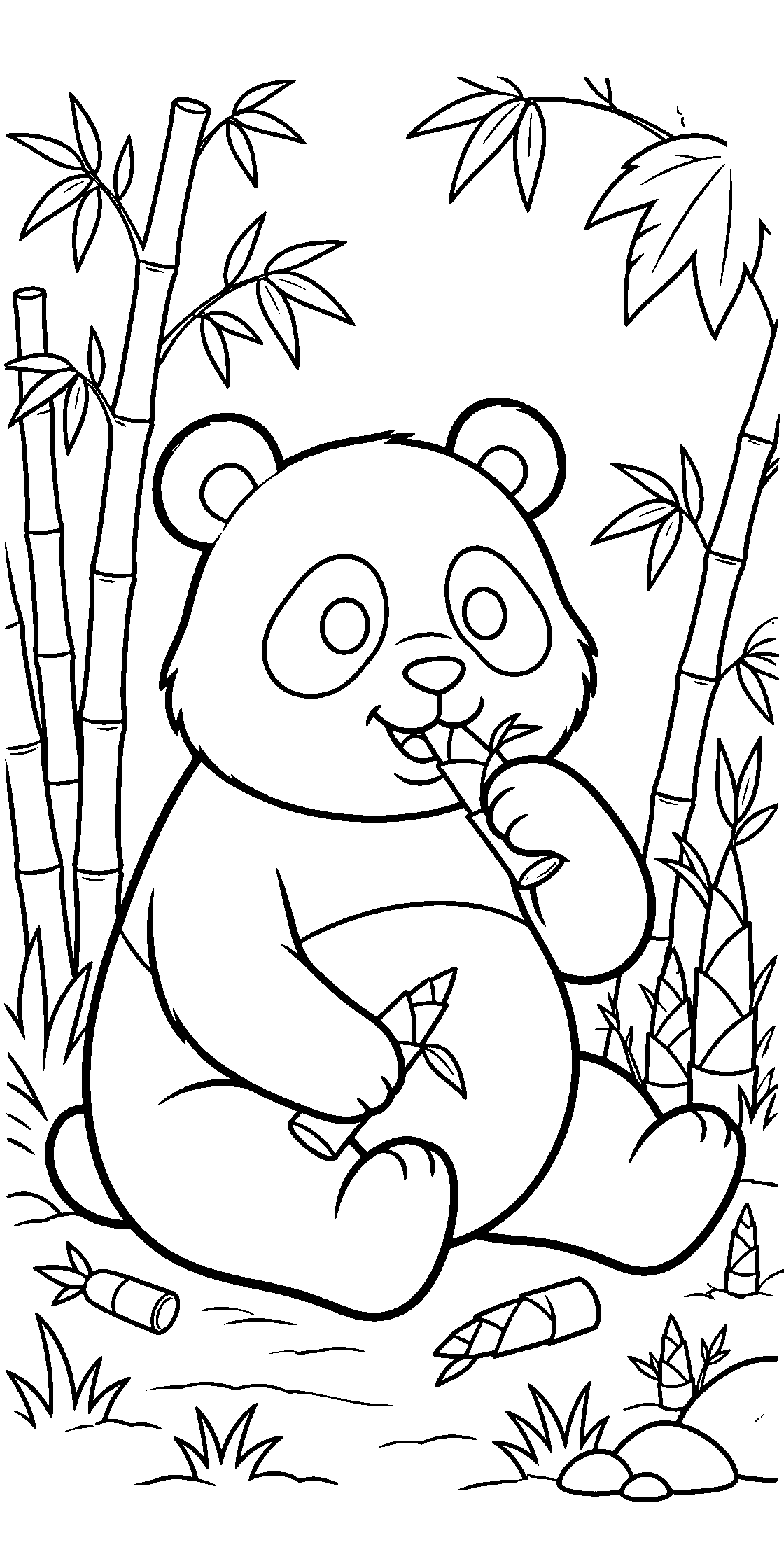
A giant panda sits and eats bamboo shoots, holding the stalks in its paws, with tall bamboo stems all around.
Colouring tip: Leave the panda’s face and belly white and colour the ears, shoulders and legs black, then give the bamboo a fresh green with tan lines where the stalks join.
Age: Best for ages 6 to 8.
12. Bear Wearing a Scarf in Falling Snow
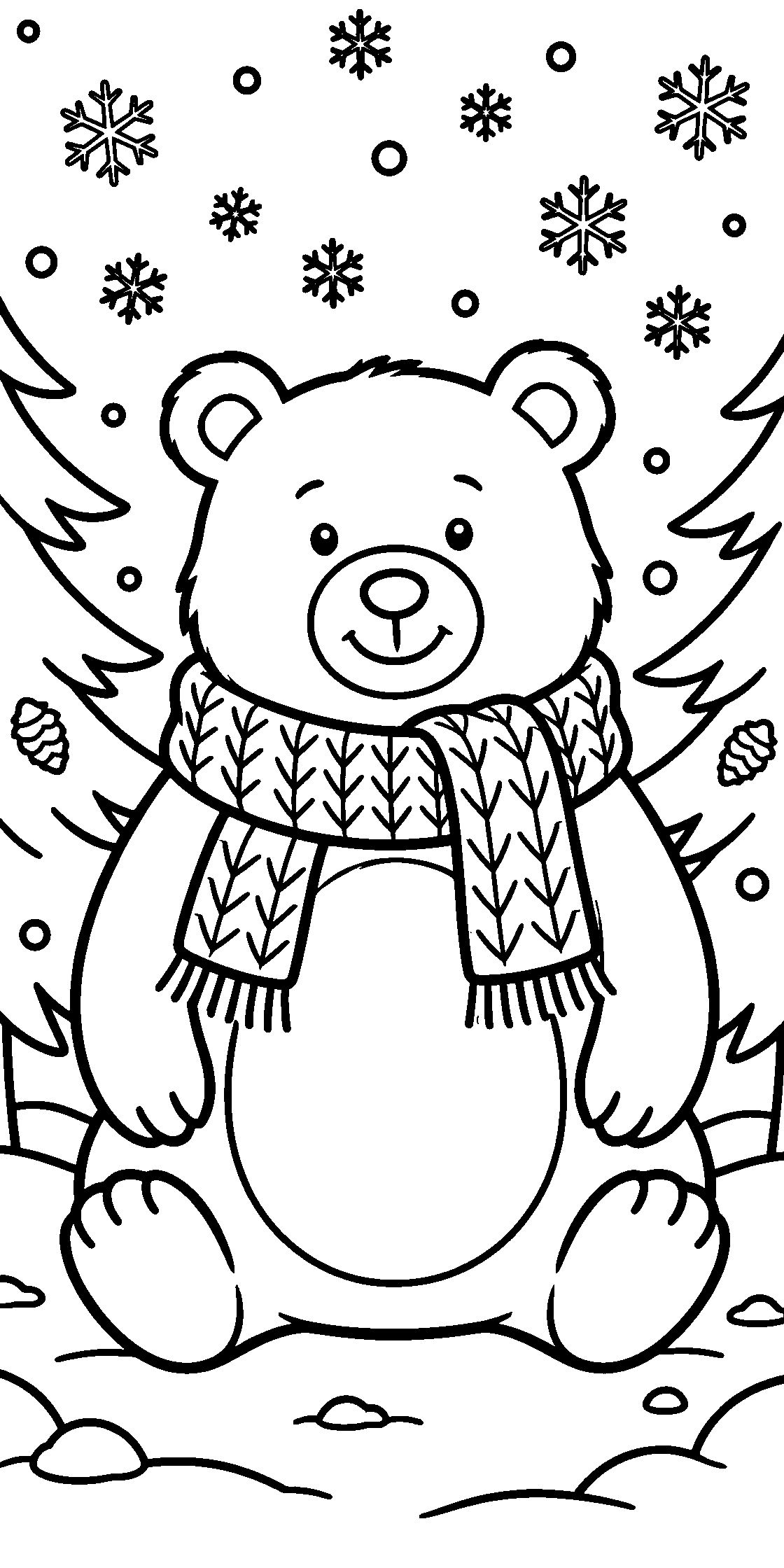
A bear wearing a knitted scarf stands in falling snow, with snowflakes, pine trees and a snowy hill around it.
Colouring tip: Colour the scarf red with white stripes, and the bear a pale cream, so the scarf is the brightest thing on the page.
Age: Best for ages 6 to 8.
20. Polar Bear Cub Sliding on Ice
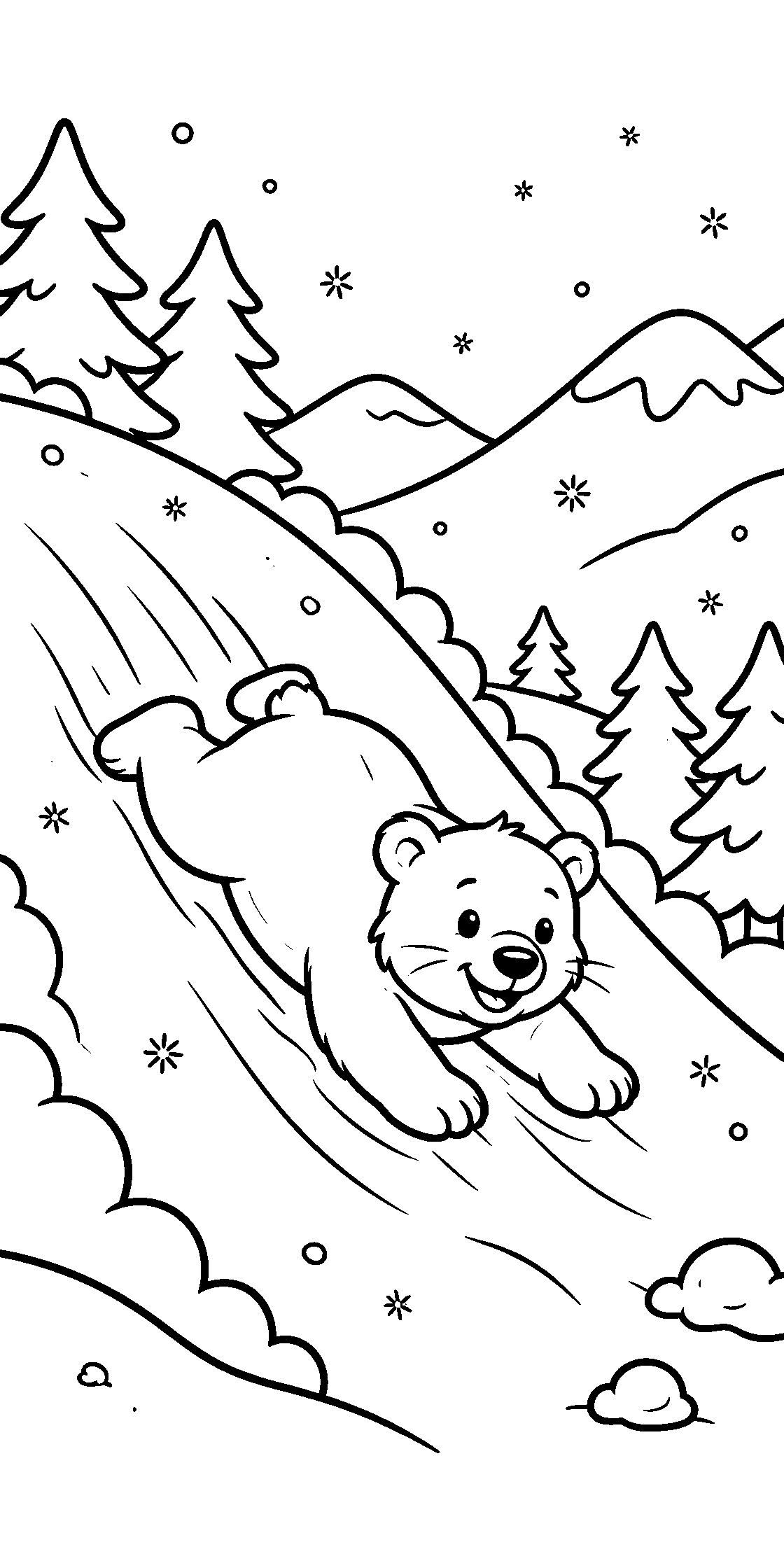
A polar bear cub slides down a snowy slope on its tummy, kicking up snow, with an iceberg behind it.
Colouring tip: Colour the cub a soft white and the snow a very pale blue, then add a darker blue for the iceberg so the cub does not disappear into the snow.
Age: Best for ages 6 to 8.
21. Panda Cub Rolling Down a Grassy Hill
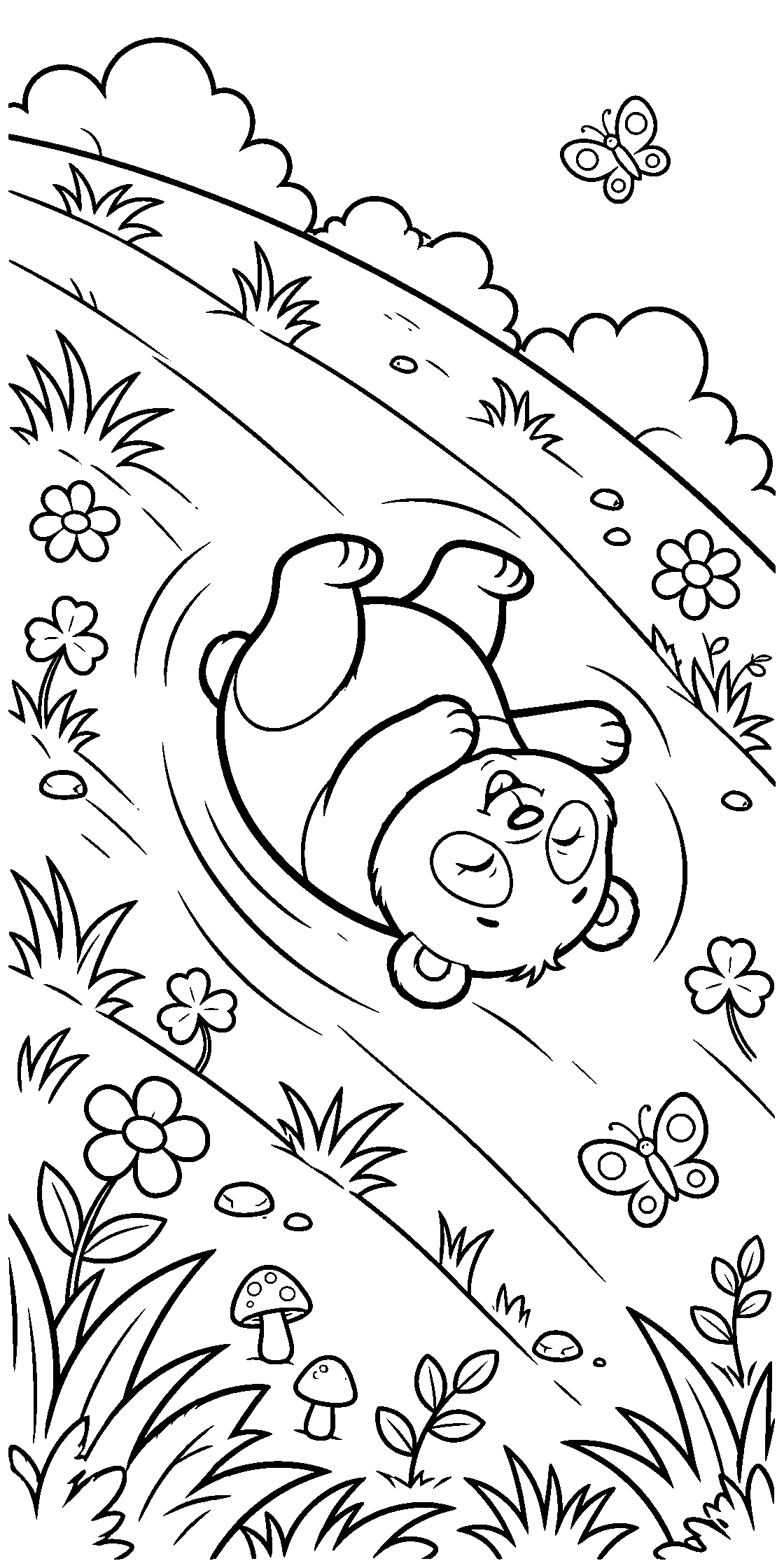
A panda cub rolls down a grassy hill, tumbling head over heels, with bamboo and wildflowers at the bottom.
Colouring tip: Colour the cub’s black patches first, ears, shoulders and legs, then fill the grass a bright green so the black and white cub pops out.
Age: Best for ages 6 to 8.
27. Bear Cub Building a Snowman
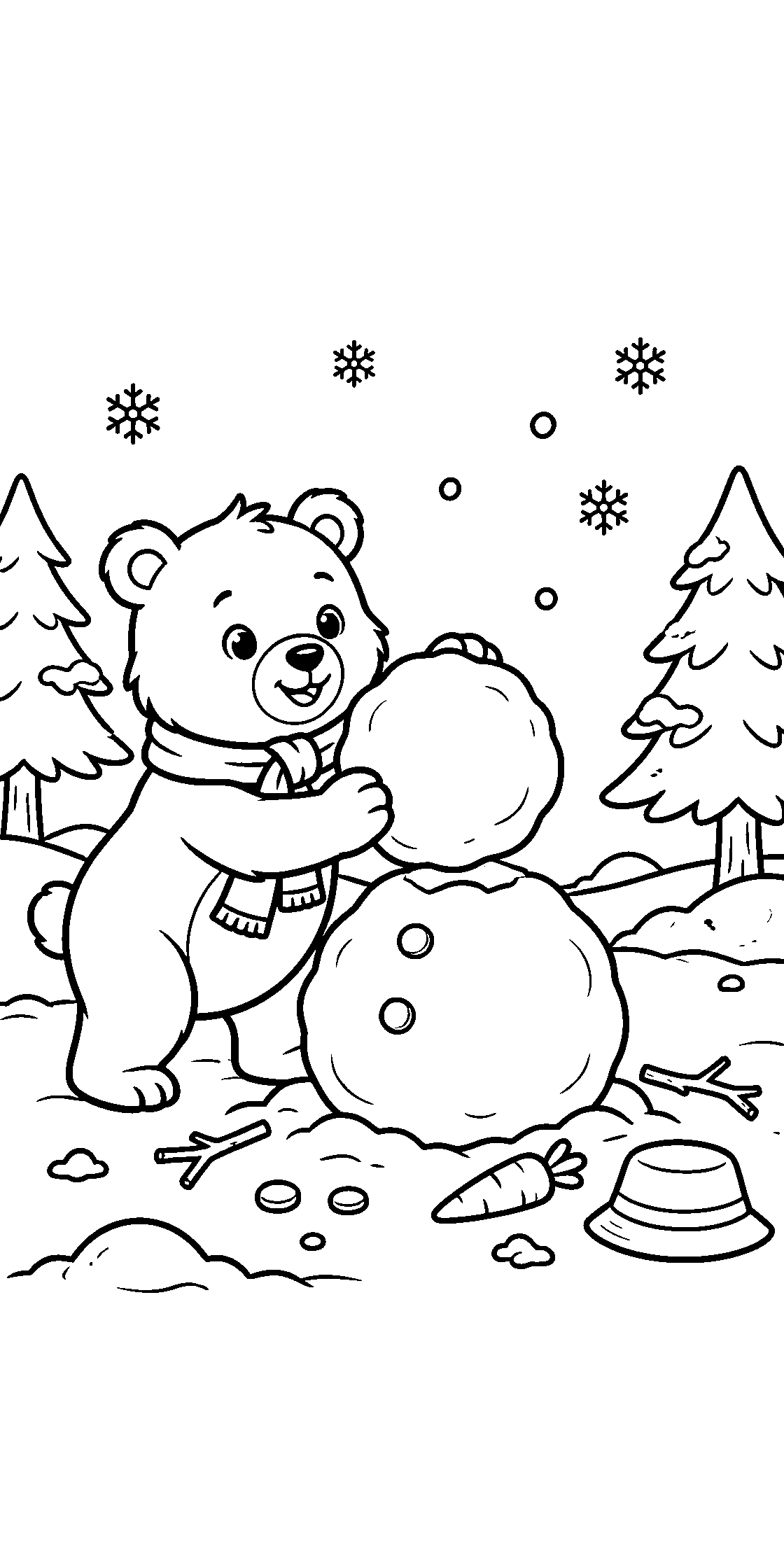
A bear cub pats snow onto a round snowman, with a carrot, a scarf and snowflakes all around.
Colouring tip: Colour the cub a warm brown and the snowman white with a bright orange carrot nose, then give the scarf the same red as the cub’s cheeks.
Age: Best for ages 6 to 8.
32. Bear Catching Snowflakes on Its Tongue
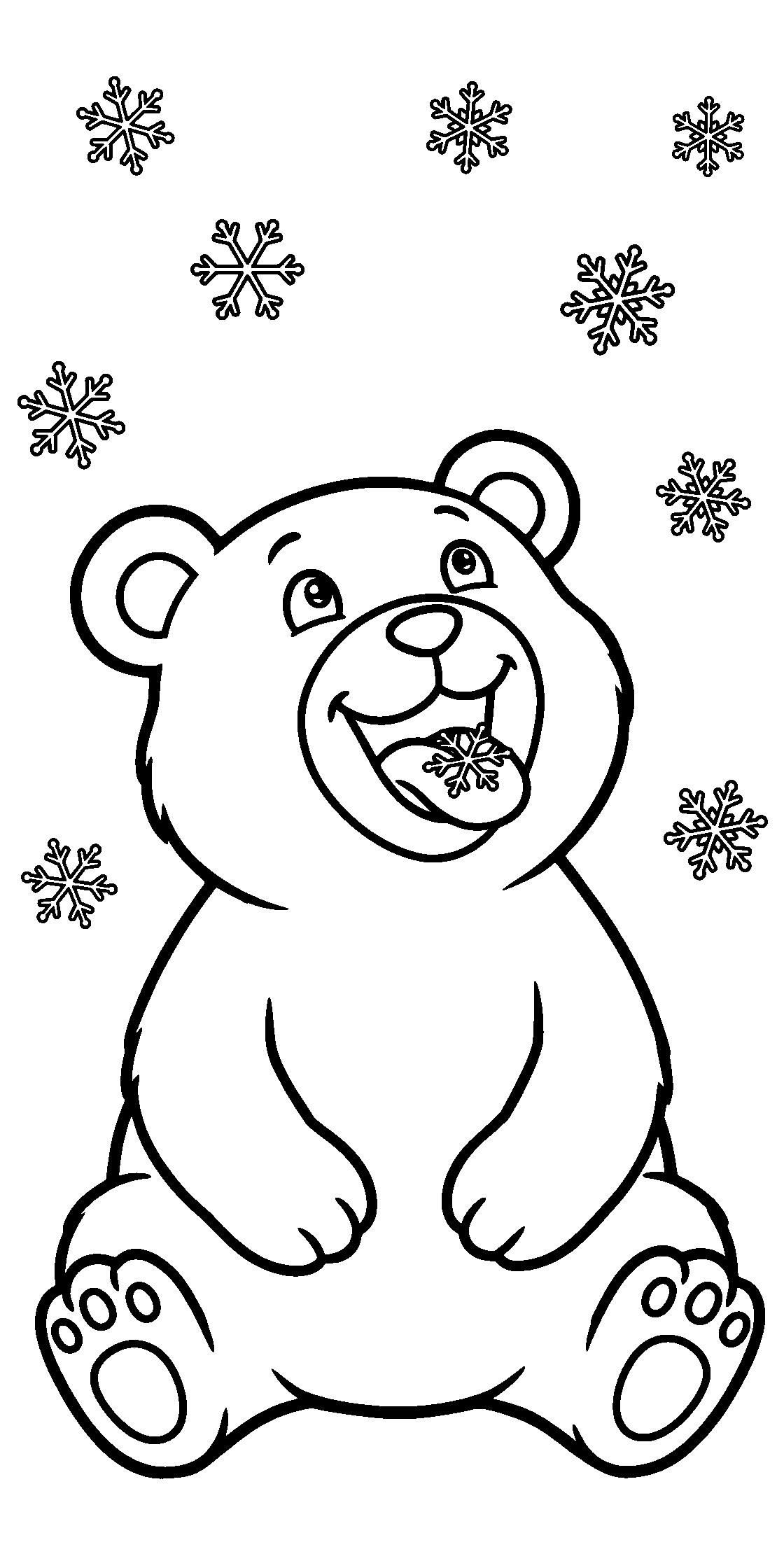
A bear stands with its head back and its tongue out, catching snowflakes, with pine trees and a snowy ground around it.
Colouring tip: Colour the bear a pale honey brown and the snowflakes white with a light blue outline, so the flakes show up against the sky.
Age: Best for ages 6 to 8.
Honey, Salmon and Berry Season
Eight pictures gather round the table, or what passes for a table when you are a bear. Honey, salmon, berries and a picnic basket all appear here, because food is what fills a bear’s day. A panda eats bamboo for most of its waking hours.
A grizzly waits at a waterfall for salmon to leap, and a black bear can spend a whole afternoon in a berry bush.
The food pictures in these bear coloring pages follow a bear through a whole day of eating. These bear coloring pages are the tastiest ones in the set, and the honey pictures are the sweetest of all.
2. Baby Bear Cub with a Honey Pot
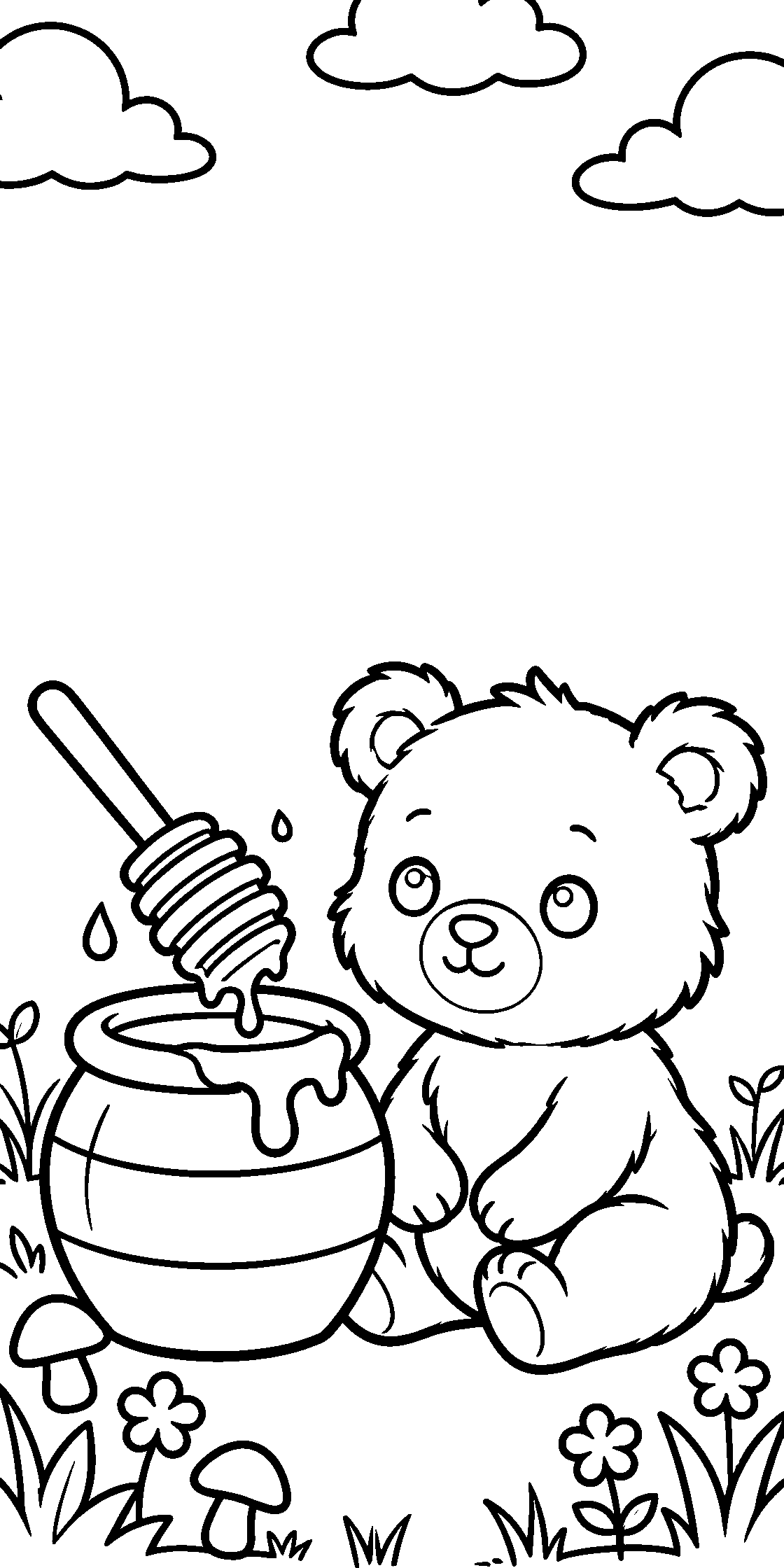
A baby bear cub sits beside a big honey pot with a honey dipper, a drip of honey on its nose and a bee flying past.
Colouring tip: Colour the honey a golden amber and the cub a soft honey brown, then give the bee yellow stripes with black, so the little bee is easy to spot.
Age: Best for ages 3 to 5.
5. Grizzly Bear Catching a Salmon
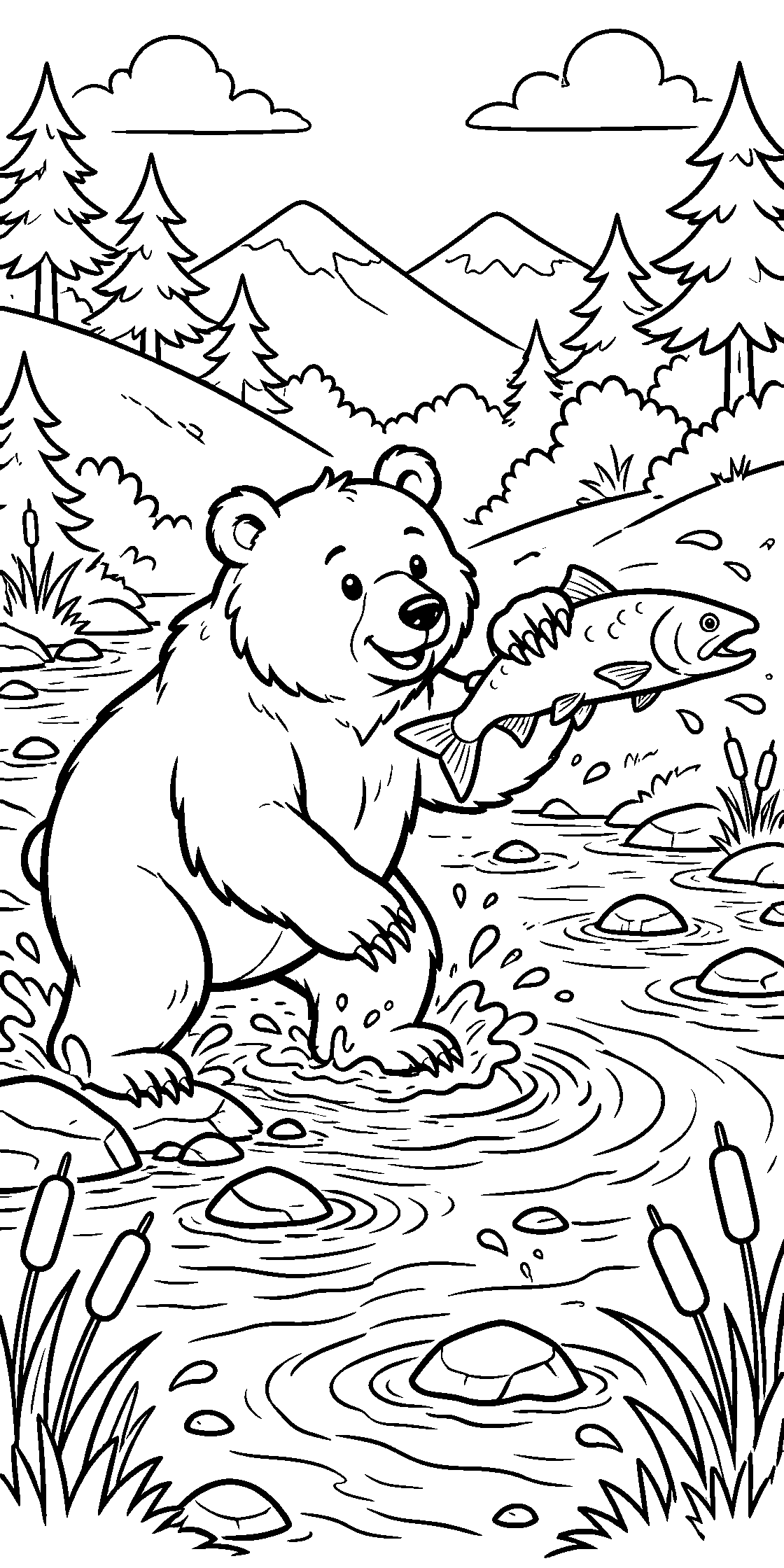
A grizzly bear catches a leaping salmon in a river at the foot of a waterfall, with mountains and pine trees behind.
Colouring tip: Colour the grizzly a dark chestnut brown with a paler hump, and the salmon a bright orange pink, so the fish is the brightest thing in the water.
Age: Best for ages 9 to 12.
13. Bear Fishing with a Fishing Rod
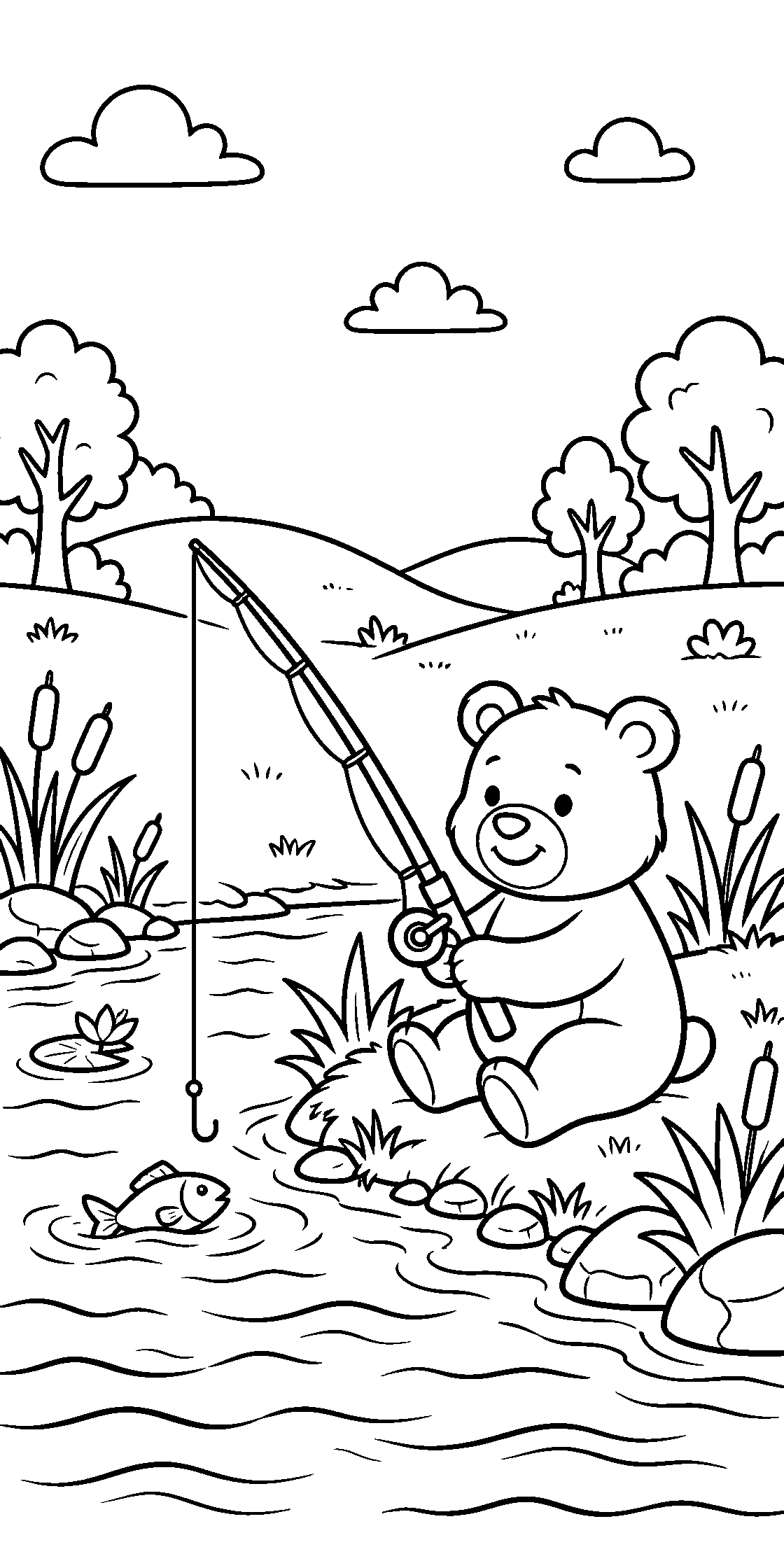
A bear sits on a riverbank holding a fishing rod, with a bucket, reeds and a fish jumping in the water.
Colouring tip: Colour the bear a warm brown, the water a clear blue, and the fish silver with a pink belly, so the catch stands out in the river.
Age: Best for ages 6 to 8.
16. Bear Family Having a Picnic
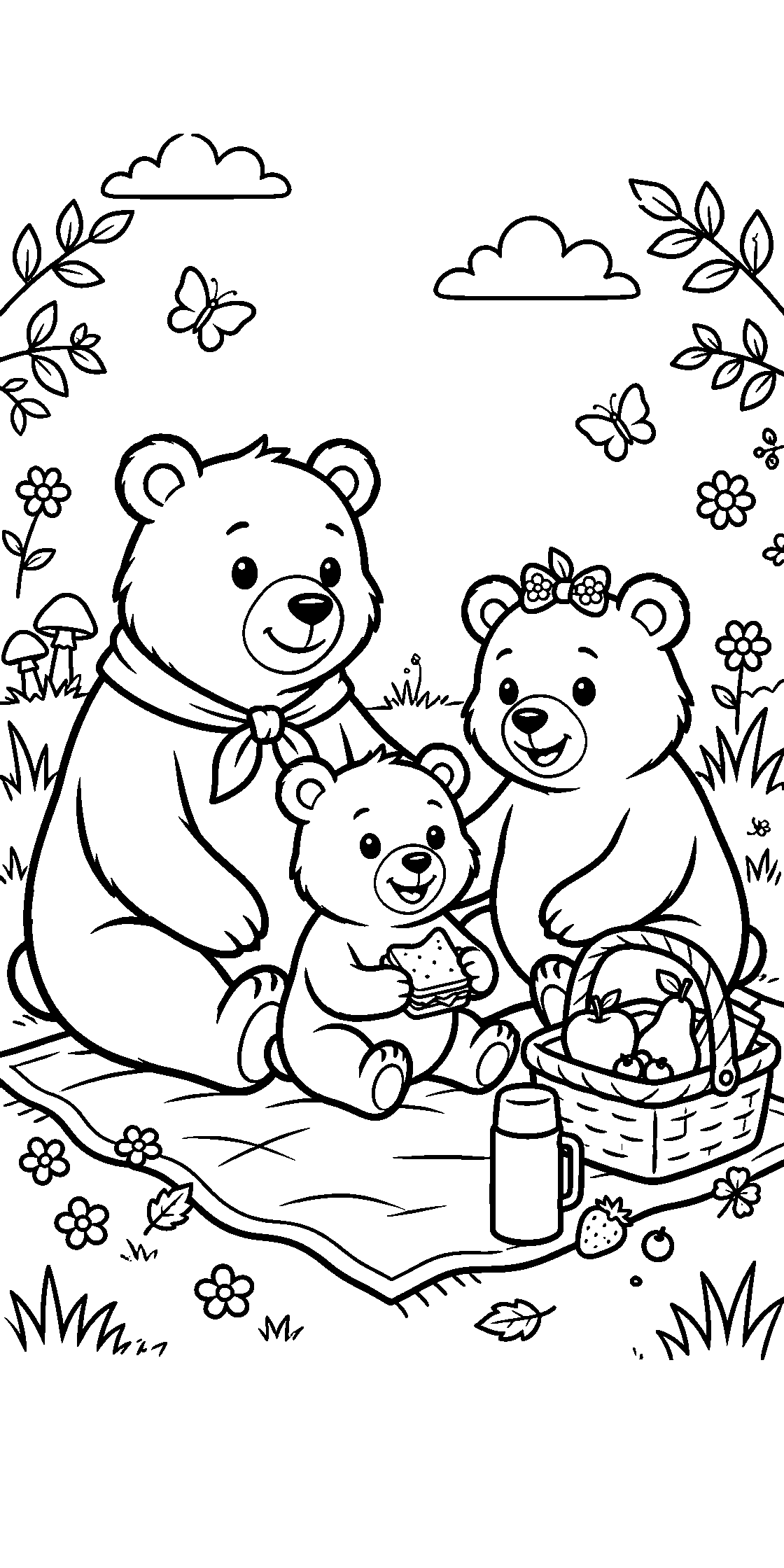
A bear family has a picnic on a checked blanket with a basket, sandwiches, fruit and a honey jar spread out.
Colouring tip: Colour the blanket red and white checks, the basket a warm tan, and give each food its own colour, so the picnic looks ready to eat.
Age: Best for ages 6 to 8.
17. Bear in a Beekeeper Hat by a Beehive
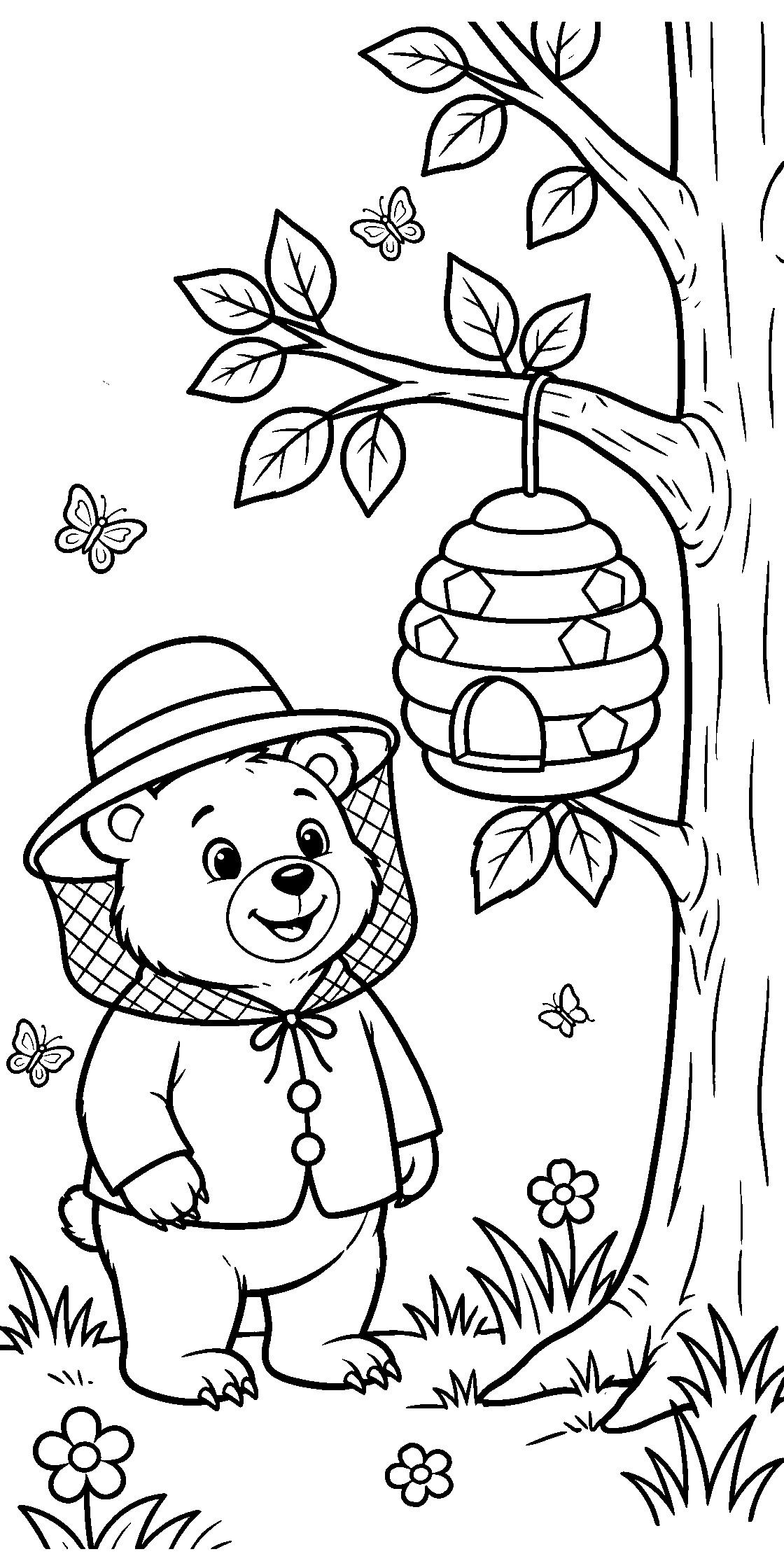
A bear in a beekeeper hat stands next to a beehive hanging from a tree, with bees flying round and flowers below.
Colouring tip: Colour the beehive a golden yellow with brown stripes, the hat a pale cream, and the bees yellow and black, then leave the bear brown so the hive shines.
Age: Best for ages 6 to 8.
18. Bear Splashing in a Pond
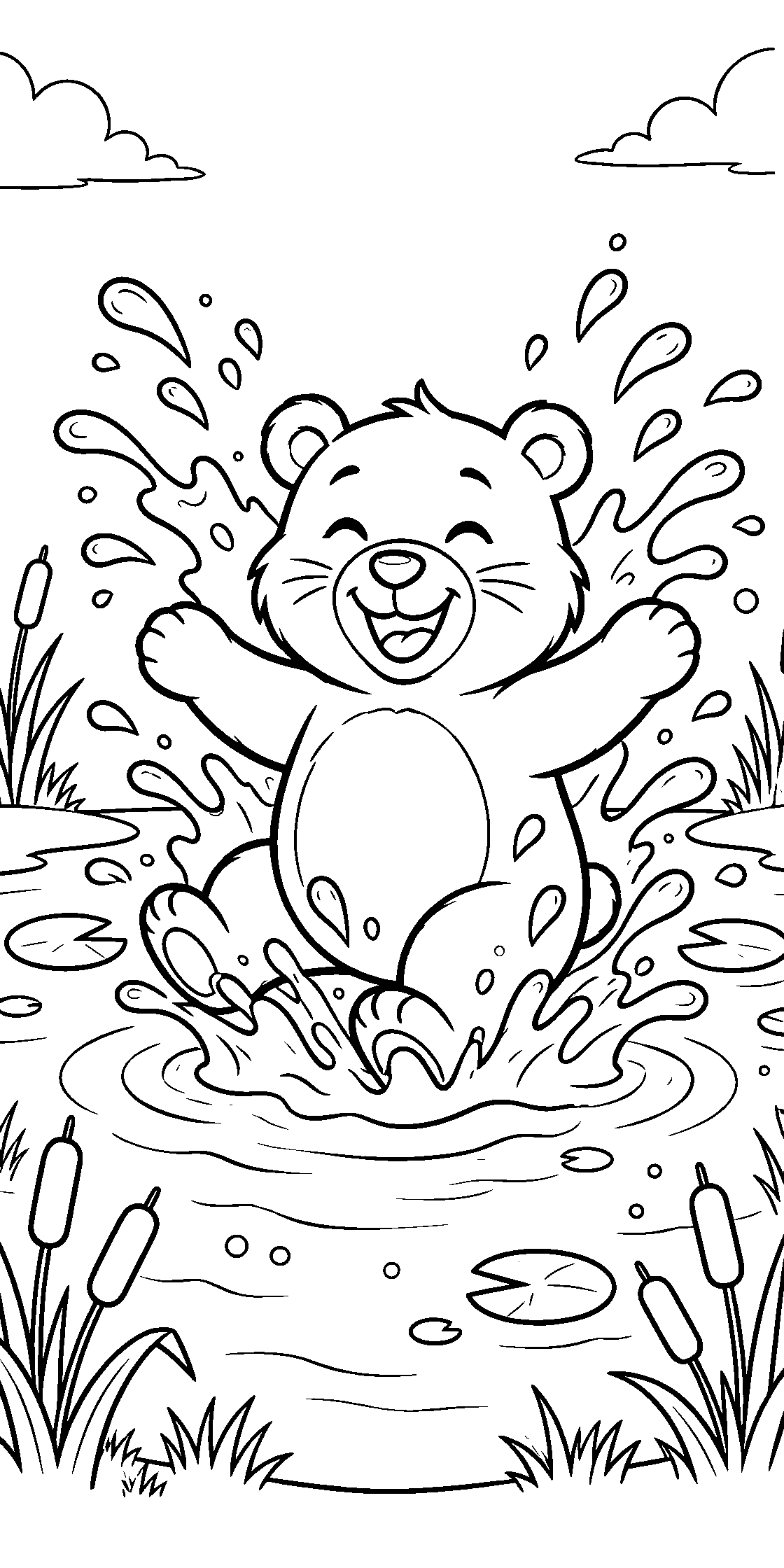
A bear splashes happily in a pond, water drops flying, with reeds, lily pads and a dragonfly around it.
Colouring tip: Colour the water a bright blue with white splashes, and the bear a warm brown, so the bear looks like it is having the best bath of its life.
Age: Best for ages 9 to 12.
33. Bear Reaching Up to a Beehive
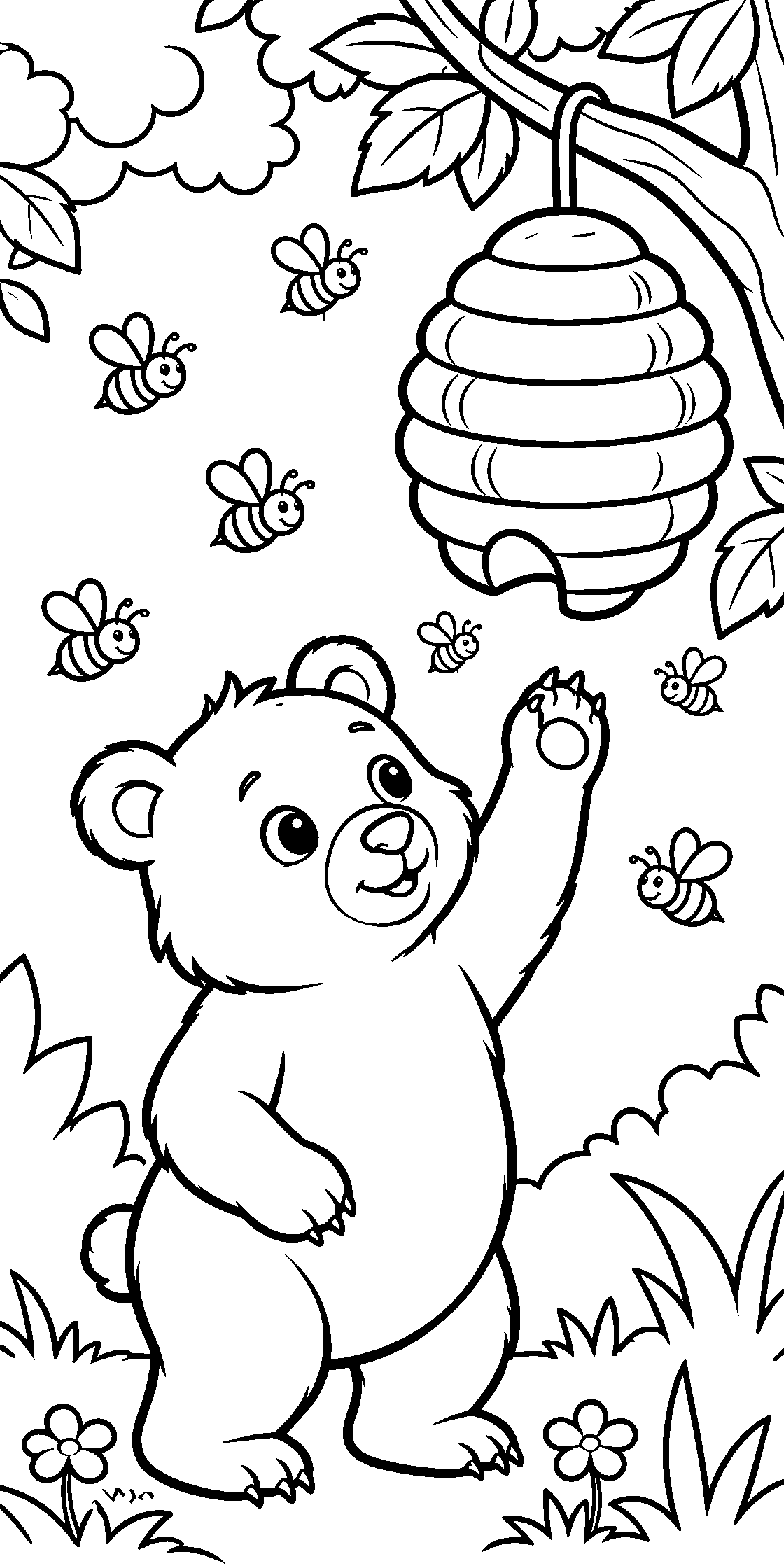
A bear stands on its hind legs reaching up to a beehive, with bees flying round its head and honey dripping down.
Colouring tip: Colour the honey drips a rich amber and the bees yellow and black, then give the bear a darker brown so the golden honey shows up on its paws.
Age: Best for ages 9 to 12.
37. Bear Cub Licking Honey from a Dipper
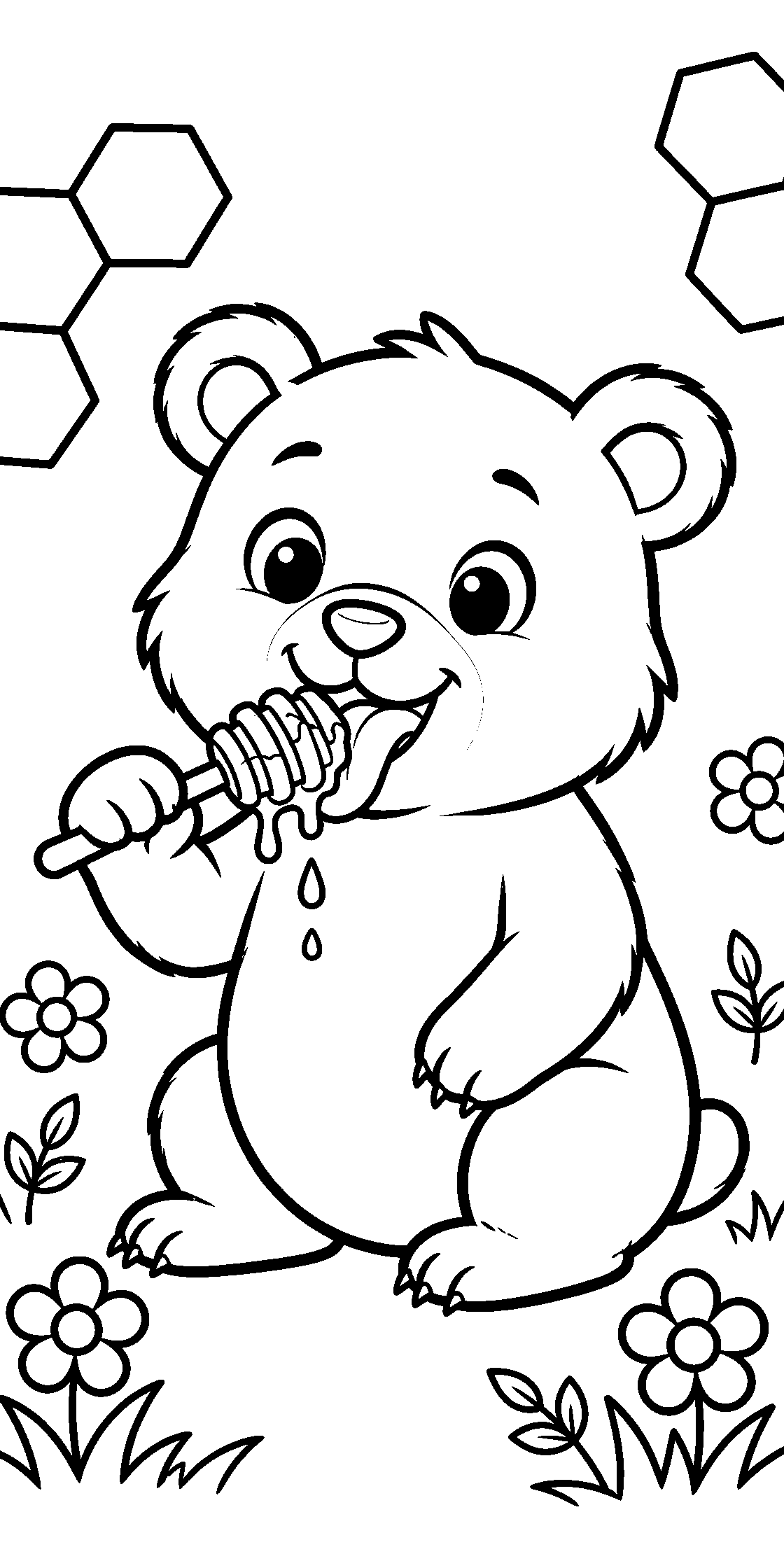
A bear cub licks honey from a wooden honey dipper, with a honey pot, a bee and a flower beside it.
Colouring tip: Colour the honey a bright golden yellow and the cub’s tongue pink, then give the flower a purple petal so the honey looks even sweeter.
Age: Best for ages 3 to 5.
Cubs at Play
Six pictures belong to the cubs, and they are the liveliest in the set. A cub is a young bear, and cubs spend their days the way young animals do: chasing butterflies, rolling down hills, flying kites and getting into trouble with pumpkins. The cub pictures in these bear coloring pages are the ones to start with on a first day of colouring.
The cubs themselves are the easiest to colour, because their shapes are big and round, and a chunky crayon suits them best.
7. Bear Cub Playing with a Butterfly
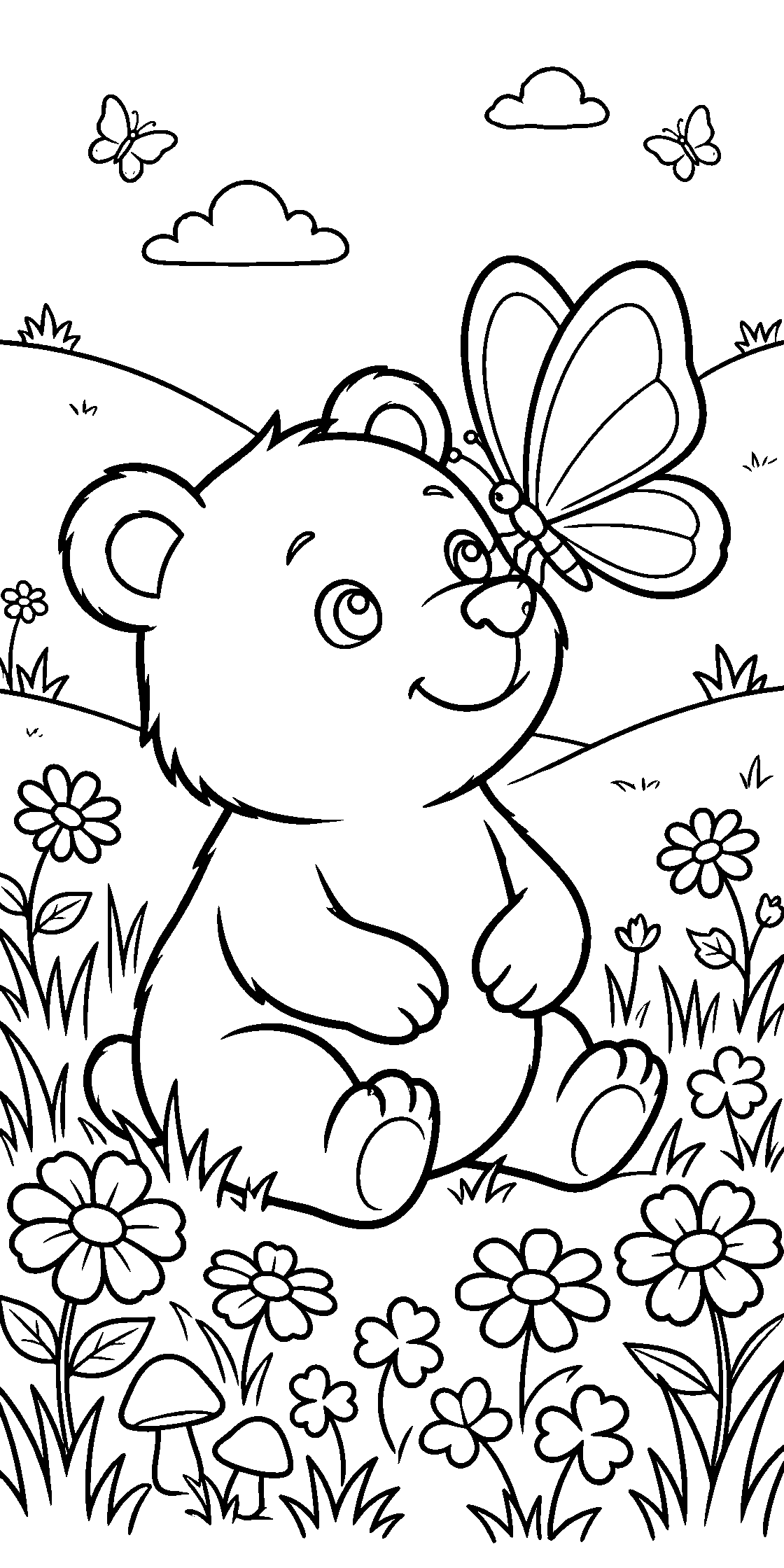
A bear cub sits in a meadow with a butterfly on its nose, flowers and grass all around.
Colouring tip: Colour the butterfly orange with black edges, and the cub a soft honey brown, so the little butterfly is the star of the picture.
Age: Best for ages 3 to 5.
15. Bear Cub in a Flower Meadow
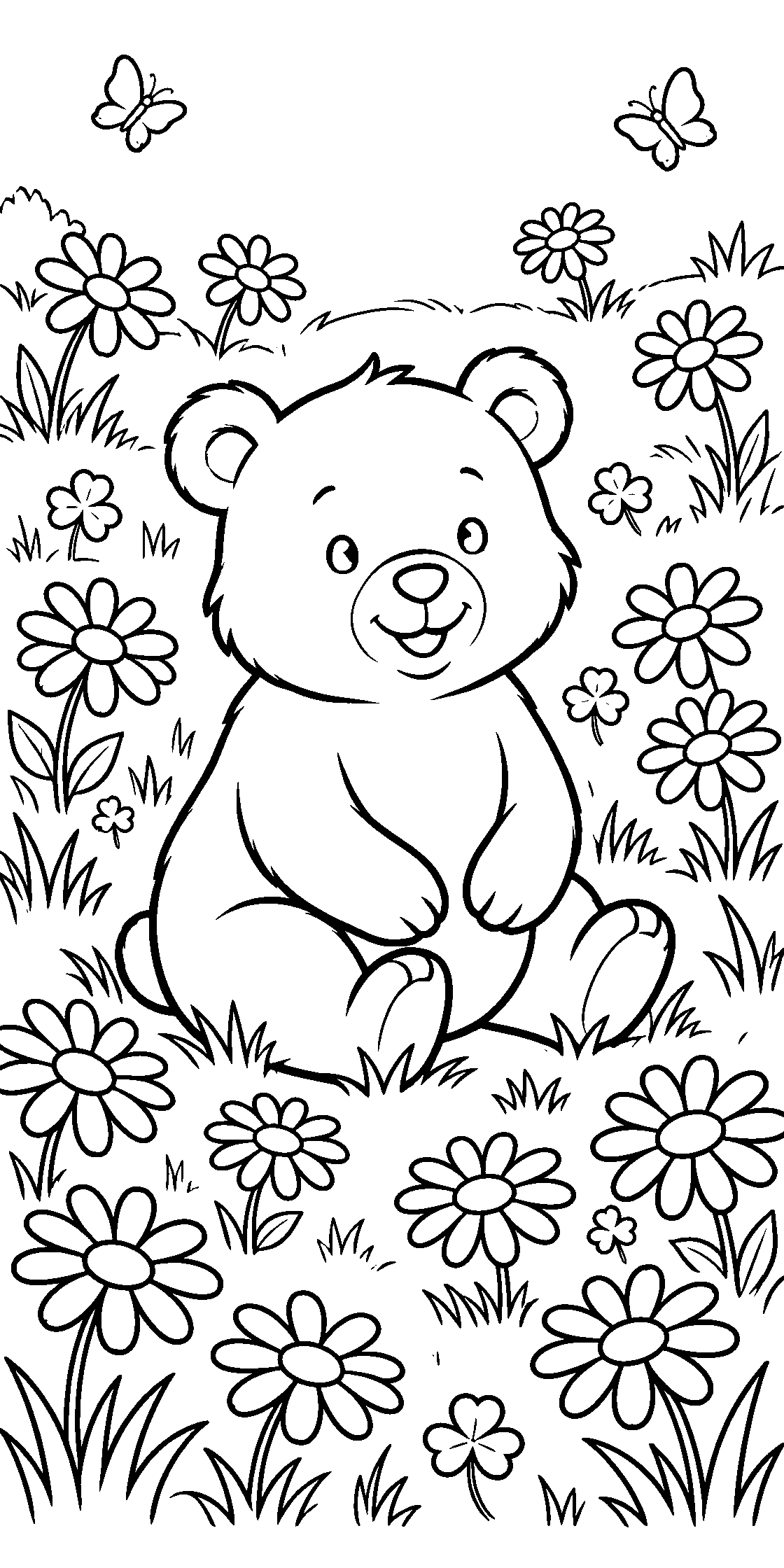
A bear cub sits in a flower meadow with daisies and tall grass, a bee buzzing past its ear.
Colouring tip: Colour the daisies white with yellow middles, the grass a bright green, and the cub a pale honey, so the whole meadow feels sunny.
Age: Best for ages 3 to 5.
24. Bear Cub Flying a Diamond Kite
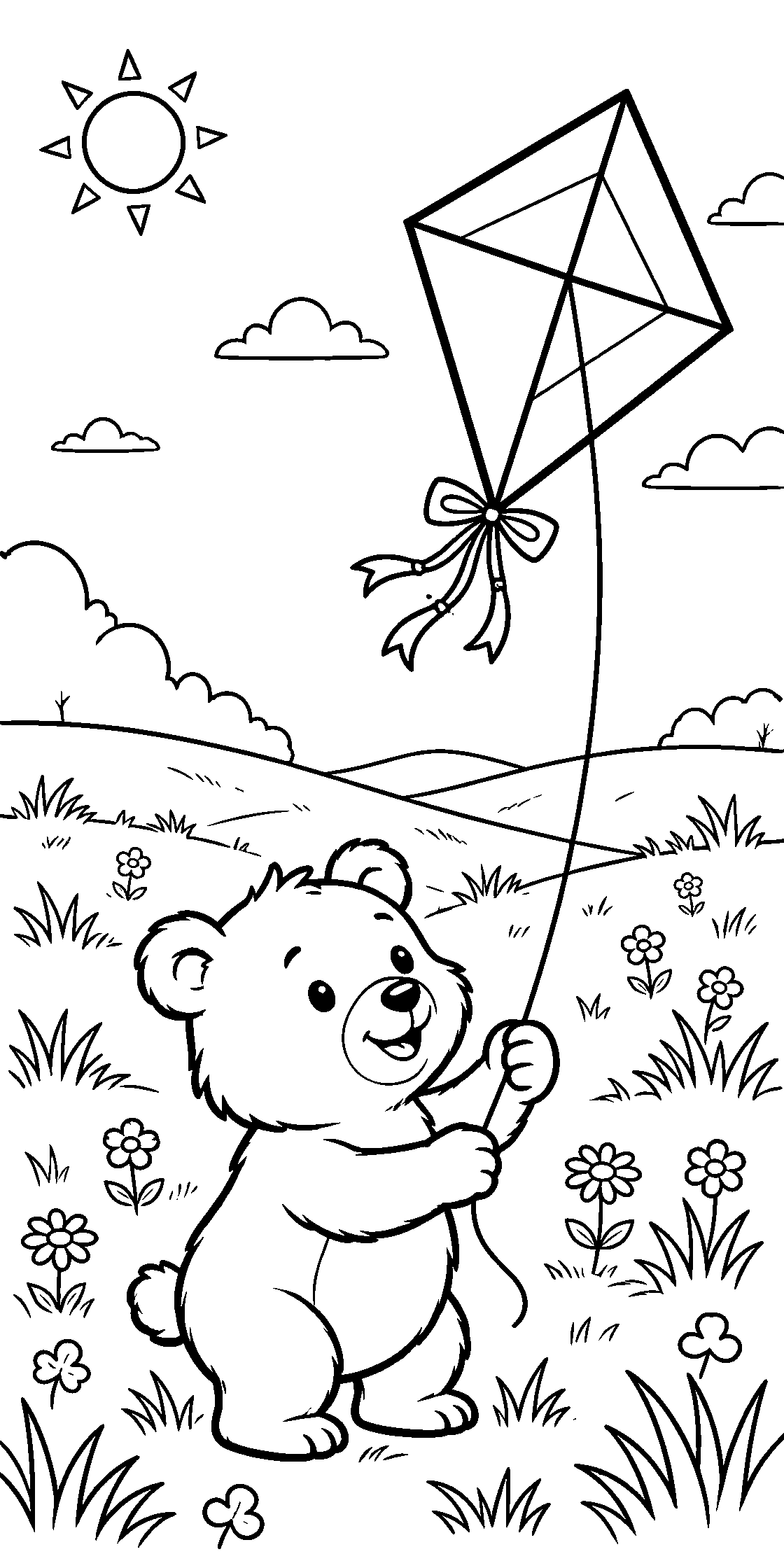
A bear cub holds the string of a diamond kite with a bow tail, running through a field under puffy clouds.
Colouring tip: Colour the kite red and yellow in bold stripes, and give each bow on the tail a different colour, so the kite looks ready to fly.
Age: Best for ages 6 to 8.
31. Bear Cub Riding a Bicycle
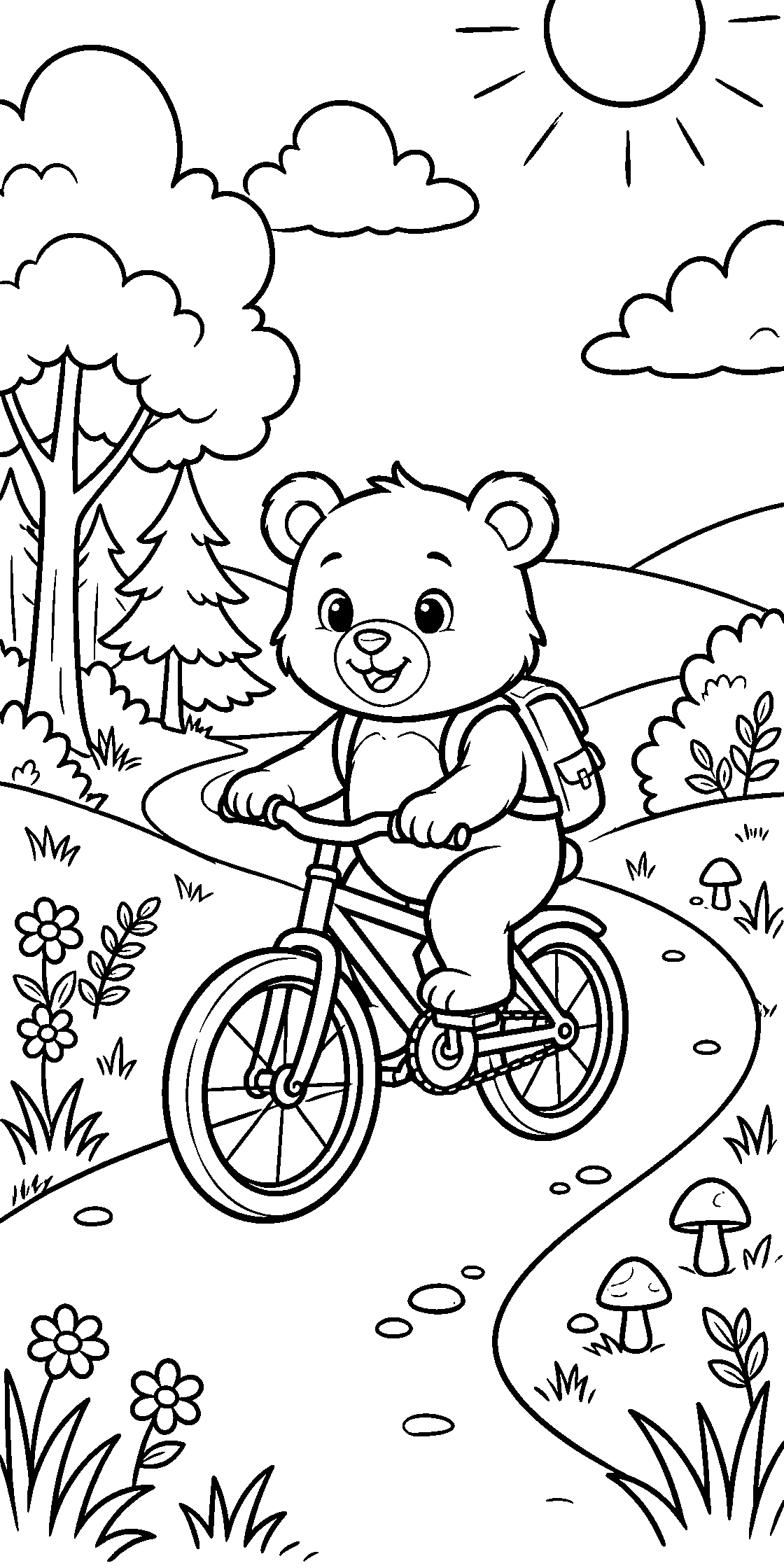
A bear cub rides a bicycle along a path, with a basket on the front and flowers lining the way.
Colouring tip: Colour the bicycle a bright red and the basket a warm tan, then give the cub a blue cap so the rider stands out from the bike.
Age: Best for ages 3 to 5.
40. Bear Cub with a Ladybug on Its Nose
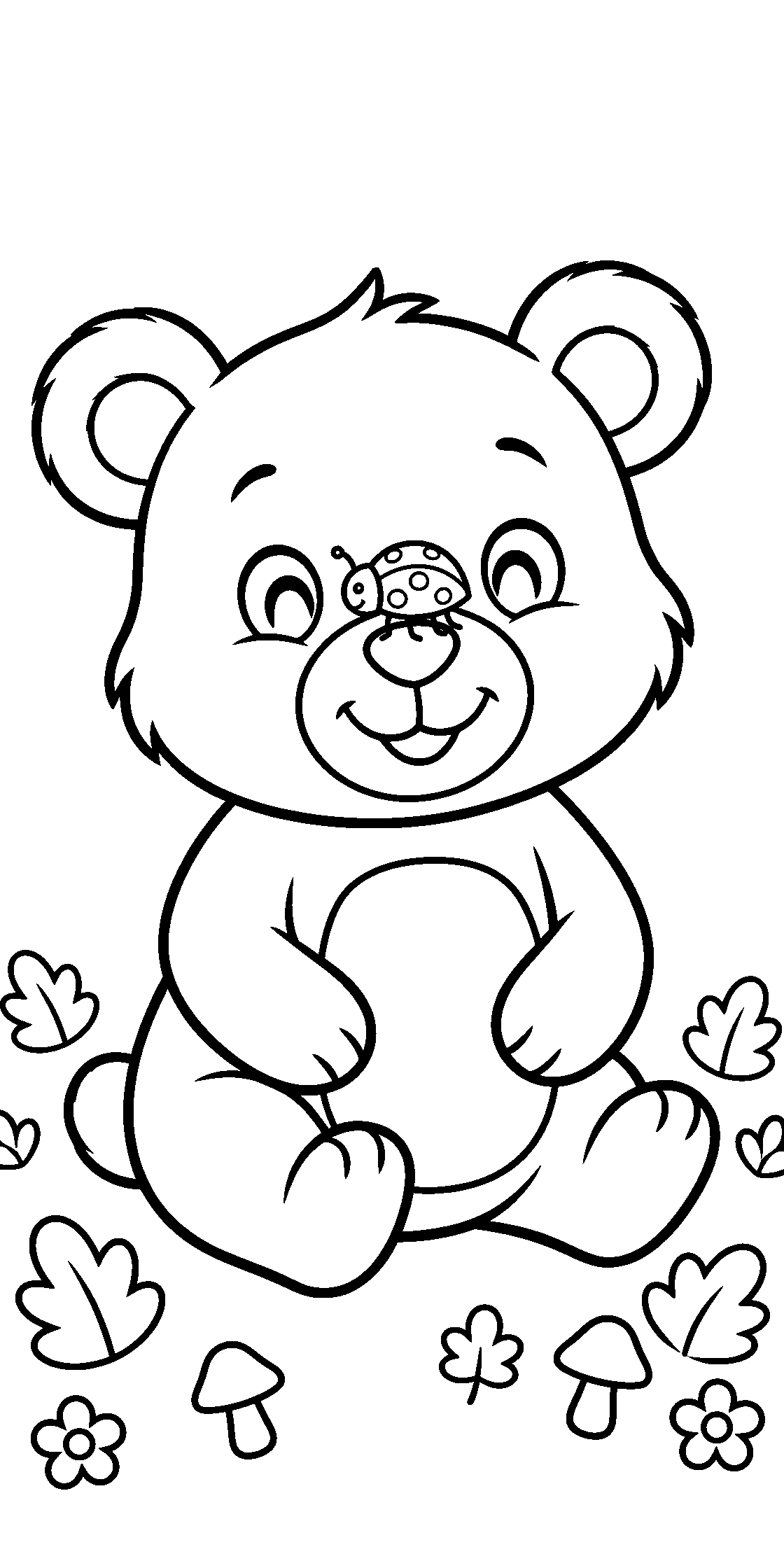
A bear cub sits cross legged with a ladybug on its nose, smiling with its eyes shut, in a patch of clover.
Colouring tip: Colour the ladybug red with black spots, and the cub a pale cream, so the tiny red ladybug is the first thing you see.
Age: Best for ages 3 to 5.
43. Bear Cub with a Pumpkin in Autumn Leaves
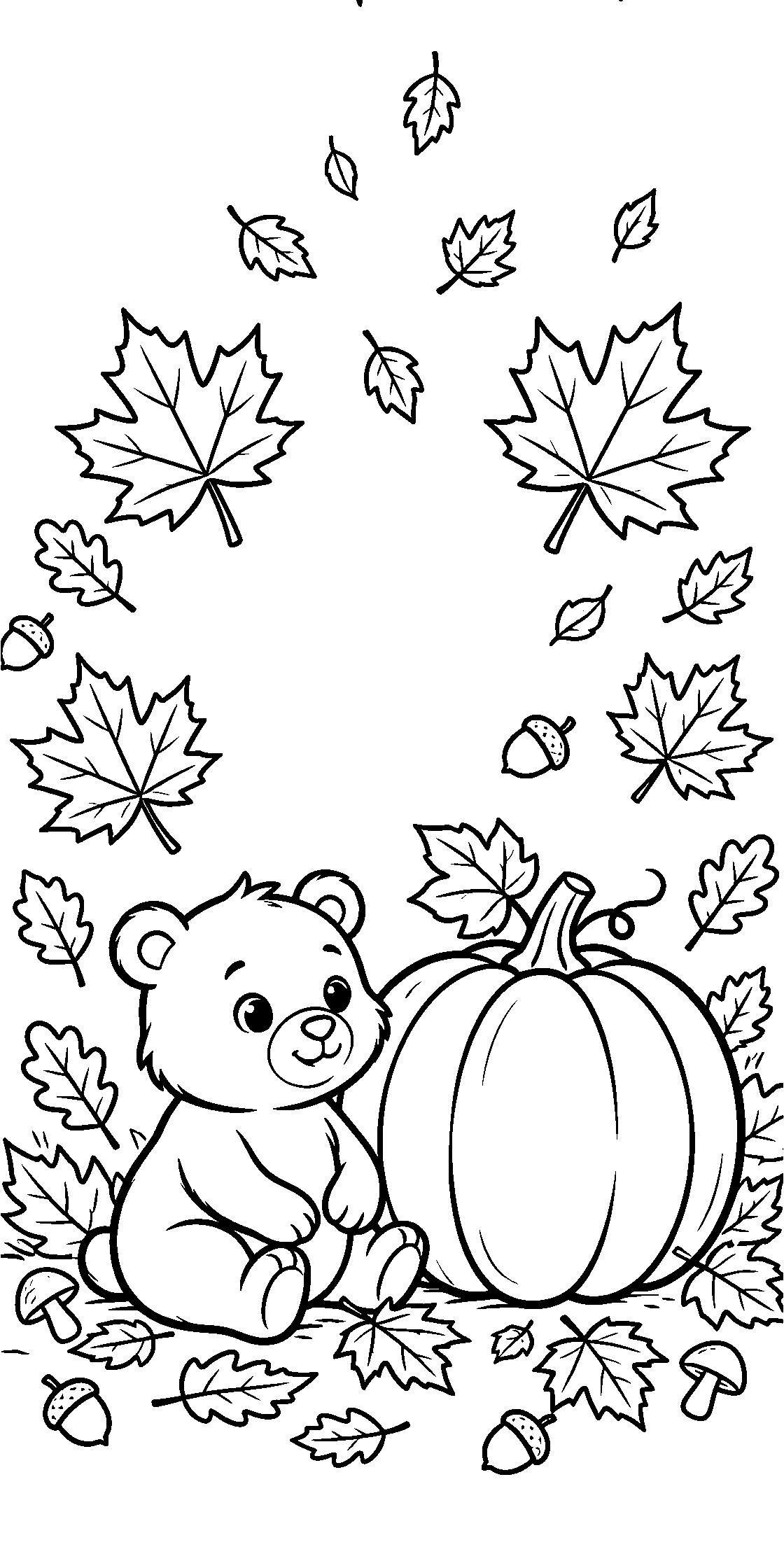
A bear cub sits beside a big pumpkin in a pile of autumn leaves, with a bare tree and a falling leaf above.
Colouring tip: Colour the pumpkin a deep orange and the leaves red, yellow and brown, then give the cub a warm honey brown so it glows against the autumn colours.
Age: Best for ages 3 to 5.
Bears Having Fun
Eleven pictures show bears doing the things people do when they are not working: having a party, reading a book and watering the garden. Others go for a hike, ride in a balloon or play music under the moon. A bear with a guitar is not something you will see in the wild, and that is the point.
The play pictures in these bear coloring pages are the silliest in the set, and they are meant to be.
10. Big Bear Waving Hello
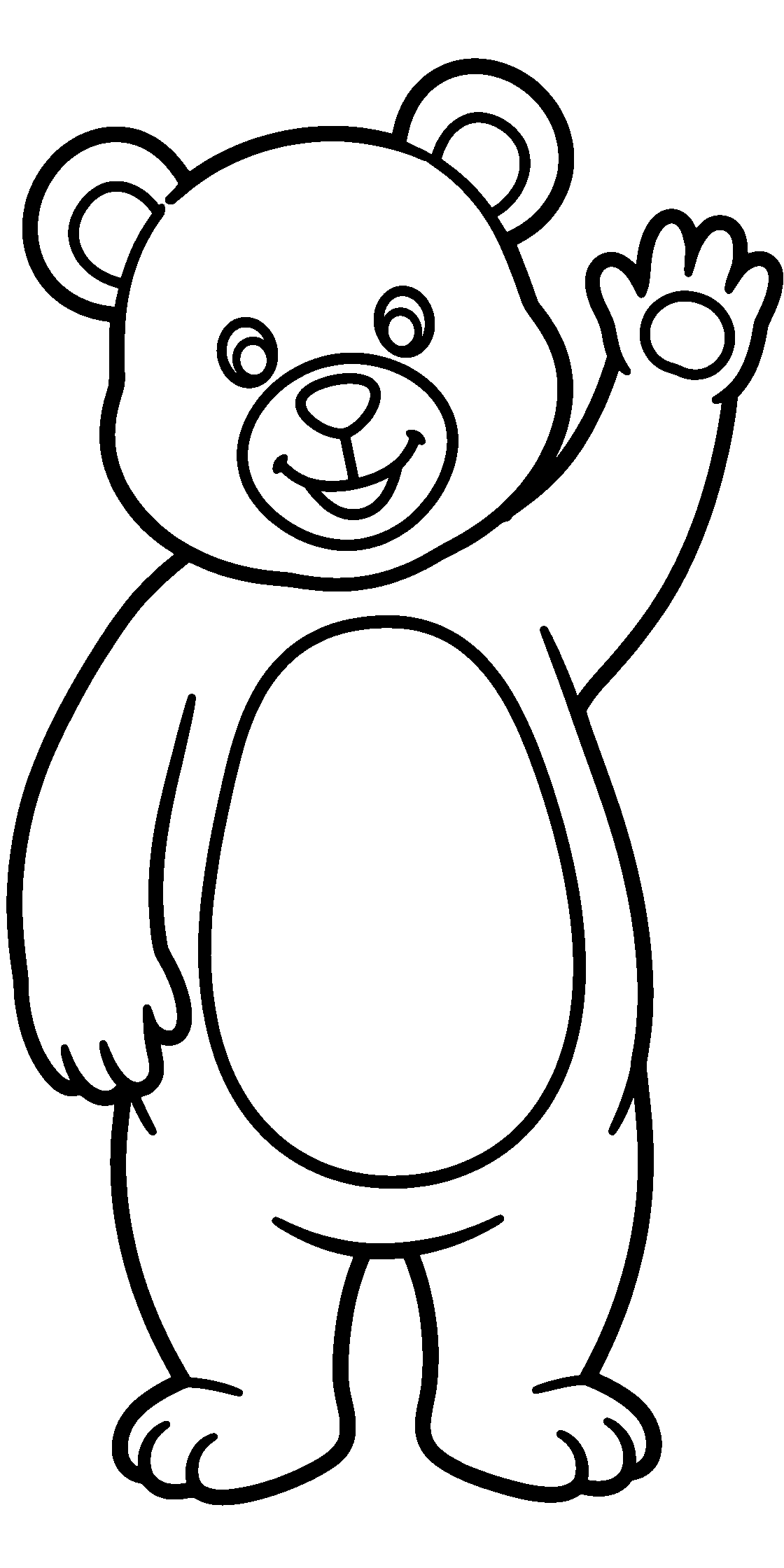
A big bear stands on its hind legs and waves hello with one paw, smiling, in a sunny clearing.
Colouring tip: Colour the bear a warm honey brown and leave its belly a paler cream, so the waving paw is easy to see.
Age: Best for ages 3 to 5.
22. Bear with a Party Hat and a Birthday Cake
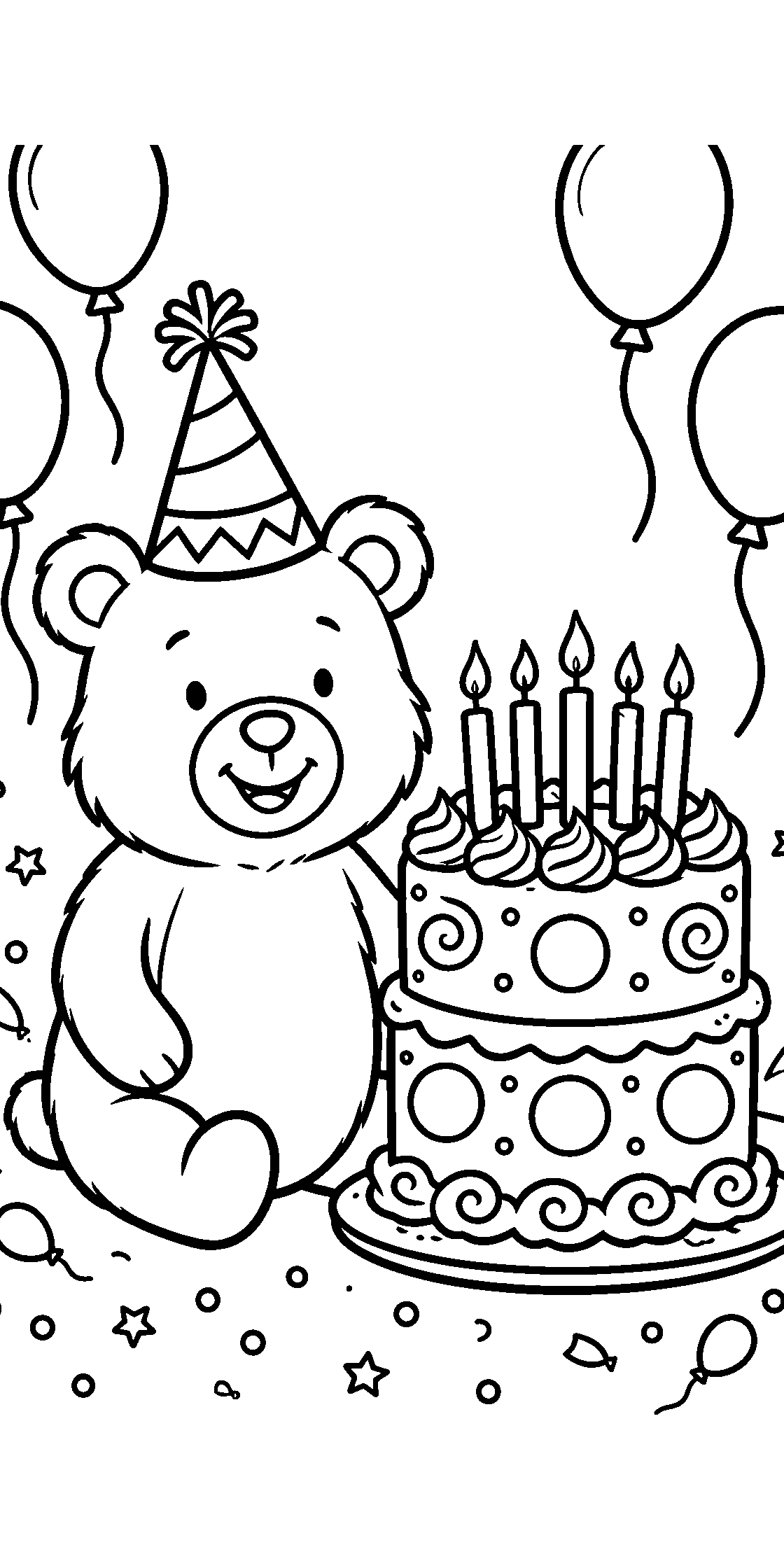
A bear wearing a party hat sits beside a birthday cake with candles, balloons and bunting behind it.
Colouring tip: Colour the cake pink with white icing and the candles yellow, orange and blue, then give the party hat stripes in all three colours.
Age: Best for ages 3 to 5.
23. Bear Reading a Book Under a Tree
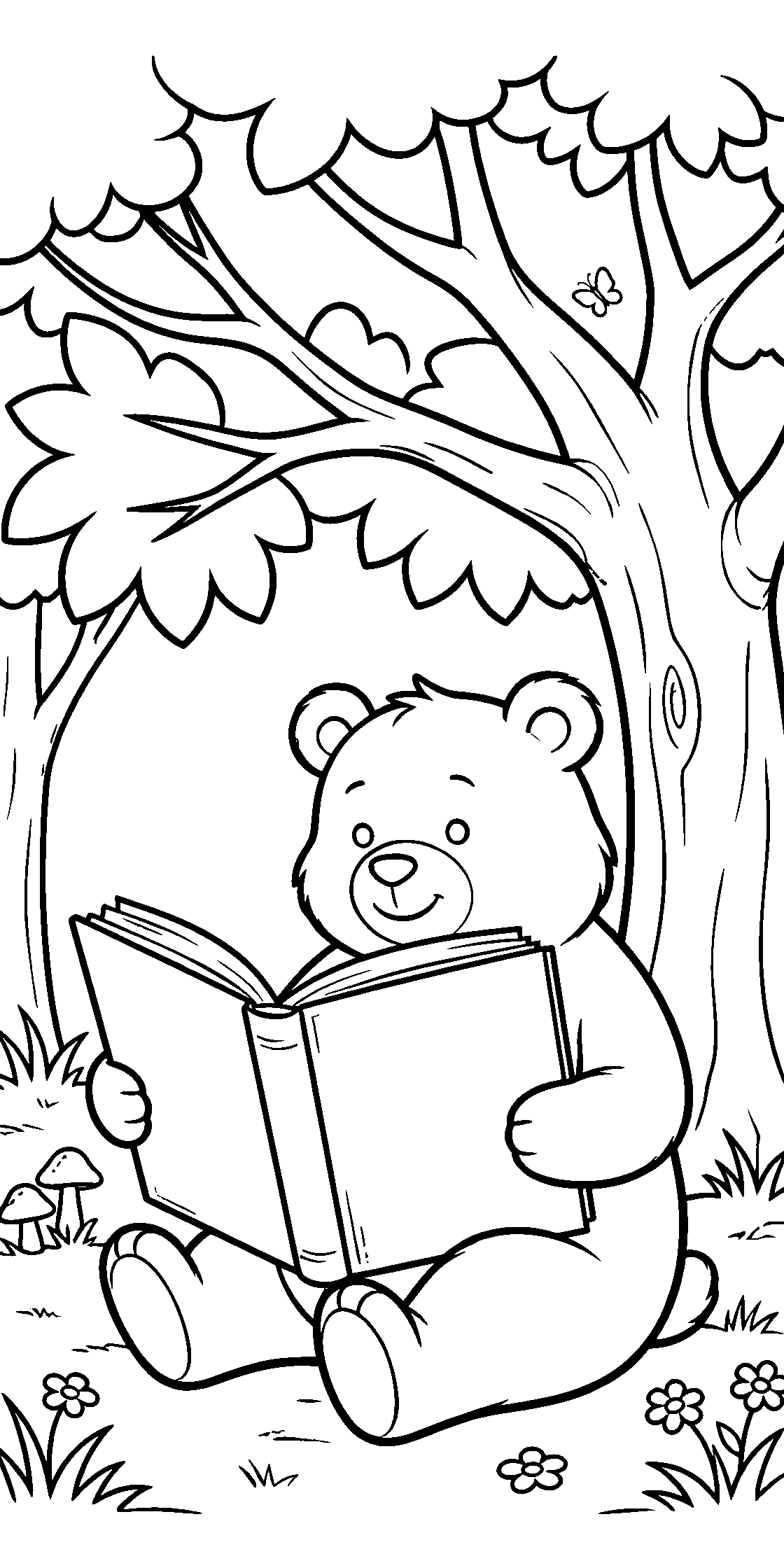
A bear sits under a shady tree reading a big open book, with a teapot, a cup and a pile of books beside it.
Colouring tip: Colour the book cover a deep blue and the pages a pale cream, then give the tree leaves a rich green so the reading corner feels calm.
Age: Best for ages 9 to 12.
25. Bear Watering Flowers in a Garden
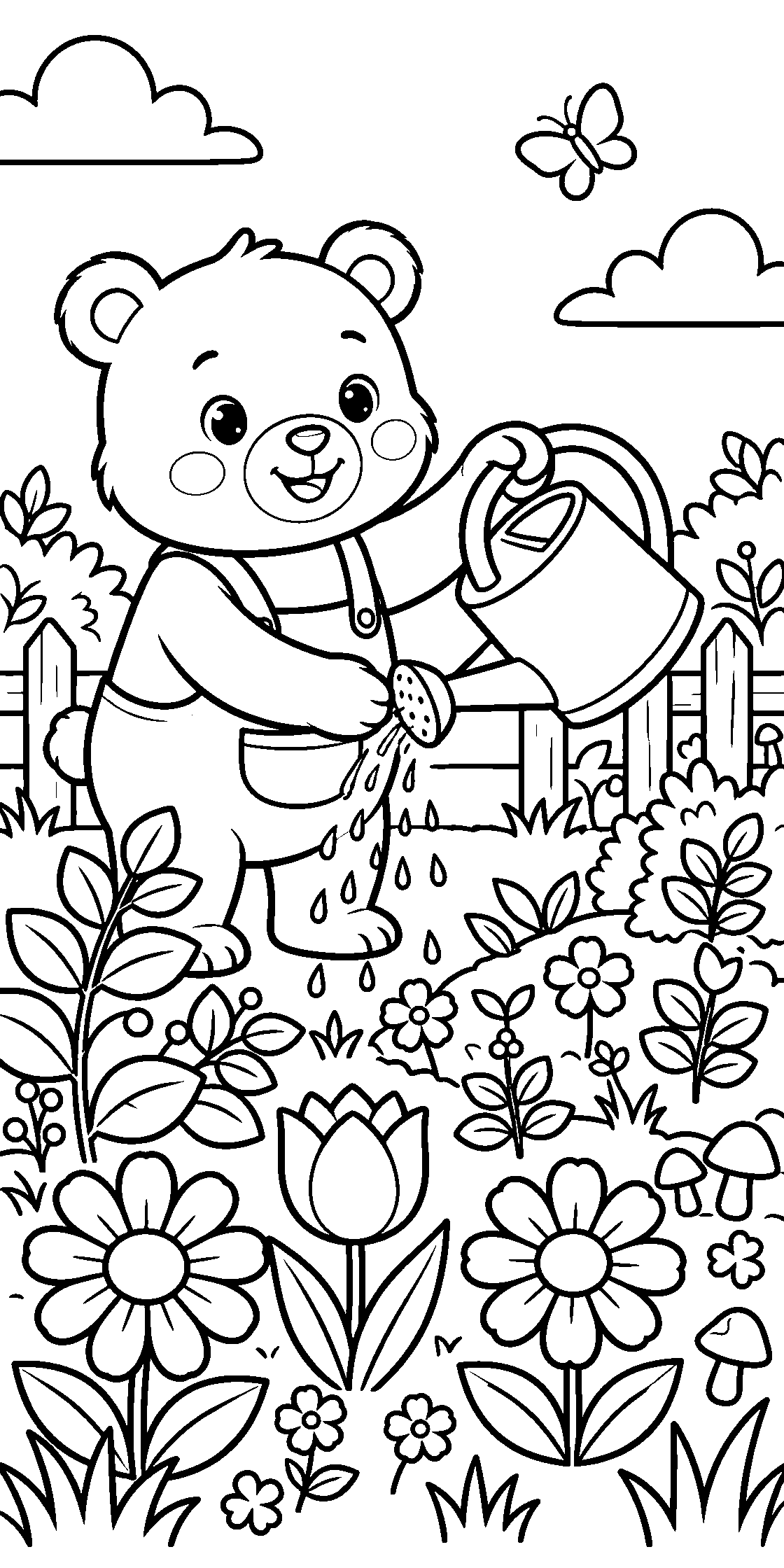
A bear in a garden waters flowers with a watering can, with tulips, sunflowers and a fence behind it.
Colouring tip: Colour the tulips red and yellow, the sunflowers golden with brown middles, and the watering can a bright green, so the garden looks freshly watered.
Age: Best for ages 6 to 8.
26. Bear Hiking with a Backpack
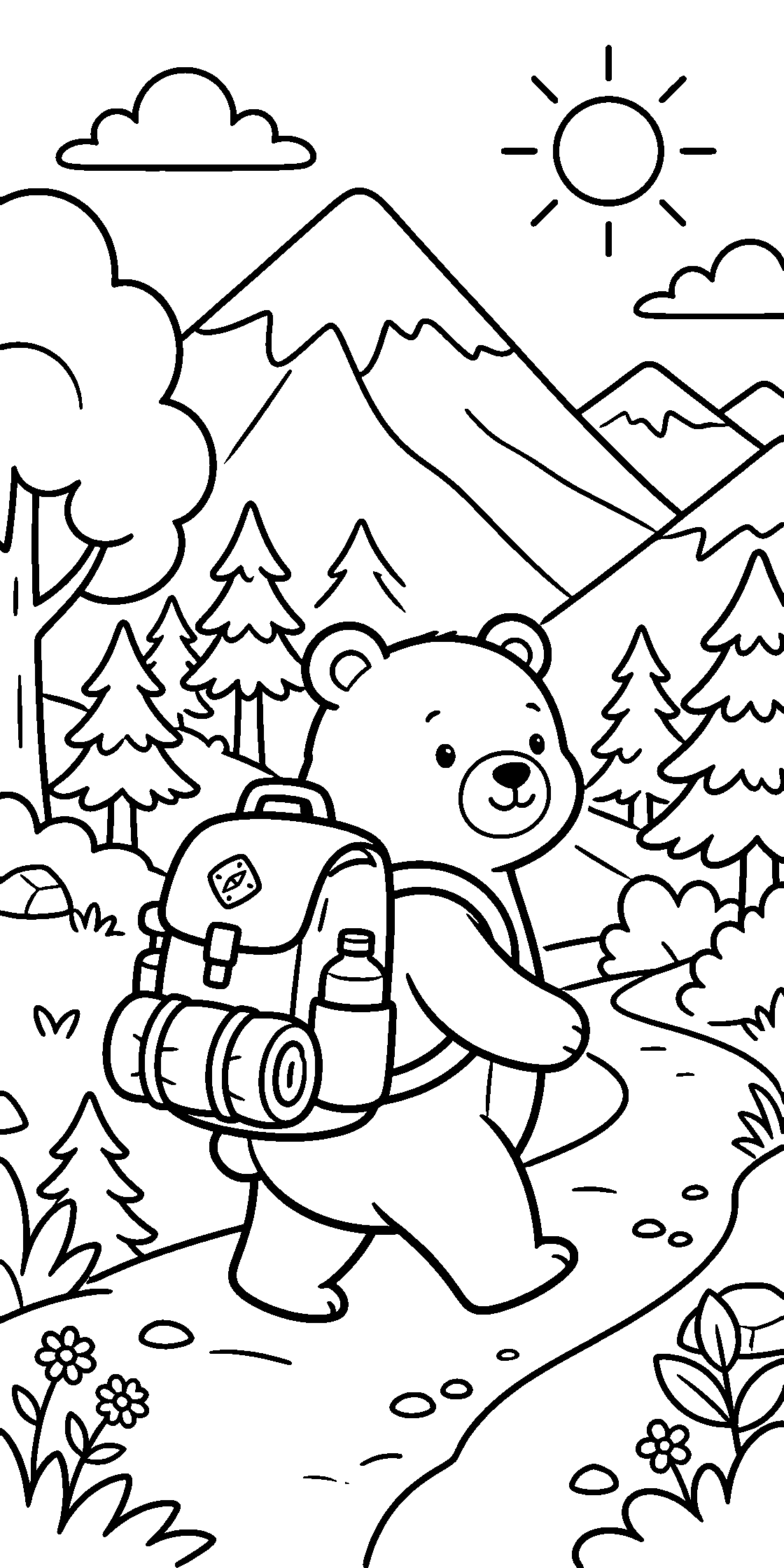
A bear with a backpack and a walking stick hikes on a mountain trail, with peaks, pine trees and a stream below.
Colouring tip: Colour the backpack a bright orange and the walking stick a wood brown, then give the mountains a pale blue grey so the bear leads the eye.
Age: Best for ages 9 to 12.
29. Bear Holding a Bunch of Balloons
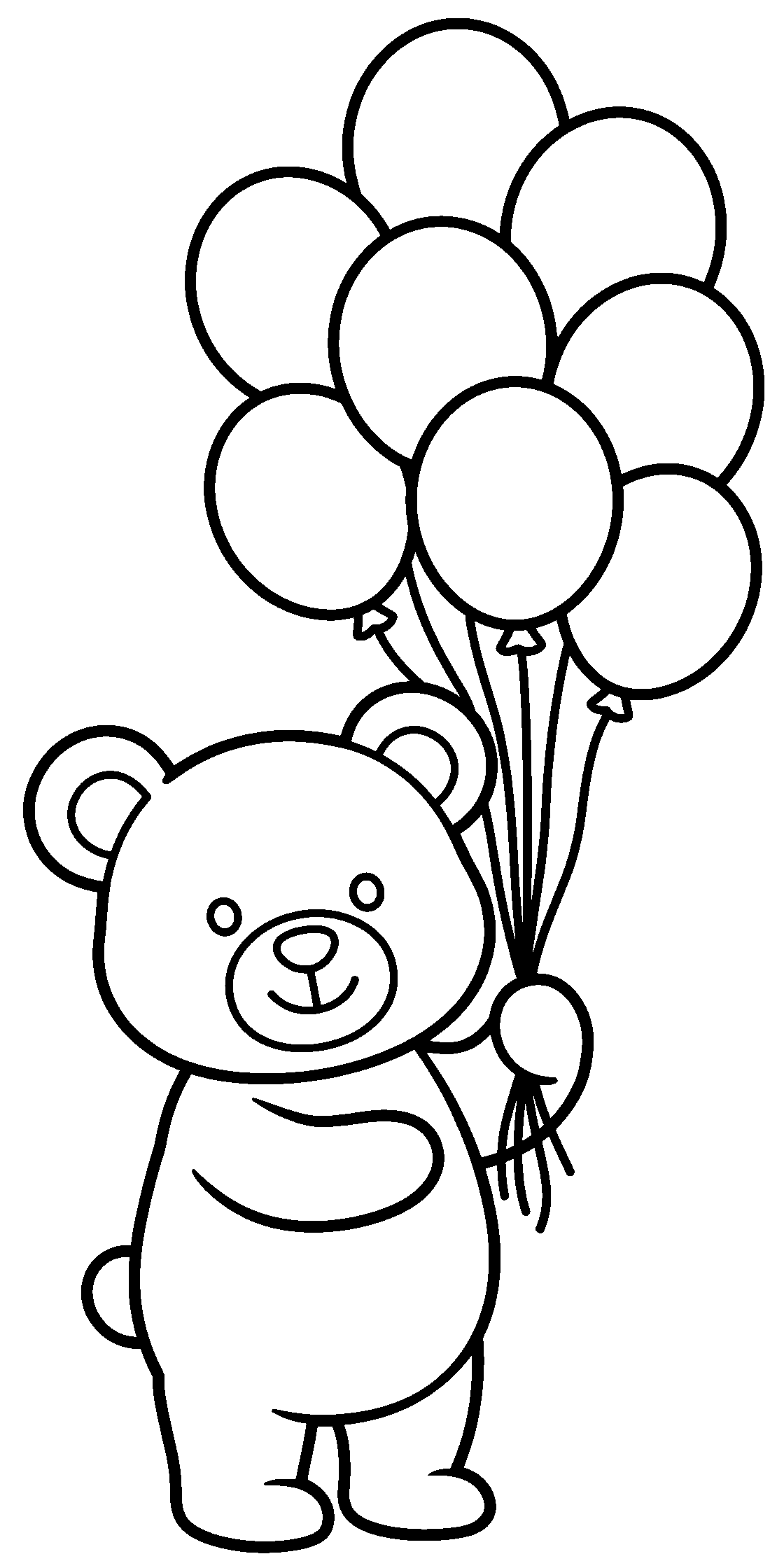
A bear holds a bunch of round balloons, floating just above the ground, with a sunny sky and clouds behind it.
Colouring tip: Give each balloon its own bright colour, red, blue, yellow, green and pink, and colour the bear a soft honey brown so the balloons do the talking.
Age: Best for ages 3 to 5.
30. Bear in a Raincoat with an Umbrella
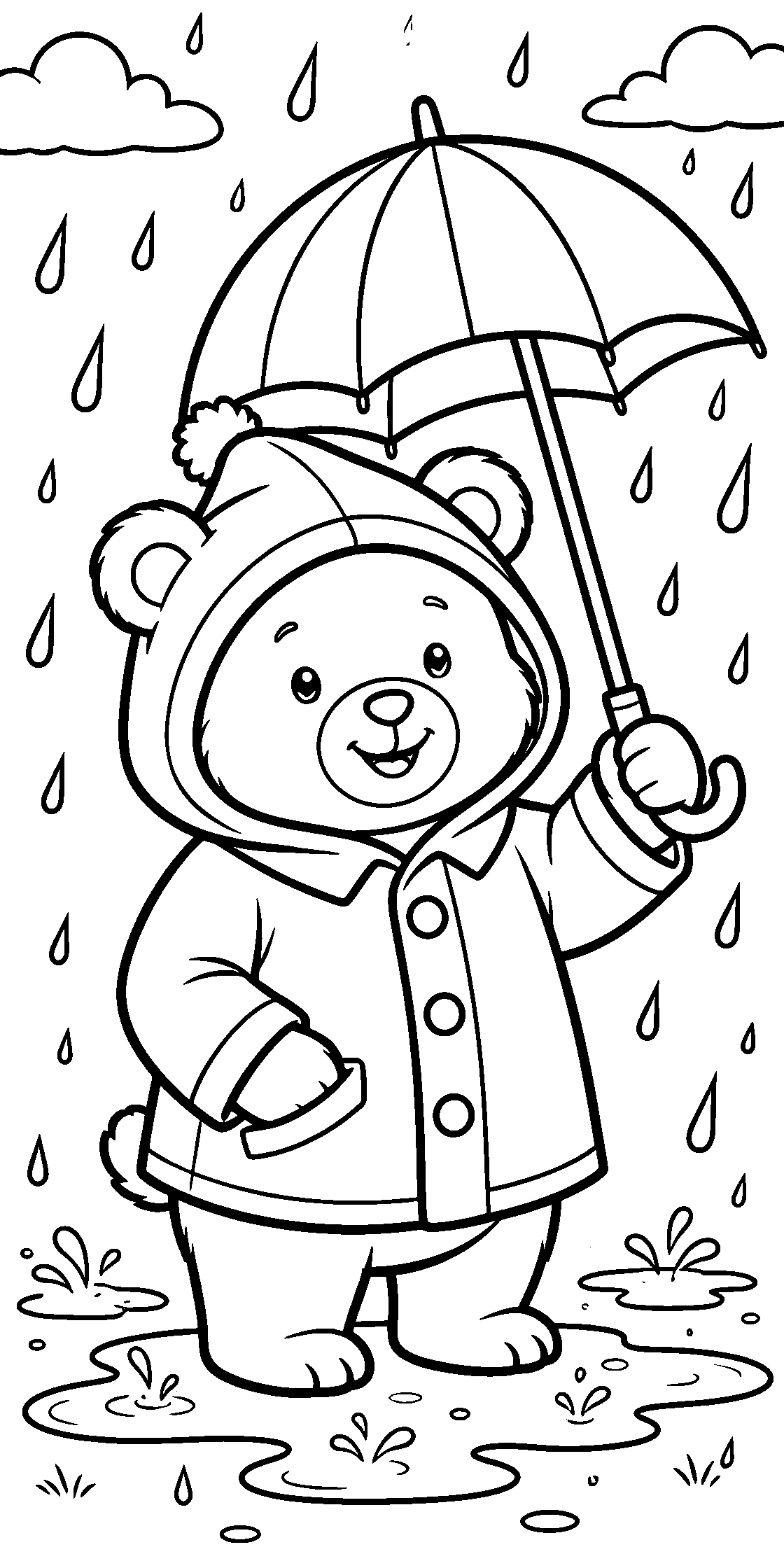
A bear in a raincoat holds an umbrella in the rain, with puddles, raindrops and a rainbow in the distance.
Colouring tip: Colour the raincoat a bright yellow and the umbrella red, then give the rainbow its six colours in order, so the rainy day still looks cheerful.
Age: Best for ages 6 to 8.
35. Bear Wearing a Crown on a Tree Stump
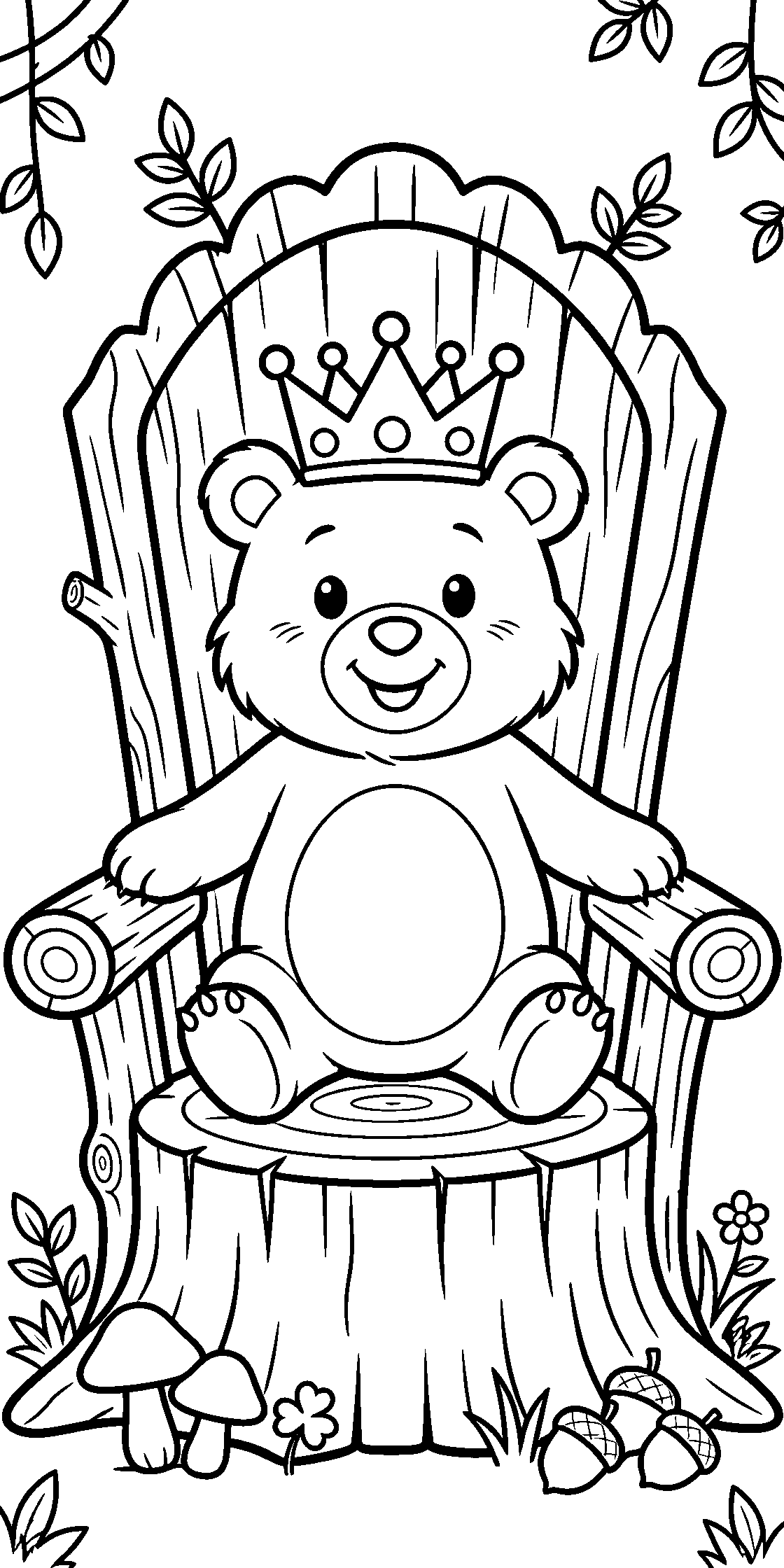
A bear wearing a crown sits on a tree stump like a throne, with a cape, a sceptre and forest animals watching.
Colouring tip: Colour the crown gold with red jewels, the cape a deep purple, and the bear a rich brown, so the king of the forest looks the part.
Age: Best for ages 9 to 12.
36. Bear Playing a Guitar Under the Moon
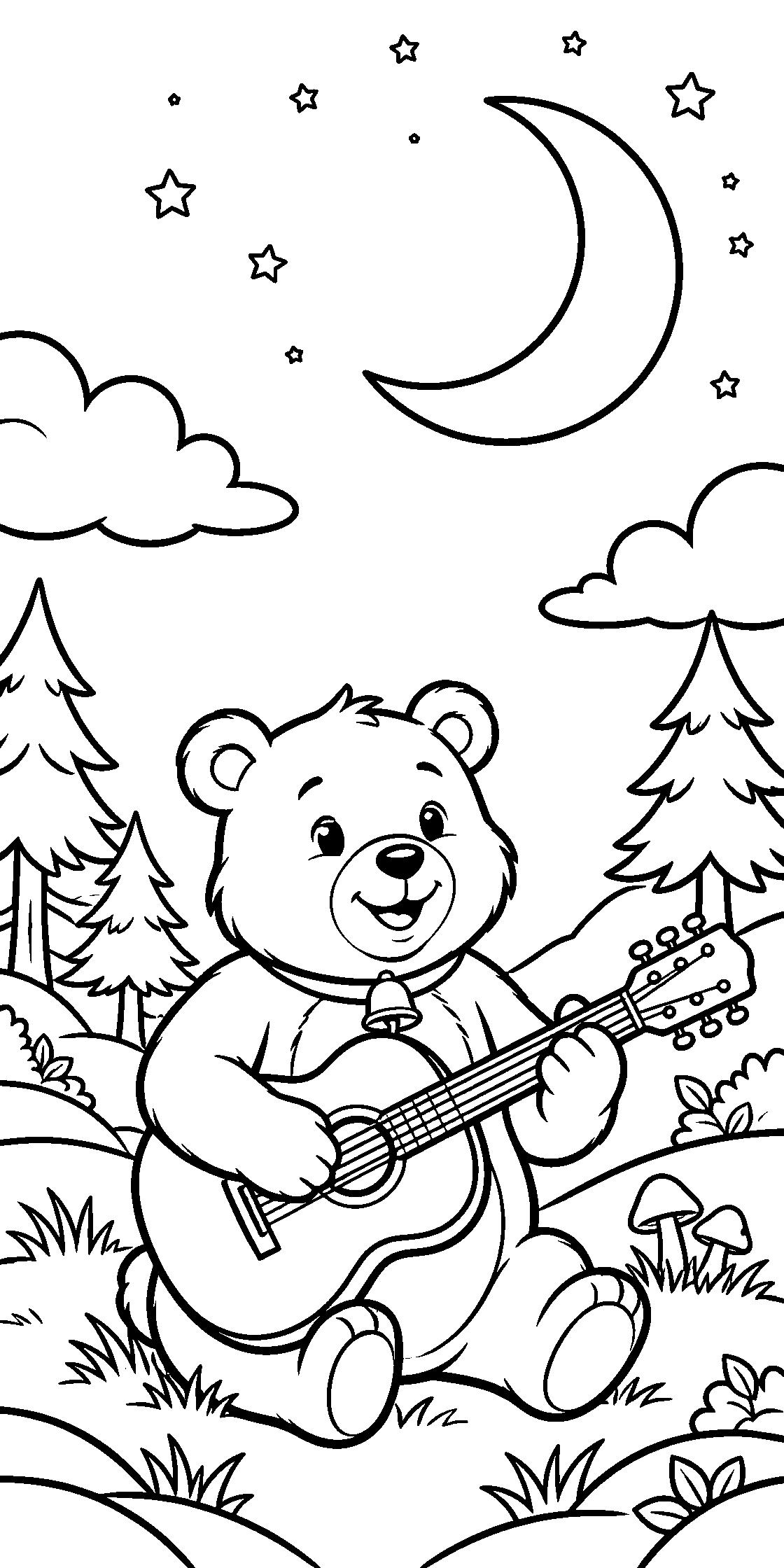
A bear plays a guitar under a round moon, sitting on a log, with stars, fireflies and pine trees around it.
Colouring tip: Colour the guitar a warm wood brown with a red stripe, the moon a soft yellow, and the sky a deep blue, so the night feels quiet and musical.
Age: Best for ages 9 to 12.
41. Bear Riding in a Hot Air Balloon
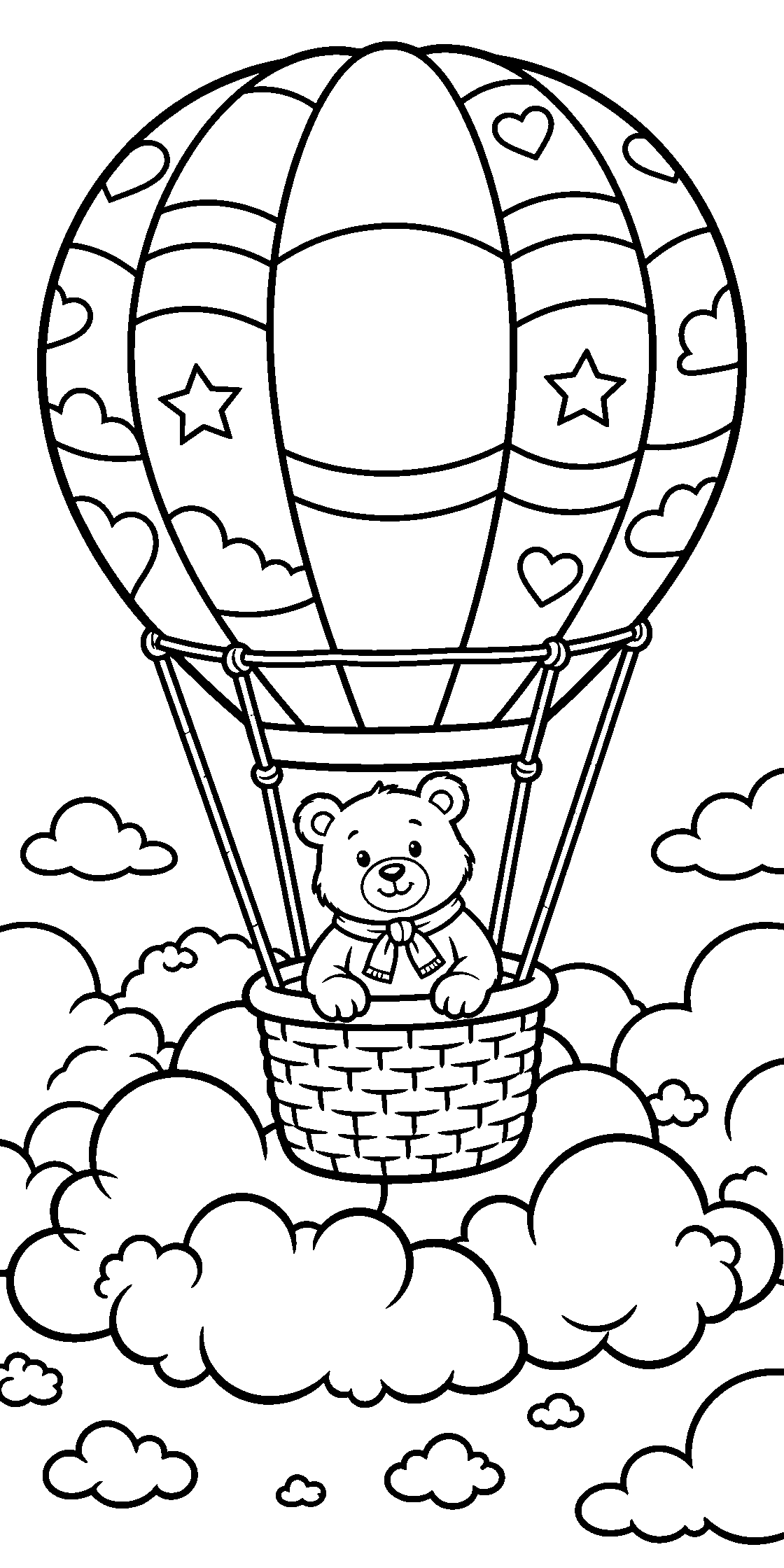
A bear rides in the basket of a hot air balloon over soft clouds, with birds and a distant mountain below.
Colouring tip: Colour the balloon in wide stripes, red, yellow and blue, and the basket a warm tan, then leave the clouds white so the balloon floats above them.
Age: Best for ages 6 to 8.
42. Bear Waving Hello in a Sunny Meadow
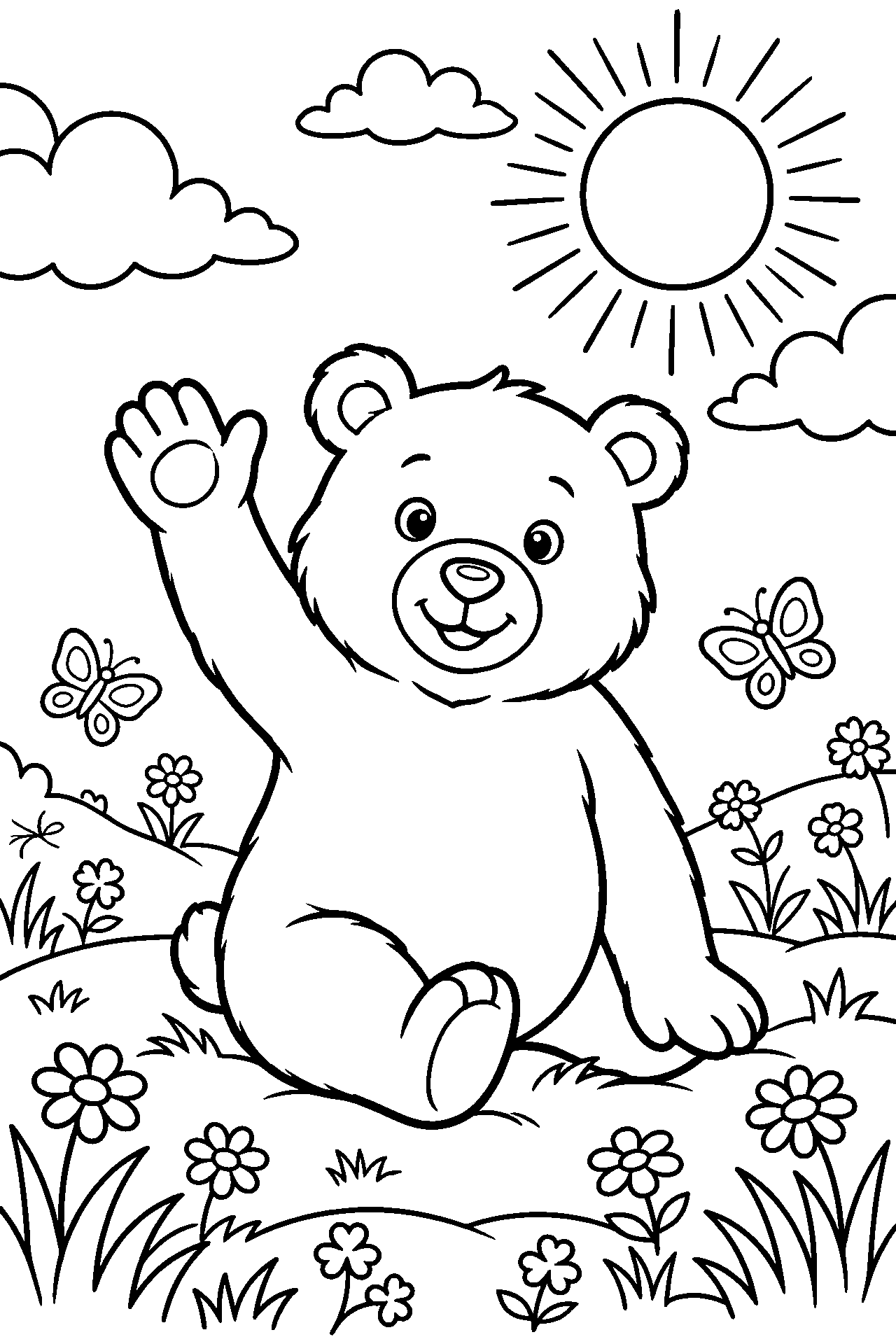
A bear waves hello with one paw raised in a sunny meadow, with daisies, grass and a butterfly nearby.
Colouring tip: Colour the meadow grass a fresh green, the daisies white with yellow middles, and the bear a golden brown, so the whole picture feels like a summer morning.
Age: Best for ages 6 to 8.
Bears at Rest
Four pictures close the set, and they are the quiet ones. A bear asleep in its cave, a teddy bear waiting for a hug, a bear by a campfire and a bear under the stars. Bears rest hard after a day of eating and walking, and a cub that has rolled down a hill, flown a kite and ridden a bicycle has earned a sleep.
These bear coloring pages suit the end of the day, when the crayons slow down too.
9. Bear Sleeping in a Cave
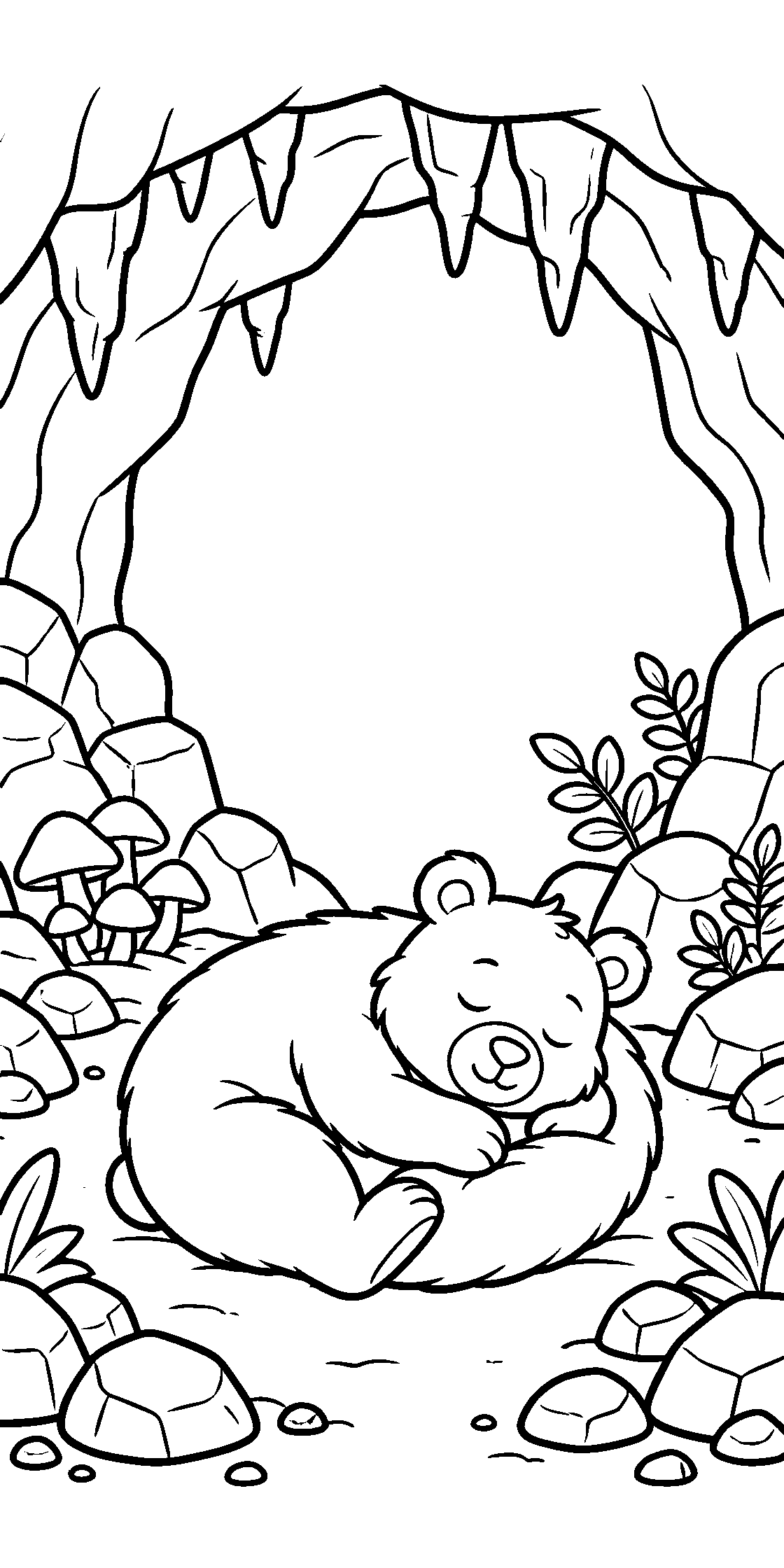
A bear sleeps curled up inside a cave, on a bed of leaves, with snow and pine trees outside the entrance.
Colouring tip: Colour the bear a deep warm brown and the cave stones a cool grey, then leave the snow outside white so the cave feels warm and safe.
Age: Best for ages 9 to 12.
11. Teddy Bear with a Big Heart
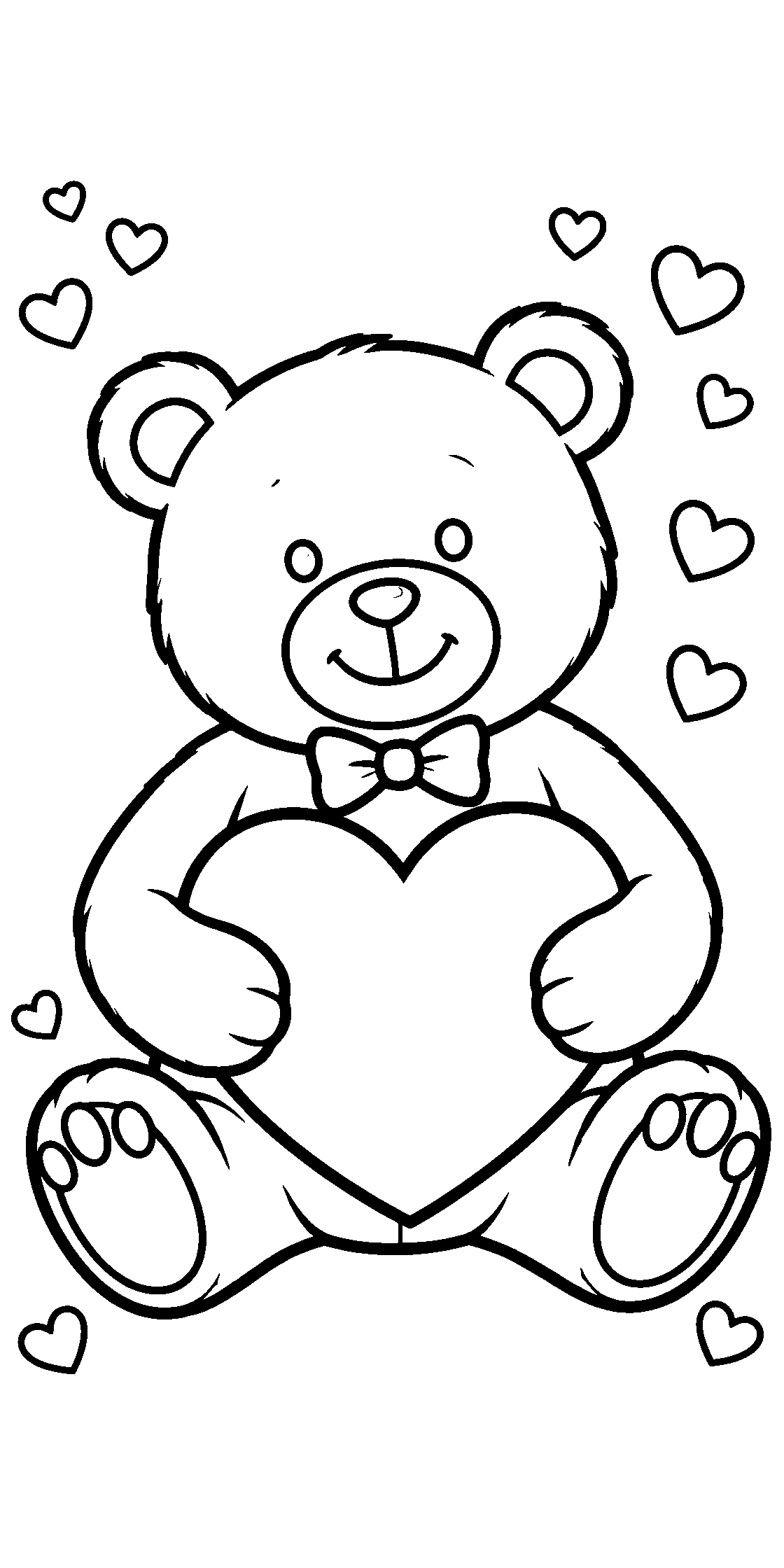
A teddy bear sits with a big heart in its paws, a bow round its neck and a patch on one ear.
Colouring tip: Colour the teddy a soft honey brown, the heart a bright red, and the bow a cheerful blue, so the teddy looks ready for a hug.
Age: Best for ages 3 to 5.
28. Bear by a Campfire with Marshmallows
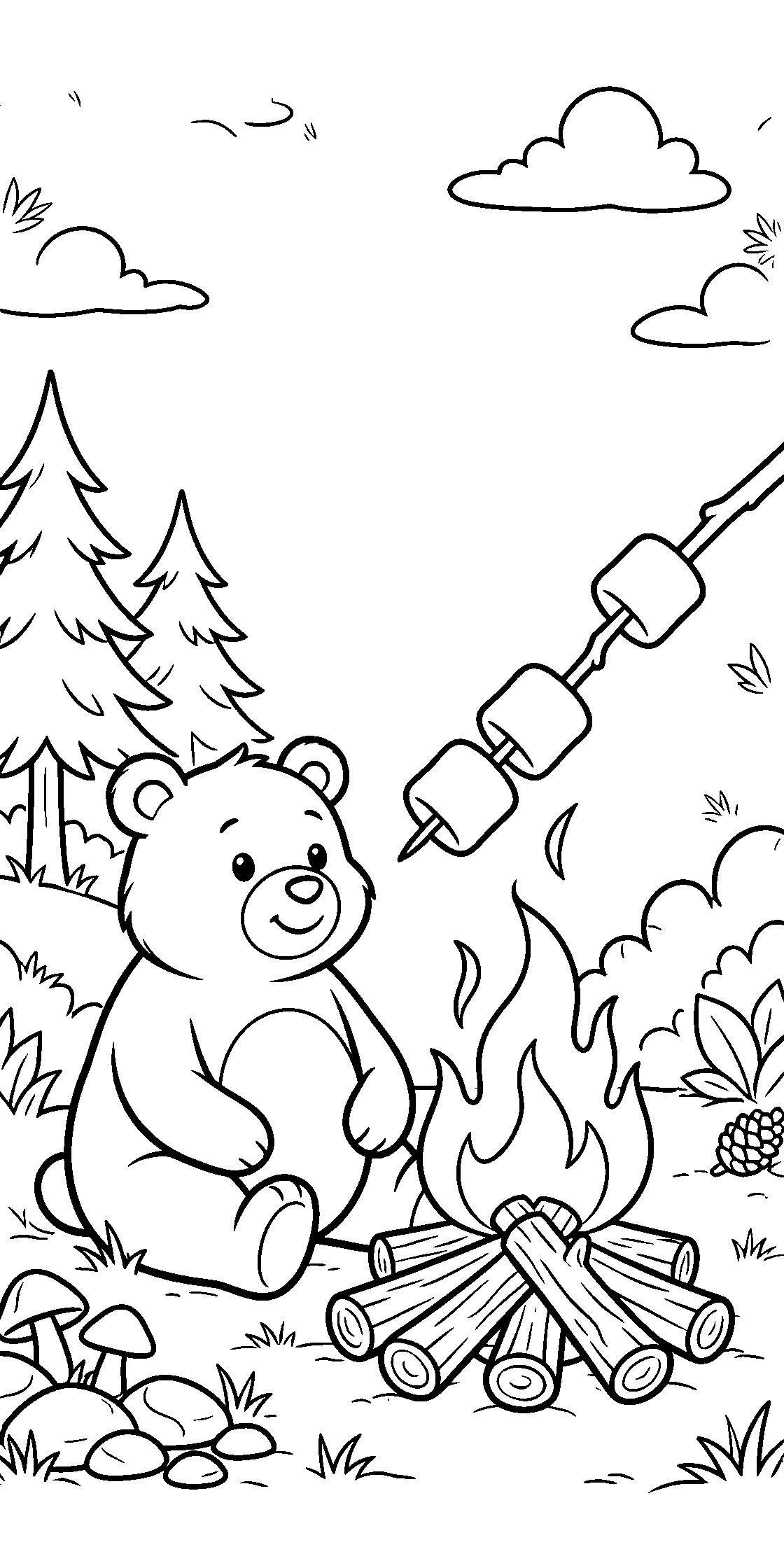
A bear sits by a campfire holding marshmallows on a stick, with a tent, pine trees and stars behind it.
Colouring tip: Colour the flames orange and yellow, the marshmallows white with a golden brown edge, and the tent a deep green, so the fire is the warm heart of the picture.
Age: Best for ages 9 to 12.
39. Bear Sleeping Under the Stars
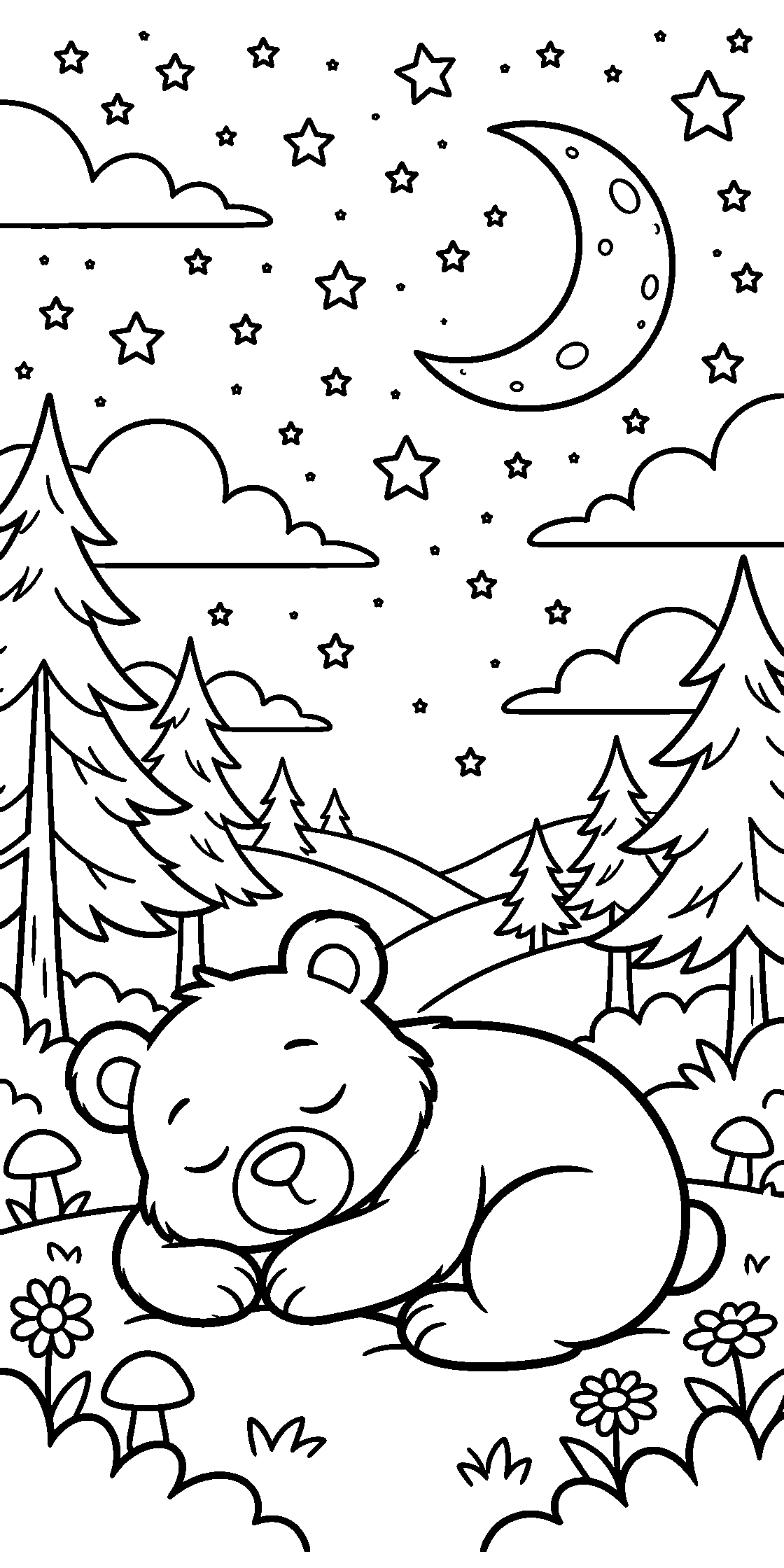
A bear sleeps under a starry night sky, curled on soft grass, with a crescent moon and fireflies above.
Colouring tip: Colour the sky a deep midnight blue, the stars and moon a soft yellow, and the bear a dark brown, so the night wraps round the sleeping bear.
Age: Best for ages 9 to 12.
Printing the Bear Pages So the Lines Stay Dark
Start with one page as a test, and pick a busy one. Picture 44, the whole bear family at sunset, has the most small lines in the set. Picture 5, the grizzly catching a salmon, has the finest lines in the water.
If those two come out dark and clear, the other 42 will print well too.
If the lines come out pale, the printer is set to draft. Change the setting to normal or best and print the test page again. The lines in these bear coloring pages are drawn bold on purpose, so a test page shows at once whether the printer is set right.
The fur strokes on the grizzly and the pine needles round the sunset clearing go pale first on draft mode, so those two pictures tell you at once.
Plain white copy paper does the job, whether your printer takes Letter or A4. With A4, pick fit to page before you print, or a balloon string or a kite tail near the edge can lose its tip. Crayons and coloured pencils work well on copy paper, and they suit the wide open shapes in most of these bear coloring pages.
Felt tips soak through thin paper, so colour them on card, or put a spare sheet underneath to catch the ink. Cut out bears hold their shape on card, while paper goes floppy. Print the balloon, kite and hot air balloon pictures on card if you plan to cut them out for the games below.
Sort the printed pile by group, forest bears first and evening bears last, so a child can work through these bear coloring pages in order. Put the coloured pages in one pile and the blank ones in another, and these bear coloring pages will stay in order right through the week.
What Colour Is a Real Bear?
A bear is not one colour, and that is the best part of these bear coloring pages. Start with the species, because each bear has its own true colours, and the pictures reward a child who gets them right.
A brown bear runs from a pale honey to a dark chestnut. The grizzly’s fur often looks tipped with silver at the ends, which is how it got its name. A black bear can be black, brown, cinnamon or blond, so almost any brown you pick has a real answer behind it.
The polar bear is creamy white, and its skin is black underneath, which you never see in a picture but is worth knowing.
The panda is black and white, and nowhere in between. The sun bear is dark all over with a pale golden patch on its chest, like a little sun rising.
Then come the details that make a bear look real. The muzzle is always paler than the rest of the face, and the nose is dark brown or black. The claws are dark, and the pads of the paws are darker still.
A cub’s fur is softer and paler than an adult’s, so colour the cubs a shade lighter than their mothers.
For the rest of the picture, keep three browns ready. Use a pale honey for cubs and fresh wood, a warm chestnut for the grizzly and the guitar, and a dark brown for tree bark and the cave stones. Once the browns are right, the green leaves, the blue water and the golden honey will stand out on their own.
These bear coloring pages reward a child who colours slowly. The forests and the rivers hide small details worth finding, a bee here, a butterfly there, a fish jumping where you least expect it.
Which Pictures Suit Which Age
Three year olds and twelve year olds do not colour the same way, so these bear coloring pages are sorted for you. The youngest children get pictures with big open shapes. The middle group gets pictures that ask them to make more choices, and the oldest children get the busiest scenes in the whole set.
Give the youngest children, ages 3 to 5, the big open shapes in these bear coloring pages first. The numbers are 2, 7, 10, 11, 15, 19, 22, 29, 31, 37, 40 and 43.
A chunky crayon suits these best. The cub with the honey pot and the teddy with the heart are simple enough to finish in one sitting. So are the cub with the ladybug and the cub with the pumpkin.
Children aged 6 to 8 can move on to pictures with more to decide in these bear coloring pages. The numbers are 1, 3, 4, 8, 12, 13, 14, 16, 17, 20, 21, 24, 25, 27, 30, 32, 34, 38, 41 and 42. The panda eating bamboo, the bear fishing with a rod, the picnic and the hot air balloon all reward a child who takes their time.
The twelve most detailed pictures in these bear coloring pages go to ages 9 to 12: numbers 5, 6, 9, 18, 23, 26, 28, 33, 35, 36, 39 and 44. These need a whole afternoon. The grizzly catching a salmon, the black bear climbing the pine, the bear reading under the tree and the whole family at sunset all carry a lot of small lines.
They suit a steady hand.
Every one of the 44 pictures in these bear coloring pages has a home in one of the three bands. Sort the pile first, and every child gets pictures that fit their age.
Six Things to Do with the Finished Bear Pages
A coloured bear does not have to go in a drawer. The six ideas below each start with a picture from these bear coloring pages, and none of them needs more than an hour.
Build a bear den in a shoebox. Colour a forest bear and cut it out, then build it a home inside an empty shoebox. Green paper makes a forest floor, crumpled blue tissue makes a river, and torn brown paper makes a cave. Stand the bear up with a folded tab of card taped to its back.
Picture 9, the bear sleeping in its cave, makes the best den of all.
Play the honey pot game. Colour picture 2, the cub with the honey pot, and picture 37, the cub with the dipper. Cut out the honey pots, hide them round the room, and send the children hunting like bears looking for a hive. The one who finds the most pots wins a spoonful of real honey on toast.
Play Poohsticks on a bridge. Colour picture 38, the bear family crossing the bridge, then find a real bridge over a stream. Each player drops a stick on one side and runs to the other side to see whose stick comes out first. It is the game from the Winnie-the-Pooh stories, and it works on any small bridge with moving water.
Make a bear mask. Pick a bear face picture, colour it, then cut out the eye holes and punch a hole beside each ear. Thread elastic through the holes and your child has a mask that fits. Card holds up far better than printer paper here, so print the mask picture on card.
Picture 10, the big bear waving hello, makes a friendly mask.
Hold a teddy bear picnic. Colour picture 16, the bear family picnic, and picture 11, the teddy with the heart. Lay a blanket on the floor, bring every teddy bear in the house, and serve sandwiches and fruit from the picture. Each teddy gets a paper plate, and the picnic picture from these bear coloring pages goes in the middle like a tablecloth.
Start a bear fact file. Turn the blank back of a finished sheet into a fact card. Have your child look up three things about the kind of bear they coloured and write them on the reverse. Which bear is the smallest?
Which bear eats only bamboo? Which bear is not really white? It ties the art to a little reading and handwriting practice without feeling like homework.
Frequently Asked Questions
Are all 44 pages really free?
Yes. Every one of the 44 pictures in these bear coloring pages is free, with no email asked and nothing to pay.
Keep the PDF on your computer and print from it whenever you like, at home or at school. The only rule is that the pages are not for sale, and the files are not to be shared anywhere else.
Which bear should a small child start with?
Start with a big picture with wide open shapes from these bear coloring pages. The cub with the honey pot in picture 2 is a good first pick, and so is the teddy bear with the heart in picture 11. A young child can finish one of these in one go and feel proud of it.
Save the grizzly catching a salmon in picture 5 for later, when they are ready for smaller details.
Can I print just one picture?
Yes. Every picture in these bear coloring pages has its own page in the PDF, in the same order as the gallery above. The pictures run in order, so picture 1 sits on page 1 and picture 44 sits on page 44.
Print one page when a single picture is enough, or the whole file when a class is waiting, and hold on to the file for next year as well.
What is the difference between a grizzly bear and a brown bear?
There is none. A grizzly is a brown bear that lives inland, and a brown bear that lives on the coast and eats salmon is called a coastal brown bear. They are the same animal with different meals and different addresses.
In these bear coloring pages, picture 5 shows a grizzly catching a salmon, and picture 1 shows a brown bear in a forest clearing.
Is a koala a bear?
No. A koala is called a koala bear sometimes, but it is not a bear at all. It is a marsupial, which means it carries its babies in a pouch, and it lives in Australia, where there are no wild bears.
The eight real bears in these bear coloring pages all belong to one family, and the koala is not in it.
Can I use these pages in my classroom?
Yes. A teacher may print off as many copies as the class needs, and it costs nothing.
The bear den and the fact file activities in these bear coloring pages work well as group projects. The honey pot game keeps a class moving, because everyone is hunting at once.
Time to Go and Find a Bear
Print the set of bear coloring pages tonight, while there is still time to enjoy it. Pick a picture, any picture, and colour the bear first, before anything else. A brown bear in honey brown with a pale muzzle is the whole forest in one shape.
Once the first bear in these bear coloring pages is done, the rest of the set follows on its own. Then keep the animal colouring going with our cat coloring pages, 35 cats, kittens and whiskers waiting for a lap, or our lion coloring pages, 37 lions, manes and savannah sunsets, or our dog coloring pages, 42 dogs, puppies and wagging tails. Print them whenever you like, free of charge, and let the bears walk on into the woods.
More Animals fun: keep coloring with our giraffe coloring pages, red panda coloring pages, and fennec fox coloring pages.